
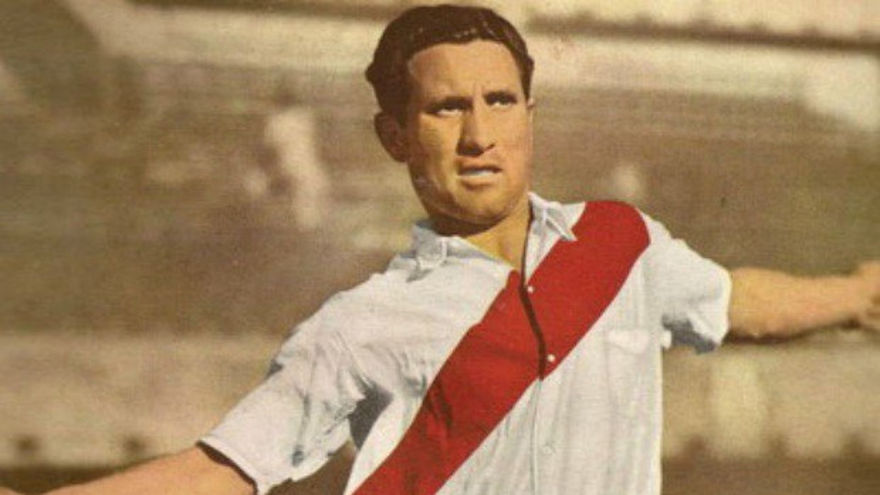
From his adolescent years, Adolfo Pedernera had already showcased his special football skills. He began his football journey with Cruceros de la Plata, which was followed by his first professional move to Atlético Huracán. A year later in 1933, he made the switch to River Plate. Within 2 years in 1935, he made his club debut at age 16. Pedernera's career was rising like anything at an early age.
His era at River plate was an immensely successful one, during which he achieved glory with the Argentina national side as well.
Pedernera had won five Primera División winning squads with River Plate (1936, 1937, 1941, 1942 and 1945). The Argentine inside forward had also won the 1941 and 1946 Copa América, with Pedernera being named as the later tournament's Best Player.
Unfortunately, the Second World War robbed the player's opportunity to participate in the World Cup. Nonetheless, his career still continued to rise, and he played with several greats of the game at River Plate. The most notable one of these was the legendary Alfredo Di Stéfano.
In 1947, he was offered a million pesos to play for Atlanta of Buenos Aires. This move was, however, a short-lived one. Atalanta's eventual relegation saw him return to Huracán in 1948. As destiny would have it though, a few run of events eventually led to Pedernera immediately making his next move. This was to Colombian club Millonarios. Upon his arrival, he was greeted at the Aeropuerto de Techo by over 5,000 fans.
The Millonarios years
Pedernera made his Millonarios debut against Deportes Caldas, helping his team win 3-0. It was at Millonarios where Pedernera was given the name of El Maestro (The Teacher) by the press, as his excellent abilities made them believe that anything was possible.
The Argentine also reunited with his old teammates Nestor Rossi and Alfredo Di Stéfano. They all were pivotal in helping the club win their Colombian championship title in 1949. The team were in rampant form, even winning nine consecutive games. Pedernera had also scored the two decisive goals in the championship deciding play-off matches against Deportivo Cali.
After the retirement of Carlos Aldabe as Millonarios coach, it was Pedernera who took over as player-manager. He was instrumental in helping them win three consecutive championships from 1951 to 1953 and the Copa Colombia of 1953.
In 1952 at age 33, Pedernera was part of the Millonarios tour of Europe. The highlight of this tour was their legendary 4-2 win over Real Madrid at the Santiago Bernabéu Stadium. Madrid asked for a rematch, resulting in two other games that were also won by Millonarios.
Pedernera was also pivotal in helping the side win the 1953 Small Club World Cup, which was an international club tournament held in Venezuela. He is credited with establishing the club's mark on Colombia football.
In 1954, the Lima Pact forced all "illegal" players to return to their clubs of origin, so Pedernera returned to Huracán. He spent a year there, before calling it a time on his magical career. He later became a football coach, managing several Argentine clubs and even the national team.
Legacy
Pedernera was widely considered to be one of the best world football players in the 1940s era. He also was elected the 12th-best South American footballer of the 20th century in a poll by the IFFHS in 2000. Additionally, he was also included in the list of the 100 greatest all time footballers by magazine FourFourTwo in 2017.
The legend of Pedernera is bound to live on forever.
Must Read | 1941-47 River Plate: The legendary “La Maquina”
