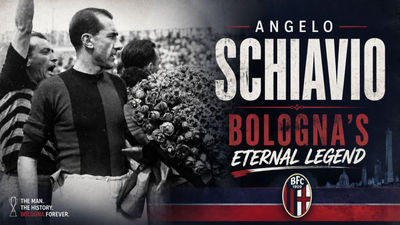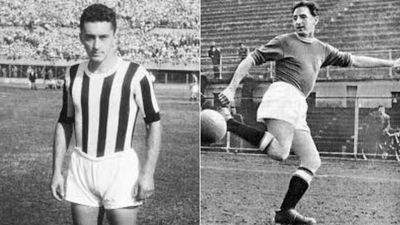


Angelo Schiavio began his professional football life with Bologna during the 1922–23 Prima Divisione. It was a bright start to the then 17 year old's career, as he managed to score 6 goals in 11 games that season. This was a time when the Italian league was organised into several different regional groups, before the birth of what we now know as Serie A.
The young Italian striker continued his rise at Bologna, breaking into the starting line-up permanently at the age of 19. Silverware success soon followed him as well, as Schiavio and Bologna achieved their first league championship triumph in 1925. Schiavio was immense in achieving this feat, as he scored 16 goals in 27 appearances during this campaign.
Italian football saw the final season of this regional group format in the 1928–29 season, which saw Bologna claim their second league title. The Italian striker was yet again a key figure, scoring a sensational 30 goals in just 26 games that season.
Serie A heroics, Bologna legacy, and World Cup triumph
The 1929-30 season was a monumental one for Italian football, as it saw the introduction of the Serie A Format. Schiavio and Bologna faced Lazio away in their first ever Serie A match on 6th October 1929, which ended in a 3-0 win for the hosts. It was about a month later that Schiavio scored his first Serie A goal against Triestina on 13th November.
Schiavio was at his very best during the 1931–32 campaign, scoring 25 goals to finish as Serie A top scorer that season. Schiavo won two more Scudetti in 1936 and 1937, although he only played in two games in the latter victory. Schiavio's final season was the 1938–39 season, which signified a sharp decline of a legendary striker. He just made 6 appearances in the league, and failed to score a single goal. Nonetheless, he exited Italian football as one of the greatest strikers it had ever seen.
Serie A heroics and Bologna legacy
The 1929-30 season was a monumental one for Italian football, as it saw the introduction of the Serie A Format. Schiavio and Bologna faced Lazio away in their first ever Serie A match on 6th October 1929, which ended in a 3-0 win for the hosts. It was about a month later that Schiavio scored his first Serie A goal against Triestina on 13th November.
Schiavio was at his very best during the 1931–32 campaign, scoring 25 goals to finish as Serie A top scorer that season. Schiavo won two more Scudetti in 1936 and 1937, although he only played in two games in the latter victory. Schiavio's final season was the 1938–39 season, which signified a sharp decline of a legendary striker. He just made 6 appearances in the league, and failed to score a single goal.
Despite an underwhelming final season, Schiavo will forever remain an important figure in the club's history. The Italian striker managed to score 249 goals in 361 appearances for the club, with a club-record 242 goals in the Italian league, 109 of these goals also came in the Serie A format. Schiavio's legacy is bound to live on eternally in the history books of Italian football.
World cup legacy
The legend of Schiavio extended to the international stage as well. He won a bronze medal with Italy in the 1928 Olympic Games, which was followed by Schiavio and Italy clinching the 1927–30 Central European International Cup and 1933–35 Central European International Cup.
His ultimate achievement in football came in the year of 1934, as the then Bologna striker was instrumental in Italy's first World Cup win in 1934. Schiavo scored 4 goals throughout the tournament, thus finishing as the competition's second best goalscorer.
The most important goal of his career came in the World Cup final, as Italy faced Czechoslovakia. Schiavio went on to score from a cross delivered by Enrique Guaita, and it was this moment that Eternalized him in the football history books. The goal proved to be the deciding one, as Italy beat Czechoslovakia 2-1 to become World Champions. This was also coincidentally his final goal for Italy. It was the most beautiful ending to a legendary chapter with the national side.
Must Read | Greatest Italian footballers of all time