
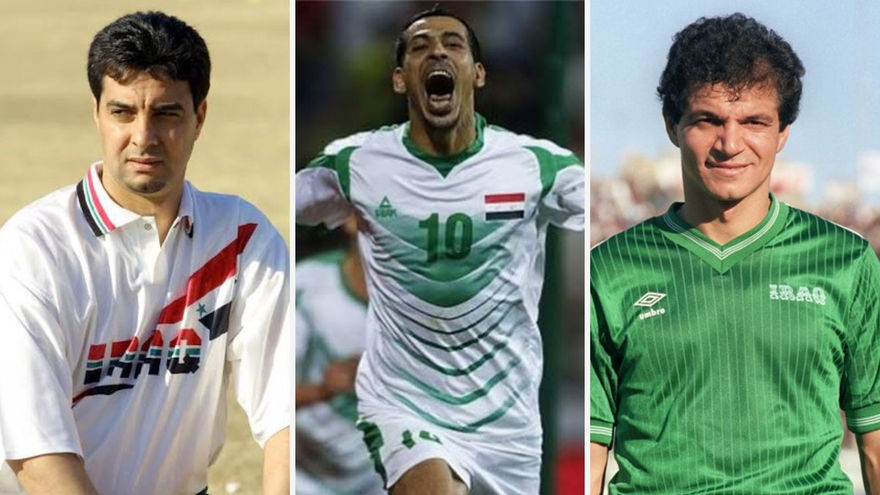
Iraq’s football story is one of talent forged under pressure. Through wars, embargoes and years of instability, the “Lions of Mesopotamia” have produced players whose skill and courage united a nation. From the tactical pioneers of the 1970s and 1980s to the miracle of the 2007 AFC Asian Cup, Iraqi football has repeatedly proven it can deliver moments of global significance.
Top 10 Greatest Iraqi Footballers
10. Raad Hammoudi — Goalkeeper (1976–1987)
A commanding presence for club and country, Raad Hammoudi anchored Al‑Shorta and the national side during Iraq’s most successful period in the 1970s and 1980s. He captained the team in the 1986 World Cup cycle and accumulated more than 100 caps. Hammoudi combined leadership with shot‑stopping and organizational authority, setting the standard for Iraqi goalkeepers.
Key facts: Iraqi Premier League winner (1980); Asian Games Gold (1982); Arabian Gulf Cup winner (1979, 1984).
9. Hawar Mulla Mohammed — Left Winger / Wing‑Back (1998–2015)
A dynamic wide player with excellent crossing and an eye for goal, Hawar was integral to Iraq’s success in the 2000s. He was the first Iraqi to score in the UEFA Champions League and played a crucial role at the 2004 Olympics and the 2007 Asian Cup. As a Kurdish Iraqi, his prominence also carried significant cultural weight.
Key facts: AFC Asian Cup winner (2007); Cypriot Cup winner (2006); Iraqi Premier League champion (2005).
8. Falah Hassan — Forward / Attacking Midfielder (1968–1986)
Nicknamed “The Fox,” Falah Hassan was a creative and agile forward who dominated Iraqi domestic football in the 1970s. Renowned for dribbling, spatial intelligence and audacious flair, he helped Al‑Zawraa to multiple league titles and shone in regional tournaments, bridging Iraq’s amateur past with its modern era.
Key facts: Multiple Iraqi League titles (1976, 1977, 1979); World Military Cup winner (1972, 1977, 1979).
7. Ali Adnan — Left‑Back / Wing‑Back (2010–Present)
A modern attacking full‑back with pace and delivery, Ali Adnan announced himself at the 2013 U‑20 World Cup and became the first contemporary Iraqi to secure sustained Serie A minutes. His overlapping runs, set‑piece threat and technical ability make him one of Iraq’s most important modern exports.
Key facts: Asian Young Footballer of the Year (2013); AFC Asian Cup Team of the Tournament (2019); U‑20 World Cup fourth place (2013).
6. Adnan Dirjal — Centre‑Back (1977–1990)
A defensive rock and a natural leader, Adnan Dirjal marshaled Al‑Rasheed and the national team for more than a decade. He combined aerial power, tactical intelligence and uncompromising defending, helping his clubs dominate regional competitions and later transitioning into coaching and sports administration.
Key facts: Multiple Iraqi League titles and Arab Club Champions Cup wins (1985–1987); 124 international caps.
5. Ammo Baba — Forward & Coach (1955–1970; manager thereafter)
A foundational figure in Iraqi football, Ammo Baba (Emmanuel Baba Dawud) scored Iraq’s first official international goal in 1957 and later became a transformative coach. His playing grace and subsequent managerial achievements earned him near‑mythic status in Iraq.
Key facts: Scorer of Iraq’s first international goal (1957); successful coaching career with multiple Gulf Cup titles.
4. Nashat Akram — Midfielder / Playmaker (2000–2015)
“The Maestro,” Nashat Akram combined vision, composure and incisive passing. He was the creative fulcrum of Iraq’s 2007 Asian Cup winners and later won domestic and continental honors across the Gulf and in the Netherlands with FC Twente. His final‑third intelligence and set‑piece excellence made him indispensable during Iraq’s golden era.
Key facts: AFC Asian Cup winner (2007); Eredivisie winner (2010, with FC Twente); Asian Cup Man of the Match in the final.
3. Younis Mahmoud — Striker (1999–2016)
“The Leopard” is Iraq’s consummate captain and big‑game scorer. Physically dominant and relentless in the box, Mahmoud led Iraq to the 2007 Asian Cup title, scoring the memorable winning header in the final. Prolific in Qatar’s domestic league and decorated regionally, he combined leadership with an uncanny knack for decisive goals.
Key facts: AFC Asian Cup winner and MVP (2007); multiple Qatar Stars League titles; scored in four consecutive Asian Cup tournaments.
2. Hussein Saeed — Striker (1975–1990)
A prolific and loyal goalscorer, Hussein Saeed spent his club career at Al‑Talaba while amassing a staggering international tally—78 goals in 137 caps. Saeed’s consistency and lethal finishing across the late 1970s and 1980s make him one of Asia’s most effective strikers of his generation.
Key facts: All‑time leading Iraqi scorer (78 goals); Asian Games Gold (1982); Arabian Gulf Cup top scorer.
1. Ahmed Radhi — Forward / Striker (1982–1999)
Ahmed Radhi stands at the summit of Iraqi football. A complete forward with elegance, aerial prowess and clinical finishing, Radhi scored Iraq’s only World Cup goal to date—a celebrated strike past Jean‑Marie Pfaff of Belgium in Mexico 1986. He won Asian Footballer of the Year (1988) and collected a glittering array of club and regional trophies. Radhi’s blend of artistry, trophies and historical resonance places him as Iraq’s greatest footballer.
Key facts: 62 international goals; 1986 World Cup goal; Asian Footballer of the Year (1988); multiple Iraqi League and Arab Club Champions Cup titles.
Honorable Mentions
Jalal Hassan (goalkeeper, modern stalwart and 2023 Gulf Cup hero).
Laith Hussein (creative midfielder of the 1990s).
Emad Mohammed (prolific striker of the 2000s).
Karim Mohammed Allawi (versatile figure at the 1986 World Cup).
Ali Kadhim (1970s forward and crowd favorite).
Biggest Ranking Debate: Radhi vs. Saeed vs. Mahmoud
Iraq’s top‑three debate distills into three virtues: Radhi’s technical artistry and historic World Cup goal; Hussein Saeed’s unmatched goalscoring record and era‑defining efficiency; and Younis Mahmoud’s leadership and the emotional magnitude of the 2007 Asian Cup. Each case is compelling. Saeed’s raw numbers are extraordinary for his era; Mahmoud’s 2007 heroics rallied a fractured nation; Radhi combines both transcendent peak ability and defining historic moments—hence his placement at number one.
How the Top Three Compare
Ahmed Radhi: Peak technical skill, World Cup landmark goal, Asian Footballer of the Year.
Hussein Saeed: Prolific international scorer, domestic icon, era‑defining striker.
Younis Mahmoud: Captain and clutch performer, 2007 Asian Cup winner and MVP.
Iraqi football has produced artists, leaders and warriors who performed under extreme circumstances, lifting the nation’s morale time and again. The players on this list represent generations of resilience and excellence—Raad Hammoudi’s leadership, Nashat Akram’s orchestration, Younis Mahmoud’s big‑game delivery, and the transcendent artistry of Ahmed Radhi. In the collective memory of Iraq, Radhi’s Mexico 1986 strike remains the single enduring image that captures the country’s footballing soul. For technical brilliance, historical consequence and cultural resonance, Ahmed Radhi is rightly celebrated as Iraq’s greatest footballer.
FAQs
Who is considered Iraq’s greatest footballer?
Ahmed Radhi is widely regarded as Iraq’s greatest for his technical excellence, historic World Cup goal in 1986 and his 1988 Asian Footballer of the Year award.
Who scored Iraq’s only World Cup goal?
Ahmed Radhi scored Iraq’s only World Cup goal against Belgium at the 1986 FIFA World Cup.
Which Iraqi player led the 2007 Asian Cup victory?
Younis Mahmoud captained Iraq to the 2007 AFC Asian Cup, scoring the winning header in the final and earning the tournament MVP.
Who is Iraq’s all‑time leading goalscorer?
Hussein Saeed is Iraq’s all‑time leading international scorer with 78 goals in 137 appearances.
Which Iraqi players played in Europe’s top leagues?
Notable Iraqis who played in Europe include Nashat Akram (FC Twente), Ali Adnan (Serie A clubs), and Younis Mahmoud (Qatar and regional leagues with continental success).
Also Read |