
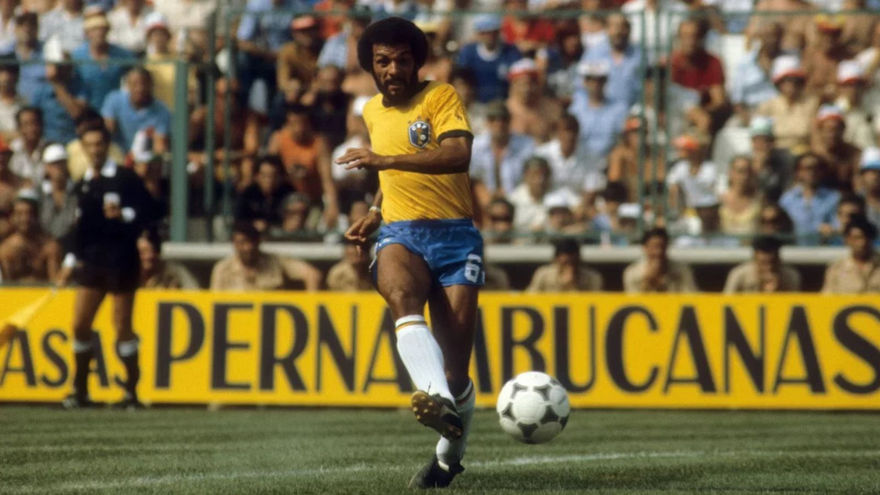
Léo Júnior was quite a special player of his time, showcasing moments of brilliance with his specially gifted talented. He was a part of the legendary 1982 Brazilian World Cup side, widely considered to be one the greatest sides to have never won the trophy.
What made the Brazilian stand out was his two footedness, which made him a shooting threat even from his weaker foot. Júnior was blessed with immense skills, passing ability, and set-piece expertise as well.
Let us now look back at his memorable years as a football player.
Club career
Júnior came up through the youth side of Brazilian club Flamengo, with whom he went on to have a legendary stint. The Brazilian ended up winning four Brazilian Championships (1980, 1982, 1983, 1992), the 1981 Copa Libertadores and 1981 Intercontinental Cup with Flamengo. He also made a record 857 appearances with the Brazilian side.
After a decade at Flamengo, Júnior was signed by Italian club Torino On 12th June 1984. Although the Brazilian was capable of operating both as a midfielder and full-back, he obtained a guarantee to play as a midfielder with Torino. He considered the midfield role to be a less stressful one that could prolong his career.
After initial struggles, Júnior established himself as a key player for Torino under Luigi Radice, who made him the side's midfield leader. Although Júnior performed brilliantly throughout the season, he was also subject to racism in the country. Those incidents took place in Milan and Turin respectively, with the latter occurring during the heated derby with Juventus.
Despite Torino's inability to clinch the league from eventual champions Verona, Júnior's sensational individual contributions saw him named as Serie A's player of the year.
He remained with the club till 1987,until he had a fallout with manager Radice. The manager believed that Júnior's performance had dipped from his debut season, and the Brazilian's substitution in a crucial UEFA Cup tie against HNK Hajduk Split was the final nail in the coffin. Torino eventually got eliminated from the competition after Júnior's substitution, which marked the end of his time in Turin.
This was followed by a stint at Italian club Pescara, where Júnior spent the next 2 years of his career. He returned back to Flamengo in 1989, where it all started. The Brazilian had also returned to Torino on loan in 1991, helping the side win the Mitropa Cup.
The 1980's Brazilian hero retired from football in 1993 after a glorious 19 years career.
Brazilian legacy
Junior's first noticeable appearance for Brazil was in the 1976 Summer Olympics. Coming to his time with the national first-team side, The Brazilian made a total of 74 appearances between May 1979 and December 1992. He was also a part of the 1982 and 1986 World Cup sides.
Although World Cup success eluded him with the Brazilian side, he managed to achieve immense success in many Beach Soccer World Championships as part of the Brazil national team. Júnior ended up winning several awards for being top scorer and best player in those tournaments. The Brazilian has a commendable record of 71 goals in the Beach Soccer World Championships ( later renamed FIFA Beach Soccer World Cup).
His heroics in beach football even saw him crowned "Best Legend" at the 2019 Beach Soccer Stars awards, and the France Football magazine placed Júnior fifth in an article named "10 Legends of Beach Soccer".
Although his name might be overshadowed by several other greats from his nation, Júnior will always remain as one of the finest to have come from Brazil.
Also Read | Brazil’s Greatest footballers of all time