
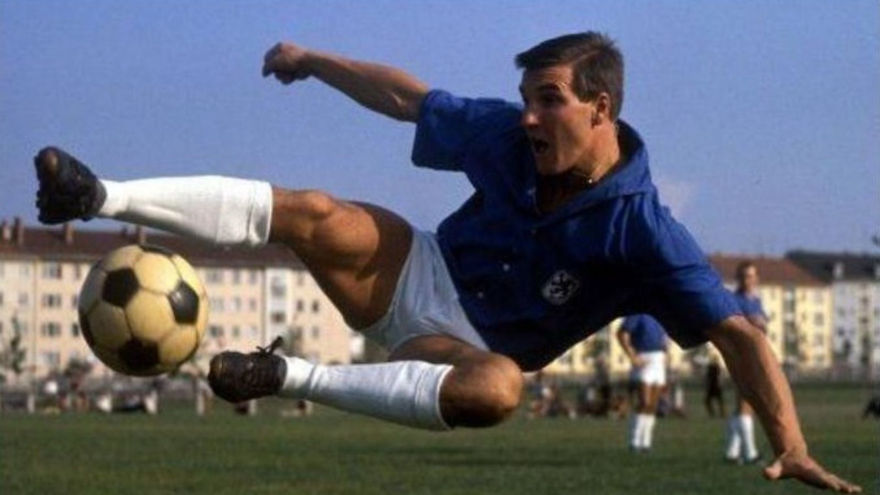
It was in 1960 that a youngster named Rudolf Brunnenmeier joined German club 1860 Munich. This was a period when the club were in the Oberliga Süd, the southern division of the then five-way split German first division. 1860 Munich were a top club at the time, as they won the league in 1963, earning the title of "South German Champions", a berth in the play-offs for the national championship of that year, and finally a place in the inaugural 1963–64 Bundesliga season. Brunnenmeier was a world-class striker during the Oberliga years from 1960 till 1963, scoring an impressive 73 goals in 88 matches.
The Bundesliga years and European heartbreak
Munich continued their success under manager Max Merkel, marking a successful beginning to a new era of German football by winning the German Cup in 1964. Brunnenmeier was instrumental in the cup final, scoring one of the decisive goals in their 2-0 victory over Frankfurt. He was also magnificent in their debut Bundesliga campaign, scoring 19 goals in 29 league matches.
Brunnenmeier continued his excellent form in the following season, scoring 24 goals to finish the campaign as Bundesliga top scorer. As for Munich, that season was memorable for their feats in Europe, as the German club reached the 1965 Cup Winners' Cup final. The final saw 1860 Munich take on West Ham, in a mesmerizing crowd of over 100,000 in the Wembley Stadium in London. Despite the best efforts of Brunnenmeier and his teammates, an outstanding performance from West Ham goalie Jim Standen and a brace from Alan Sealey saw West Ham end Munich's European dreams on a shattered note.
The golden period
Brunnenmeier's continued goalscoring exploits saw him earn call-ups from the West Germany national side in 1964 and 1965. The following year however, was one that saw greatness await both him and his teammates.
1966 saw Munich at arguably their greatest ever phase in history, and that brilliance eventually led to their first and only Bundesliga title victory. The likes of Peter Grosser and Hans Rebele were architects of their famous offensive style of football. Munich also had Petar Radenkovic, the first foreign star in the Bundesliga. In addition to these, several other top players like Otto Luttrop , Lukas Reich, Alfred "Fredi" Heiß, Friedhelm Konietzka, Wilfried Kohlars and Hans Küppers played key roles in making Munich the Champions of Germany.
An unfortunate downfall
Surprisingly, Brunnenmeier's powers were diminishing around this time. In the championship season he only scored 15 goals, which was his lowest season output since he joined the club. Unfortunately, this was the beginning of a sharp decline for both the player and his club.
Munich began to slide down below the top half of the league table, while Brunnenmeier struggled to match his usual double digit goalscoring feats throughout the season. The German only managed to score 7 goals in the 1966–67 season, and the following campaign saw him record only a single goal in 12 games.
1968 proved to be his final year at Munich as well, spelling the end of a legendary 8 year chapter. Brunnenmeier left the club with 66 goals in 119 league matches, which remains a club record, and is still considered as one of the greatest forwards in club history.
The aftermath
Brunnenmeier's next footballing chapter took him to Swedish side Neuchatel Xamax, where he spent the next 4 years of his career. This was followed by a move to Swiss side FC Zürich.
The German then took a trip to Austria to play for SW Bregenz, before playing three more years with amateur side FC Balzers in Liechtenstein, who were the final club in his career. Brunnenmeier bid farewell to football in 1980, thus closing the curtains on what was a magical career.
Also Read |