
Test cricket rewards patience, concentration and the ability to withstand pressure over long periods. While individual centuries and five-wicket hauls often dominate the headlines, great batting partnerships can determine the outcome of an entire match. They allow teams to recover from early setbacks, wear down opposition bowlers and build commanding positions.
The greatest Test partnerships of all time demonstrate how two batters can combine different skills to change a match. Some stands produced record-breaking totals, while others helped teams escape difficult situations or secure memorable victories.
This ranking considers partnership runs, match impact, opposition quality and historical significance. It also examines the tactical lessons behind these performances and the records that make them memorable.
Top 10 Greatest Test Partnerships of All Time
The following table ranks ten outstanding partnerships, highlighting the batters, runs scored, wicket position, opposition and year.
Rank | Batting Partners | Runs | Wicket | Opposition | Year |
1 | Kumar Sangakkara and Mahela Jayawardene | 624 | 3rd | South Africa | 2006 |
2 | VVS Laxman and Rahul Dravid | 376 | 5th | Australia | 2001 |
3 | Sanath Jayasuriya and Roshan Mahanama | 576 | 2nd | India | 1997 |
4 | Joe Root and Harry Brook | 454 | 4th | Pakistan | 2024 |
5 | Don Bradman and Bill Ponsford | 451 | 2nd | England | 1934 |
6 | Andrew Jones and Martin Crowe | 467 | 3rd | Sri Lanka | 1991 |
7 | Conrad Hunte and Sir Garry Sobers | 446 | 2nd | Pakistan | 1958 |
8 | Graeme Smith and Neil McKenzie | 415 | 1st | Bangladesh | 2008 |
9 | Ben Stokes and Jonny Bairstow | 399 | 6th | South Africa | 2016 |
10 | Jonathan Trott and Stuart Broad | 332 | 8th | Pakistan | 2010 |
Editorial note: The list combines different wicket positions and match contexts, so it should not be interpreted as an official statistical ranking.
Detailed Analysis of the Greatest Test Partnerships
1. Kumar Sangakkara and Mahela Jayawardene – 624 Runs (2006)
Venue: Sinhalese Sports Club, Colombo | Opposition: South Africa
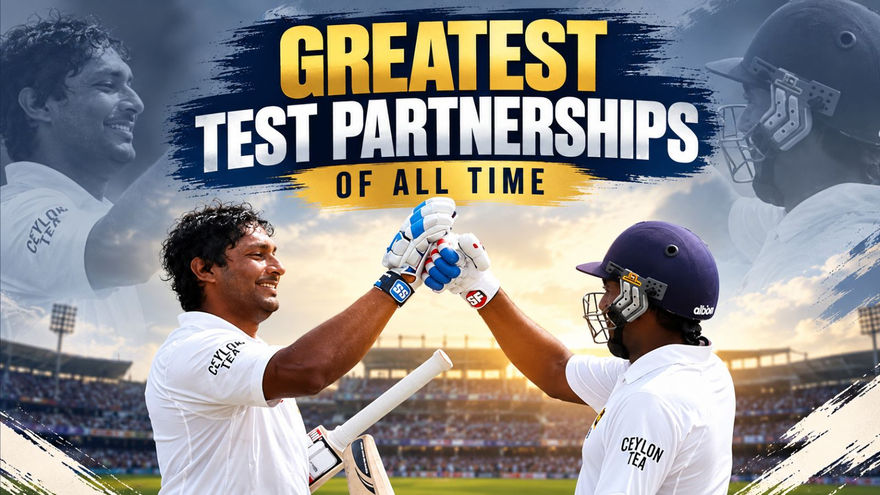
Sri Lankan greats Kumar Sangakkara and Mahela Jayawardene produced one of the most remarkable batting performances in Test history with their 624-run partnership for the third wicket in Colombo in 2006.
The stand is widely recognised as the highest partnership in Test cricket. Jayawardene scored 374, while Sangakkara contributed 287, combining technical precision with exceptional concentration over an extended period at the crease.
Their partnership demonstrated how two established batters could maintain pressure on the bowling attack without losing control of their innings. It remains a landmark achievement in Sri Lankan cricket and a defining example of sustained batting dominance.
2. VVS Laxman and Rahul Dravid – 376 Runs (2001)
Venue: Eden Gardens, Kolkata | Opposition: Australia
India's 2001 Test against Australia at Eden Gardens remains one of the most memorable comeback victories in cricket. Australia arrived on the back of a 16-match Test winning streak and forced India to follow on.
VVS Laxman and Rahul Dravid responded with a defining fifth-wicket partnership. Laxman scored 281 and Dravid made 180, batting through the fourth day without losing their wickets.
Their stand transformed India's position and helped set up a historic victory. It ranks among the finest examples of a partnership built around patience, discipline and resilience under pressure.
3. Sanath Jayasuriya and Roshan Mahanama – 576 Runs (1997)
Venue: R. Premadasa Stadium, Colombo | Opposition: India
Sri Lanka's 1997 Test against India produced one of the biggest team totals in cricket history. After India declared at 537/8, Sri Lanka responded with 952/6 declared.
Sanath Jayasuriya scored 340, while Roshan Mahanama added 225 in a monumental second-wicket partnership of 576 runs.
The pair occupied the crease for more than two days, demonstrating the stamina required to sustain a long Test innings. Their performance remains a defining example of how a substantial partnership can turn a match into a battle of endurance.
4. Joe Root and Harry Brook – 454 Runs (2024)
Venue: Multan Cricket Stadium | Opposition: Pakistan
England's Joe Root and Harry Brook delivered a remarkable batting performance against Pakistan in Multan in 2024. Root scored 262, while Brook struck 317, recording a triple-century in an innings that showcased England's attacking approach.
Their fourth-wicket partnership of 454 runs helped England establish a commanding first-innings total and secure an innings victory.
The stand highlighted the value of combining consistency with scoring intent. Root's composure and Brook's aggressive stroke play placed sustained pressure on Pakistan's bowlers and demonstrated how contrasting batting styles can complement each other.
5. Don Bradman and Bill Ponsford – 451 Runs (1934)
Venue: The Oval, London | Opposition: England
During the deciding Test of the 1934 Ashes series, Don Bradman and Bill Ponsford combined for a huge second-wicket partnership against England.
Bradman scored 244 and Ponsford made 266, giving Australia a commanding position in the match. Their partnership formed a major part of Australia's successful Ashes campaign.
The performance also illustrates the historical significance of long partnerships in Test cricket. Despite differences in playing conditions and equipment across eras, the ability to maintain concentration and capitalise on scoring opportunities has remained central to successful batting.
6. Andrew Jones and Martin Crowe – 467 Runs (1991)
Venue: Basin Reserve, Wellington | Opposition: Sri Lanka
New Zealand faced a difficult situation against Sri Lanka in Wellington in 1991. After falling behind by 323 runs, the hosts needed a substantial second-innings response to avoid defeat.
Andrew Jones scored 186, while Martin Crowe made 299 in a remarkable third-wicket partnership. Their efforts helped New Zealand recover and secure a draw.
The innings demonstrated the importance of adapting to match circumstances. Rather than allowing the deficit to dictate their approach, Jones and Crowe concentrated on building a partnership that could keep New Zealand in the contest.
7. Conrad Hunte and Sir Garry Sobers – 446 Runs (1958)
Venue: Sabina Park, Kingston | Opposition: Pakistan
Conrad Hunte and Sir Garry Sobers formed a major second-wicket partnership against Pakistan in 1958. Hunte contributed 260, while Sobers produced an extraordinary unbeaten 365.
Sobers' innings became a landmark achievement in Test cricket, establishing a new individual record for the highest Test score at the time.
Their partnership reflected the value of combining a substantial individual innings with a reliable contribution from the other batter. Together, they helped the West Indies build a commanding position.
8. Graeme Smith and Neil McKenzie – 415 Runs (2008)
Venue: Chattogram | Opposition: Bangladesh
South African openers Graeme Smith and Neil McKenzie shared a 415-run opening partnership against Bangladesh in 2008.
Smith scored 232, while McKenzie made 226. Both batters reached double-centuries, giving South Africa a powerful start and placing Bangladesh under sustained pressure.
The stand became a landmark in Test opening partnerships. It demonstrated how an opening pair can shape an entire innings by combining sound defence, effective shot selection and the patience to build a substantial total.
9. Ben Stokes and Jonny Bairstow – 399 Runs (2016)
Venue: Newlands, Cape Town | Opposition: South Africa
Ben Stokes and Jonny Bairstow produced a remarkable sixth-wicket partnership against South Africa in Cape Town in 2016.
Stokes scored 258 from 198 balls, while Bairstow contributed an unbeaten 150. Their partnership helped England recover from a challenging position and build a substantial total.
Stokes' aggressive approach showed how attacking batting can change the tempo of a Test match. Bairstow's contribution provided the support needed to sustain the innings, making the stand an outstanding example of lower-middle-order resilience.
10. Jonathan Trott and Stuart Broad – 332 Runs (2010)
Venue: Lord's, London | Opposition: Pakistan
England's Jonathan Trott and Stuart Broad rescued their side after it slumped to 102/7 against Pakistan at Lord's in 2010.
Trott scored 184, while Broad made 169. Their eighth-wicket partnership transformed England's innings and helped the team reach 446.
The stand demonstrated that a Test innings can recover even after the loss of several early wickets. It also highlighted the importance of lower-order contributions, particularly when a recognised batter and a bowling all-rounder establish a productive partnership.
Frequently Asked Questions
What is the highest partnership in Test cricket history?
The highest Test partnership is 624 runs, scored by Kumar Sangakkara and Mahela Jayawardene for Sri Lanka against South Africa in Colombo in 2006.
What is the highest opening partnership in Test cricket?
The highest opening partnership is 415 runs, shared by South Africa's Graeme Smith and Neil McKenzie against Bangladesh in 2008.
What is the highest 10th-wicket partnership in Test cricket?
The record is 198 runs, scored by England's Joe Root and James Anderson against India at Nottingham in 2014.
Which pair has scored the most partnership runs together in Test cricket?
Rahul Dravid and Sachin Tendulkar are credited in the supplied article with sharing more than 6,920 partnership runs across 143 innings. This cumulative statistic should be verified against a reliable statistical database before publication.
What is the highest partnership for the sixth wicket in Test cricket?
The supplied article identifies Ben Stokes and Jonny Bairstow's 399-run partnership against South Africa in 2016 as the sixth-wicket record. However, its accompanying historical comparison is inconsistent with the stated wicket positions. Verify the official record before publishing this claim.
Also Read |