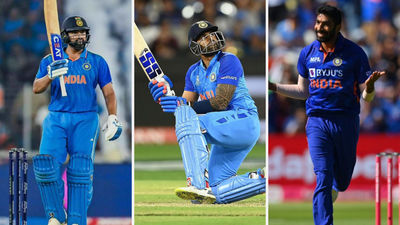

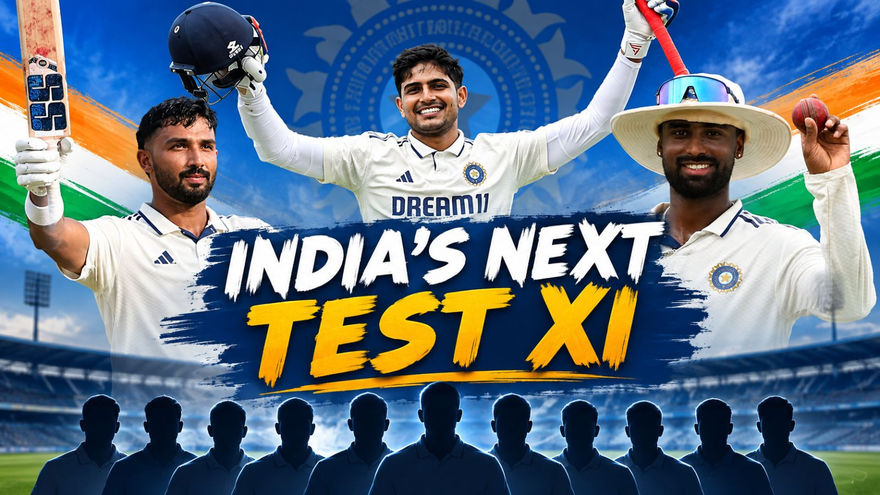
Indian Test cricket is entering a major generational transition. For more than a decade, players such as Rohit Sharma, Virat Kohli, Ravindra Jadeja, and Ravichandran Ashwin formed the core of India's success at home and overseas. As their careers move toward their later stages, the selectors face the challenge of building a Test side that can maintain that standard.
The transition will not happen overnight. India, however, has a strong pathway through the Ranji Trophy, India A cricket, and a deep pool of players with experience across formats. The next generation includes established young batters, wicketkeepers, spin all-rounders, and fast bowlers who could form the backbone of India's Test team for years to come.
Top-Order Succession: Replacing India's Modern Greats
The top order presents one of the biggest challenges. Replacing the experience and run production of Rohit Sharma and Virat Kohli requires more than finding individual replacements. India's next batting unit must develop the ability to absorb pressure, build long innings, and perform across different conditions.
Yashasvi Jaiswal and Shubman Gill: The New Pillars
Yashasvi Jaiswal has already moved beyond the prospect stage and established himself as a leading Test opener. His double centuries, attacking approach, and ability to combine aggression with composure make him a natural candidate to anchor the top order in the next phase of Indian Test cricket.
Shubman Gill has developed into a key top-order batter, regularly operating at No. 3 while also taking on leadership responsibilities. His position gives India a technically accomplished right-hander around whom the batting order can be built.
Sai Sudharsan and Devdutt Padikkal
India also has left-handed options competing for important top-order and middle-order positions.
Sai Sudharsan: His First-Class technique and composure make him a strong candidate for a long-term top-order role. His ability to handle swing and score consistently in red-ball cricket adds balance to the batting group.
Devdutt Padikkal: After making an impression on Test debut, Padikkal remains an option for the No. 3 or No. 4 positions. His reach and ability to play spin can be particularly useful in subcontinental conditions.
The succession picture can therefore be viewed broadly as follows:
Current Generation | Potential Next-Generation Options |
Rohit Sharma – Opener | Yashasvi Jaiswal |
Virat Kohli – No. 4 | Shubman Gill / Sai Sudharsan |
Devdutt Padikkal / Sarfaraz Khan |
Middle Order and Wicketkeeping Options
India's middle order must perform two contrasting jobs. Batters need to survive periods of seam movement early in an innings while also being capable of attacking spin and changing the tempo when conditions allow.
Sarfaraz Khan and Dhruv Jurel
Sarfaraz Khan's prolific Ranji Trophy record earned him an opportunity at international level. His ability to attack spin and score quickly in the middle order gives India an aggressive option when the situation demands it.
Dhruv Jurel offers a different combination. He has shown value as a middle-order batter and wicketkeeper, with composure that makes him useful in pressure situations. His batting also gives India flexibility if the team needs an additional specialist batter.
Rishabh Pant's Role
Rishabh Pant remains central to India's Test plans as a wicketkeeper-batter. His role means Jurel and other emerging wicketkeepers are likely to compete for backup duties or alternative middle-order positions rather than immediately displacing him.
That competition is important for India's depth, particularly across a demanding Test schedule.
Filling the Jadeja and Ashwin Void
Replacing Ravindra Jadeja and Ravichandran Ashwin presents perhaps the most difficult challenge in India's red-ball transition. Their value went beyond bowling. Both could contribute important runs, while Jadeja also provided elite fielding.
The next generation does not necessarily need to reproduce that combination through one player. India could instead divide those responsibilities among several all-rounders and specialist spinners.
Player | Primary Role | Domestic Benchmark | Key Strength |
Harsh Dubey | Left-arm spin all-rounder | 69 wickets in a single Ranji season | Turn, drift and useful batting |
Manav Suthar | Left-arm orthodox spinner | Consistent India A performances | Accuracy and lower-order batting |
Washington Sundar | Off-spin all-rounder | Proven overseas Test performer | Control against pace and tight bowling |
Nitish Kumar Reddy | Fast-bowling all-rounder | Seam option with middle-order depth | Seam movement and pace |
Harsh Dubey and Manav Suthar
Harsh Dubey stands out as one of the most intriguing spin-all-rounder candidates. The Vidarbha player produced a dominant Ranji Trophy campaign, taking 69 wickets while also contributing more than 1,000 First-Class runs. His left-arm spin and batting ability make him a natural candidate to help cover some of the workload previously handled by Jadeja.
Manav Suthar provides another left-arm option. His performances for India A and ability to combine accuracy with lower-order batting make him part of the wider succession picture.
Rebuilding India's Pace Attack Beyond Jasprit Bumrah
Jasprit Bumrah remains the central figure in India's fast-bowling group, but managing fast-bowling workloads requires depth. A strong pipeline allows India to rotate pacers according to conditions, workload, and the demands of a long Test schedule.
Emerging Seamers to Watch
Prasidh Krishna offers height, pace, and steep bounce, characteristics that can be particularly valuable in conditions such as Australia and South Africa.
Gurnoor Brar, listed at 6'5", provides another tall seam option. His height creates the potential for natural bounce, while his development in the India A red-ball setup gives him an avenue toward higher-level cricket.
Akash Deep and Harshit Rana provide further depth. Both offer seam movement and control, giving India options across different conditions rather than relying on one fixed bowling combination.
India's Predicted Next Test XI
A long-term Test XI will depend on form, injuries, domestic performances, and conditions. Based on the player pool and roles outlined above, the potential lineup is:
No. | Player | Role |
1 | Yashasvi Jaiswal | Left-hand opener |
2 | Shubman Gill | Right-hand top-order batter / Captain |
3 | Sai Sudharsan | Left-hand top-order batter |
4 | Devdutt Padikkal / Sarfaraz Khan | Middle-order batter |
5 | Rishabh Pant | Wicketkeeper-batter |
6 | Dhruv Jurel | Batter / wicketkeeper |
7 | Harsh Dubey / Washington Sundar | Spin-bowling all-rounder |
8 | Manav Suthar / Kuldeep Yadav | Primary spinner |
9 | Mohammed Siraj / Akash Deep | Fast bowler |
10 | Jasprit Bumrah / Prasidh Krishna | Fast bowler |
11 | Gurnoor Brar / Harshit Rana | Fast bowler |
This should be viewed as a projected long-term combination rather than a fixed selection. India's final XI will naturally change according to opposition, pitch conditions, player workloads, and current form.