
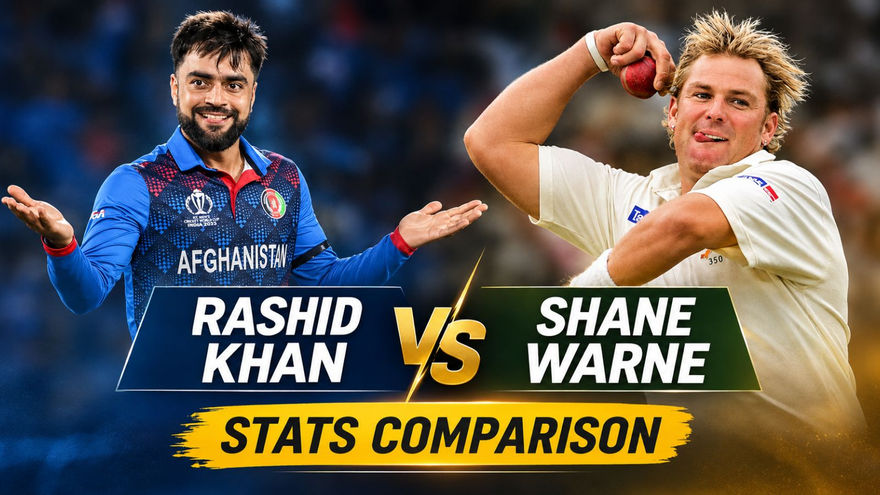
Leg-spin bowling requires precise control, deceptive variations, and the ability to outthink batters. Few bowlers have demonstrated these skills as effectively as Shane Warne and Rashid Khan, two spinners who shaped different eras of international cricket.
Warne revived the art of leg-spin in Test cricket through flight, drift, sharp turn, and exceptional tactical awareness. Rashid Khan brought a different approach to modern wrist-spin, using a quicker arm action, a flatter trajectory, and a deceptive googly to challenge batters in ODIs and T20 cricket.
The Rashid Khan vs Shane Warne stats comparison highlights their contrasting strengths across formats. Warne's record of 708 Test wickets establishes his standing among the greatest red-ball bowlers, while Rashid's white-ball performances demonstrate the value of pace, accuracy, and variation in limited-overs cricket.
Rather than comparing their numbers in isolation, it is important to consider the formats they played, their bowling methods, and the different demands of their respective eras.
Rashid Khan vs Shane Warne: Career Statistics
Warne played international cricket from 1992 to 2007, building his reputation primarily in Tests and ODIs. Rashid made his international debut in 2015 and has developed into one of Afghanistan's leading bowlers across white-ball formats, alongside his experience in Test cricket.
The following table presents the career figures reported in the original comparison. Rashid's figures are approximate or marked with plus signs, so they should not be treated as a verified, up-to-date statistical snapshot.
Statistical Category | Shane Warne (Tests) | Shane Warne (ODIs) | Rashid Khan (ODIs) | Rashid Khan (T20Is) |
Matches | 145 | 194 | 120+ | 115+ |
Wickets | 708 | 293 | 180+ | 190+ |
Bowling average | 25.41 | 25.73 | ~19.80 | ~14.00 |
Economy rate | 2.34 | 4.25 | ~4.15 | ~6.14 |
Bowling strike rate | 57.4 | 36.3 | ~26.8 | ~13.6 |
Five-wicket hauls | 37 | 1 | 6 | 2 |
Best bowling figures | 8/71 | 5/33 | 5/3 |
Note: Rashid's career is ongoing, so his numbers may have changed.
The table illustrates why format-specific analysis matters. Warne's Test record reflects sustained wicket-taking over long spells, while Rashid's reported T20I strike rate highlights his ability to dismiss batters quickly in a format with limited overs and aggressive scoring.
A bowling average measures runs conceded per wicket, while the bowling strike rate measures the number of deliveries required per wicket. Economy rate, by contrast, measures runs conceded per over. Each metric describes a different aspect of performance.
Shane Warne's Bowling Style: Flight, Drift and Turn
Warne built his reputation on classical leg-spin and an exceptional understanding of batter psychology. His bowling combined changes in pace, subtle variations in trajectory, and the ability to make a delivery turn sharply after pitching.
How Warne Created Wicket-Taking Opportunities
Flight and drift: Warne used trajectory and movement through the air to encourage batters to commit to a shot before the ball reached them.
Sharp turn: His leg-break could move away from a right-handed batter, creating opportunities for edges and mistimed strokes.
Variations: He developed a broad repertoire that included the flipper, slider, top-spinner, and conventional leg-break.
Tactical control: Warne regularly adjusted his line, length, and pace to exploit a batter's weaknesses over an extended spell.
His method was particularly effective in Test cricket, where he could build pressure through repeated deliveries and use changes in flight to create uncertainty.
Warne's influence extended beyond his wicket tally. He helped restore leg-spin's prominence in an era when fast bowling often dominated discussions of Test match strategy.
Rashid Khan's Bowling Style: Pace, Accuracy and the Googly
Rashid Khan approaches leg-spin differently. His quick arm action and relatively flat trajectory give batters less time to read the ball and adjust their footwork.
Instead of relying primarily on a large amount of flight, Rashid often challenges batters with speed through the air, accuracy, and subtle changes in direction.
What Makes Rashid Difficult to Face?
Quick release: Rashid delivers the ball at a brisk pace for a leg-spinner, reducing the time available for batters to judge the delivery.
Deceptive googly: His googly turns in the opposite direction to a conventional leg-break, making it difficult for batters to predict the ball's movement from the release alone.
Skidding trajectory: His flatter deliveries can rush onto the batter, limiting the time available to play attacking strokes.
Variation and control: His combination of accuracy and different deliveries makes it difficult to score freely without taking risks.
These qualities suit T20 cricket, where batters often look to attack from the beginning of an innings. Rashid can restrict scoring while creating wicket-taking opportunities, making him valuable during different phases of a limited-overs match.
Test Cricket: Why Shane Warne's Record Stands Out
Warne's Test record remains the clearest point of distinction between the two bowlers. He finished his international career with 708 Test wickets in 145 matches, alongside 37 five-wicket hauls.
His best Test innings figures were 8/71 against England. These numbers reflect both his ability to take wickets in clusters and his sustained effectiveness across a long career.
Test cricket gives spinners more time to build pressure. Bowlers can attack the stumps, vary their flight, exploit changes in pitch conditions, and target batters across multiple spells. Warne excelled in this environment, combining technical skill with tactical patience.
Rashid has also played Test cricket for Afghanistan, but his international workload has been concentrated more heavily in limited-overs formats. Afghanistan's comparatively smaller Test schedule also affects the opportunities available to build a record across five-day matches.
Consequently, comparing their Test wicket totals alone would overlook the difference in experience and opportunities. Warne's record provides a substantial body of evidence for his red-ball achievements, while Rashid's career must also be evaluated through his white-ball performances.
T20 Cricket: Rashid Khan's Greatest Strength
T20 cricket places different demands on spinners. Batters have fewer deliveries to build an innings and frequently attack from the outset, particularly when targeting boundaries or exploiting field restrictions.
Rashid's bowling style addresses these challenges. His quick release, deceptive variations, and ability to maintain control make him a sought-after bowler in international cricket and franchise competitions.
His career spans competitions such as the Indian Premier League (IPL), Big Bash League (BBL), and Caribbean Premier League (CPL). These tournaments have helped establish his reputation as a high-impact T20 specialist.
The original comparison also places Rashid's combined T20 wicket tally above 500 across international and domestic franchise cricket. Because that total changes as he plays, it should be checked against current records before publication.
Warne also contributed to the development of franchise T20 cricket, including through his leadership in the IPL. However, the format occupied a much smaller part of his career than it does for Rashid.
The key distinction is specialization: Warne's defining statistical achievement came in Tests, while Rashid's strongest case rests on his sustained impact in white-ball cricket, particularly T20s.
Rashid Khan vs Shane Warne: Strengths and Limitations
Category | Shane Warne | Rashid Khan |
Primary strength | Test match wicket-taking | T20 bowling and white-ball control |
Bowling approach | Flight, drift, turn, and tactical variation | Pace, accuracy, a deceptive googly, and a flatter trajectory |
Signature advantage | Building pressure over long spells | Limiting reaction time and controlling scoring opportunities |
Best-known international achievement | 708 Test wickets | Impact across ODIs and T20Is |
Main comparison limitation | Played in a different era and across a different format mix | Has had fewer opportunities to build an extensive Test record |
Neither bowler's statistics tell the entire story. Warne's longer spells and extensive Test experience are not directly comparable with Rashid's high-intensity white-ball workload. Pitch conditions, opposition quality, match situations, and team roles also influence bowling figures.
A fair comparison should therefore consider the conditions in which each bowler operated instead of declaring one universally superior.
Frequently Asked Questions
Who has more international wickets, Shane Warne or Rashid Khan?
Shane Warne finished his career with 1,001 international wickets: 708 in Tests and 293 in ODIs. Rashid Khan remains an active international cricketer, so his total continues to change.
How does Rashid Khan's bowling style differ from Shane Warne's?
Warne relied heavily on flight, drift, turn, and tactical variation. Rashid generally bowls faster, uses a flatter trajectory, and relies on a deceptive googly and precise execution to challenge batters.
Is Rashid Khan better than Shane Warne in T20 cricket?
Rashid has a stronger case based on sustained specialization in modern T20 cricket. However, Warne played during a period when the format was less established, so a direct comparison needs to account for differences in opportunity, role, and playing conditions.
What were Shane Warne's best Test bowling figures?
Warne's best bowling figures in a Test innings were 8/71 against England.
What are Rashid Khan's best ODI bowling figures?
Rashid's best ODI figures, as listed in the original comparison, are 7/18 against the West Indies. This performance illustrates his wicket-taking potential in limited-overs cricket.
Conclusion
The Rashid Khan vs Shane Warne comparison highlights two different approaches to leg-spin rather than a simple contest over who was the better bowler. Warne's 708 Test wickets, 37 five-wicket hauls, and ability to dominate long spells define his red-ball legacy.
Rashid has built his reputation around speed, accuracy, deceptive variations, and consistent impact in white-ball cricket. His style suits the demands of modern ODIs and T20s, where batters attack aggressively and bowlers must combine wicket-taking ability with scoring control.
Warne's Test achievements and Rashid's white-ball strengths deserve to be assessed within their respective contexts. Both have demonstrated how leg-spin can remain effective by adapting technique and tactics to the demands of the game.