

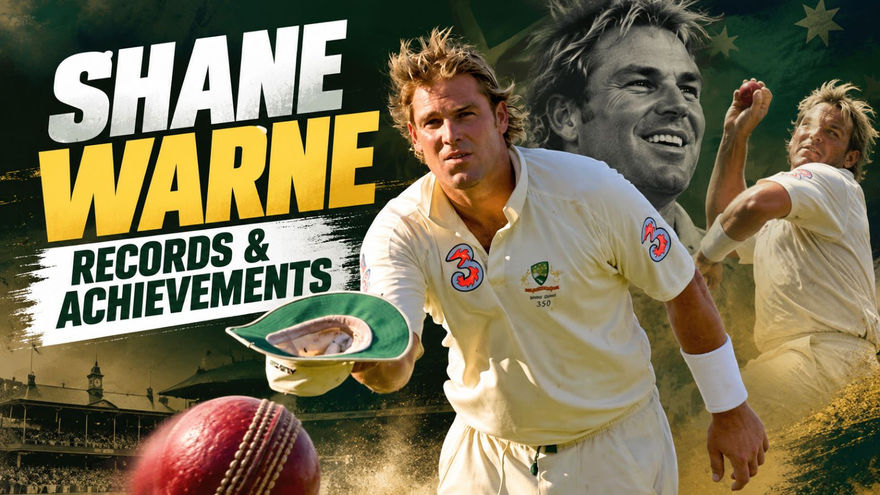
Few cricketers changed the perception of a bowling style as dramatically as Shane Keith Warne. When the Australian leg-spinner emerged in the early 1990s, wrist-spin was often viewed as a high-risk option in an era increasingly dominated by fast bowling.
Warne changed that perception. Over a 15-year international career from 1992 to 2007, he became one of Test cricket’s most successful bowlers, delivered defining performances in major tournaments, and helped restore leg-spin to the center of international cricket.
His career produced 708 Test wickets, 293 ODI wickets, a World Cup title, and 1,001 international wickets in total. His influence also extended into the Indian Premier League, where he captained the Rajasthan Royals to the inaugural IPL title in 2008.
Shane Warne Career Records at a Glance
Career Record | Achievement |
International matches | 339 |
Test matches | 145 |
ODI matches | 194 |
International wickets | 1,001 |
Test wickets | 708 |
ODI wickets | 293 |
Test 5-wicket hauls | 37 |
Test 10-wicket matches | 10 |
World Cup titles | 1 |
IPL titles | 1 |
Warne was more than a prolific wicket-taker. His value came from his ability to combine turn, accuracy, variations, tactical awareness, and pressure-building spells.
Shane Warne Test Records and Milestones
Warne made his Test debut against India at the Sydney Cricket Ground in 1992. His first match produced modest figures of 1/150, but he soon established himself as one of Australia's most important bowlers.
By the end of his Test career, Warne had played 145 matches and taken 708 wickets.
Shane Warne Test Bowling Statistics
Statistic | Record |
Tests | 145 |
Innings | 273 |
Wickets | 708 |
Bowling average | 25.41 |
Economy rate | 2.34 |
Best innings figures | 8/71 |
Best match figures | 12/128 |
5-wicket hauls | 37 |
10-wicket matches | 10 |
Catches | 125 |
First Bowler to Reach 700 Test Wickets
One of Warne's most significant statistical milestones came during the Boxing Day Test against England at the Melbourne Cricket Ground on December 26, 2006.
He dismissed Andrew Strauss to become the first bowler to reach 700 Test wickets. The achievement came during his final Ashes series and added another defining moment to an already remarkable career.
Most Test Wickets in a Calendar Year
Warne took 96 Test wickets in 15 matches during 2005 at an average of 22.50. The performance stands as a major calendar-year milestone in Test bowling.
Most Ashes Wickets
The Ashes was one of the defining rivalries of Warne's career. Across 36 Ashes Tests, he claimed 195 wickets at an average of 23.25.
His ability to influence long series against England became a major part of his reputation as Australia's premier spin bowler.
37 Test Five-Wicket Hauls
Warne finished his career with 37 five-wicket hauls in Tests. At the time and in the career record cited here, that placed him second behind Sri Lanka's Muttiah Muralitharan, who recorded 67.
Warne also collected 10 ten-wicket match hauls, demonstrating how frequently he could decide Test matches across multiple innings.
Most Test Runs Without a Century
Warne was a useful lower-order batter as well as an elite bowler. He scored 3,154 Test runs, including 12 half-centuries, but never made a Test hundred.
His highest score was 99 against New Zealand in Perth in 2001, leaving him with the notable record of the most Test runs without a century.
Shane Warne ODI Records and Achievements
Warne's international impact was not limited to Test cricket. He played 194 ODIs for Australia and took 293 wickets.
ODI Statistic | Record |
Matches | 194 |
Wickets | 293 |
Bowling average | 25.73 |
Economy rate | 4.25 |
5-wicket hauls | 1 |
Best bowling | 5/33 |
His ODI career reached its most memorable point during Australia's successful 1999 Cricket World Cup campaign.
Shane Warne at the 1999 Cricket World Cup
Warne played a decisive role in Australia's run to the 1999 World Cup title in England.
He finished the tournament with 20 wickets, sharing the position of leading wicket-taker. His biggest performances came in the knockout stages.
Semi-Final Against South Africa
In the semi-final against South Africa, Warne produced 4/29 while Australia defended a modest target. His wickets included Herschelle Gibbs, Gary Kirsten, Jacques Kallis, and Hansie Cronje.
Final Against Pakistan
Warne continued his outstanding tournament in the final at Lord's. His 4/33 helped Australia dismiss Pakistan for 132, earning him the Player of the Match award as Australia secured its second World Cup title.
Shane Warne's Most Iconic Cricket Moments
Warne's statistics tell only part of the story. Several deliveries and performances became defining moments in cricket history.
The "Ball of the Century" — 1993
On June 4, 1993, Warne delivered one of the most famous balls in cricket history to England batter Mike Gatting at Old Trafford.
The delivery pitched well outside leg stump before turning sharply across Gatting and hitting the top of off stump. The extraordinary movement immediately captured the imagination of cricket fans and became known as the "Ball of the Century."
The delivery also became an enduring example of how much variation a world-class leg-spinner could generate.
Test Hat-Trick at the MCG — 1994
During the 1994 Boxing Day Test against England at the Melbourne Cricket Ground, Warne completed a famous hat-trick.
He dismissed Philip DeFreitas, Darren Gough, and Devon Malcolm with three consecutive deliveries, adding another memorable achievement to his Test record.
The 700th Test Wicket — 2006
Warne's 700th Test wicket came at the MCG against England in December 2006. He clean-bowled Andrew Strauss in front of a huge home crowd during his final Ashes series.
The milestone provided a fitting highlight to the final stage of his international career.
Shane Warne's IPL Career and Captaincy
Although Warne retired from international cricket in 2007, he continued to influence the game through the inaugural Indian Premier League season in 2008.
He represented the Rajasthan Royals as captain and coach, leading an inexperienced squad to the IPL title.
Shane Warne IPL Statistics
IPL Record | Achievement |
Matches | 55 |
Wickets | 57 |
Best bowling | 3/16 |
Economy rate | 7.27 |
Team | Rajasthan Royals |
IPL titles | 1 |
His 2008 campaign demonstrated another aspect of his cricketing ability: tactical leadership. Warne combined his knowledge of bowling with captaincy and coaching responsibilities to guide Rajasthan Royals to the inaugural championship.
Shane Warne's Major Honors
Warne's career was recognized through several major honors:
Wisden Cricketer of the Century (2000): Selected as one of five players of the 20th century alongside Sir Donald Bradman, Sir Garfield Sobers, Sir Jack Hobbs, and Sir Viv Richards.
Australian Cricket Hall of Fame: Inducted in 2012.
ICC Cricket Hall of Fame: Inducted in 2013.
Wisden Leading Cricketer in the World: Named in 2004 and 2005.
Frequently Asked Questions About Shane Warne
How many international wickets did Shane Warne take?
Shane Warne took 1,001 international wickets: 708 in Tests and 293 in ODIs.
What were Shane Warne's best Test bowling figures?
His best innings figures were 8/71, while his best match figures were 12/128.
Did Shane Warne score a Test century?
No. Warne scored 3,154 Test runs without a century. His highest Test score was 99 against New Zealand in Perth in 2001.
How many Test five-wicket hauls did Shane Warne take?
Warne recorded 37 five-wicket hauls in Test cricket.
Did Shane Warne win the IPL?
Yes. Warne captained and coached the Rajasthan Royals to the inaugural IPL title in 2008.
Shane Warne's Lasting Legacy
Shane Warne's career combined extraordinary statistics with moments that became part of cricket's history. His 708 Test wickets and 293 ODI wickets established him among the game's most successful bowlers, while his performances in the 1999 World Cup and the 2008 IPL added major limited-overs achievements to his record.
His influence also extended beyond the numbers. Warne demonstrated how a leg-spinner could combine skill, control, variation, tactical planning, and psychological pressure at the highest level.
That combination helped redefine modern wrist-spin bowling and made Shane Warne one of the most recognizable and influential cricketers of his generation.


