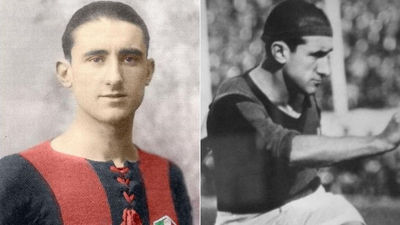

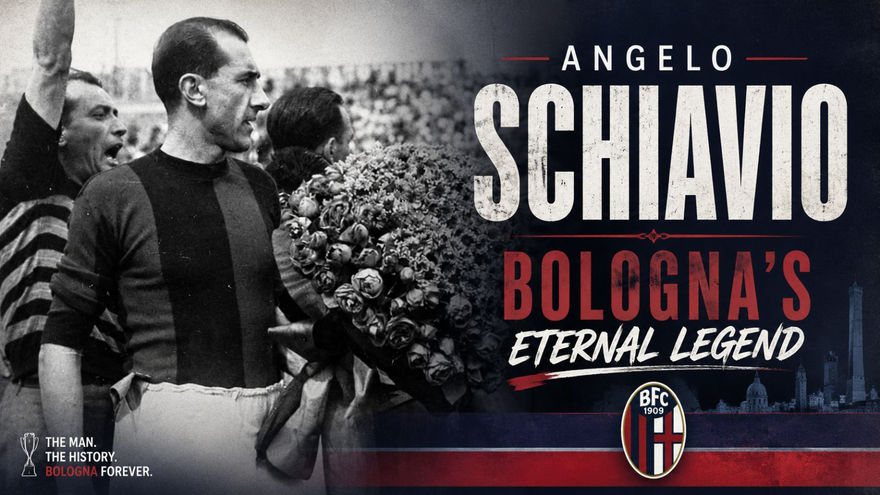
For most football fans, Bologna is just another average Italian club that often struggles to finish in the top half of the Serie A table. However, most football fans would be shocked to know that the club has won 7 Italian league titles throughout its history. This article will be looking back at arguably their greatest ever player, who was instrumental in leading them to 4 of those 7 league titles. Let us rewind the years and witness the epic career of Angelo Schiavio, the legendary striker who won it all for both club and country.
Club career
Angelo Schiavio was a one-club legend, who devoted his entire professional club football career to Bologna. The Italian began his Bologna stint during the 1922–23 Prima Divisione, which saw him score 6 goals in 6 league games. It was a promising debut for the 17 year old youngster, and a sign of great things to come. This was also a time when the Italian league was organised into several different regional groups, contrary to the current Serie A setup.
As Schiavio continued to score regularly for Bologna, he eventually became a permanent member of the starting-eleven at age 19. It was the beginning of a legendary career at Bologna, and the first major milestone was achieved in 1925.
Bologna made history that year, as the club won their first ever Italian league title. Angelo Schiavio contributed heavily to their magical success, as he scored 16 goals in 27 games.
History was yet again repeated in the 1928–29 season, and Schiavio was an even better player by this time. His career best tally of 30 goals in 26 matches provided Bologna with their second league title.
The 1929–30 was the very first season to see the current Serie A format, which spelled the end of the previous group format. Changes in format did not bring any difference in Schiavio, as he continued to showcase his goalscoring prowess.
He won the Capocannonieri award for the 1931–32 season, as his 25 goals made him the Serie A top scorer. Bologna added 2 more Italian league titles to their silverware collection in 1936 and 1937, although Schiavio only played in two games of the league campaign.
Just like most footballers, Schiavio slowed down and declined during his final years. His final season at Bologna was during 1938–39, where he failed to score in any of his 6 appearances.
He departed the club as one of their most important and greatest ever players. Schiavio scored 249 goals in his 361 appearances for the club. A club-record 242 of those came during the Italian league era, while the remaining 109 were scored after the format restructure to Serie A.
An eternal legend, for both club and country
Angelo Schiavio's heroics were not only limited for his club side Bologna, but his greatness extended to the international stage as well. Besides winning the 1927–30 Central European International Cup and 1933–35 Central European International Cup with Italy, it was in 1934 that he made himself an eternal legend for his country.
Schiavio was instrumental in Italy's first ever FIFA World Cup win in 1934. With the likes of elite players Luis Monti and Giuseppe Meazza to support him, Schiavio finished the tournament as second top goalscorer with 4 goals. He began the tournament on a brilliant note, but his form dipped in the later stages.
However, destiny made sure that he saved his best for the last. The final against Czechoslovakia was extended till extra time after a 1-1 draw by normal time. It was during extra time that Schiavio externalized himself, scoring the winner to make it 2-1. That was also the final score, as Italy became World Champions. It was also Schiavio's final match for Italy, as injuries kept him out of future games.
Thus he made his mark in both Italian club football and the international stage as well. He left football as one of Italy's finest ever to have played the beautiful game.
Also Read | Greatest Italian Footballers of all time