
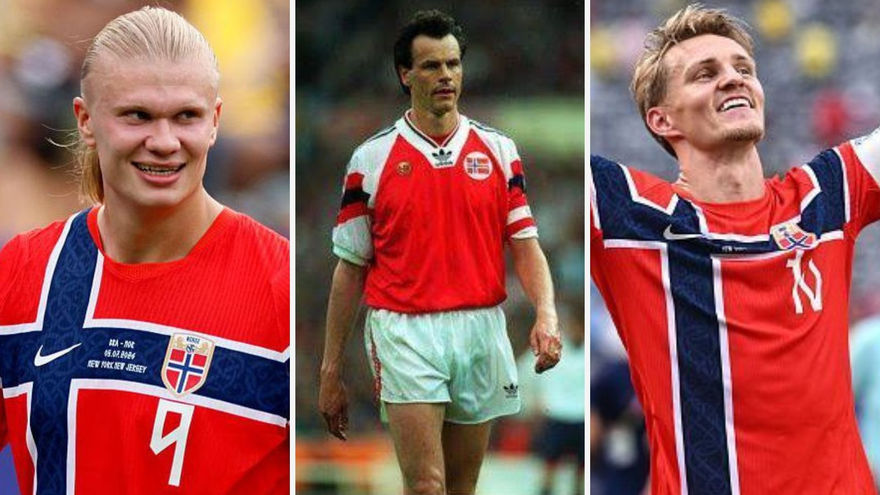
Norwegian football has long been defined by discipline, resilience, and a collective edge. For years, the national team’s identity was built on structure, physicality, and tactical clarity, especially under Egil “Drillo” Olsen in the 1990s, when Norway twice reached the World Cup and famously beat Brazil in 1998. That era gave the country a hard-earned reputation as one of Europe’s most difficult teams to face.
\
But Norwegian football has evolved. Over time, the game shifted from direct, combat-heavy football toward technical development, tactical intelligence, and sharper individual quality. That change produced a new generation of players capable of thriving at the top of European club football.
Top 10 Greatest Footballers from Norway
10. Erik Thorstvedt
Position: Goalkeeper
Years Active: 1980–1996
Major Clubs: Viking, Borussia Mönchengladbach, IFK Göteborg, Tottenham Hotspur
Erik Thorstvedt was the reliable last line behind Norway’s rise in the modern era. Commanding in the air, composed in the box, and sharp on his line, he brought stability to a national team built on organization and discipline. He also broke new ground abroad, becoming the first Norwegian to win the FA Cup, a milestone that carried symbolic importance for Scandinavian goalkeepers in Britain.
Major Achievements
Domestic: 1x FA Cup (1991), 1x Norwegian First Division (1982).
International: 97 caps for Norway, starting goalkeeper at the 1994 FIFA World Cup.
Why He Is Ranked Here
Thorstvedt earns his place because he was a core figure in Norway’s breakthrough years under Drillo. His consistency in England helped establish the standard for Norwegian keepers abroad.
Legacy
He set an early template for modern Norwegian goalkeeping, built on communication, command of the area, and reliability under pressure.
9. Tore André Flo
Position: Striker
Years Active: 1993–2012
Major Clubs: Brann, Chelsea, Rangers, Sunderland, Leeds United
Tore André Flo was an unusual striker in the best possible way. At 6'4", he looked built for direct football, yet he had the touch, mobility, and dribbling ability to cause problems in far more subtle ways. Nicknamed Flonaldo, he became one of Norway’s most memorable forwards, combining technique with finishing ability in a way that made him more versatile than the typical target man.
Major Achievements
Domestic: 1x FA Cup (1998), 1x UEFA Cup Winners’ Cup (1998), 1x Scottish Cup (2002).
International: 76 caps, 23 goals for Norway.
Why He Is Ranked Here
Flo’s famous goal against Brazil at the 1998 World Cup remains one of the defining moments in Norwegian football history. It helped secure one of the country’s most iconic victories and underlined his ability to deliver on the biggest stage.
Legacy
He changed the stereotype of the tall Scandinavian striker. Flo showed that height could be paired with finesse, movement, and intelligent ball control.
8. Joshua King
Position: Forward / Winger
Years Active: 2008–Present
Major Clubs: Manchester United, Blackburn Rovers, Bournemouth, Everton, Watford, Fenerbahçe
Joshua King was one of Norway’s most dynamic attacking players through the 2010s. Quick, powerful, and versatile, he could play across the front line and attack space on the counter. In a period when the national team was in transition, King carried a heavy scoring responsibility and became one of the country’s most dependable modern forwards.
Major Achievements
Domestic: Bournemouth’s all-time top Premier League scorer (48 goals).
International: 62 caps, 20 goals for Norway.
Why He Is Ranked Here
King ranks eighth because he bridged the gap between Norway’s older direct tradition and the more modern attacking profile. His Premier League output and international consistency gave him clear historical value.
Legacy
He helped establish a blueprint for the modern Norwegian wide forward: direct, physical, and dangerous in transition.
7. Morten Gamst Pedersen
Position: Left Winger / Midfielder
Years Active: 2000–Present
Major Clubs: Tromsø, Blackburn Rovers, Karabükspor, Rosenborg
Morten Gamst Pedersen was one of the most gifted left-footed players Norway produced in the 2000s. He spent nearly a decade in the Premier League and became known for delivery, set pieces, and the ability to produce goals from distance. While not always the flashiest player on the pitch, he was one of the most dependable creative outlets of his generation.
Major Achievements
Domestic: 1x Norwegian First Division (2014).
International: 288 Premier League appearances, 83 caps, 17 goals for Norway.
Why He Is Ranked Here
Pedersen is seventh because of his longevity and his sustained value in one of the world’s toughest leagues. He was a consistent creative reference point for both club and country.
Legacy
He popularized the idea of the technical, set-piece specialist winger in Norwegian football and inspired a generation to value delivery as much as direct running.
6. Ronny Johnsen
Position: Centre-Back / Defensive Midfielder
Years Active: 1987–2008
Major Clubs: Lyn, Lillestrøm, Beşiktaş, Manchester United, Aston Villa, Vålerenga
Ronny Johnsen was one of Norway’s most elegant defenders. Quick across the ground, calm on the ball, and tactically intelligent, he could play as a center-back or step into midfield when needed. His reading of the game made him a trusted figure for elite teams, and his role in Manchester United’s treble-winning season gave him a place in one of club football’s great sides.
Major Achievements
Domestic: 4x Premier League, 1x FA Cup, 1x UEFA Champions League (1999), 1x Norwegian Cup (2005).
International: 62 caps for Norway.
Why He Is Ranked Here
Johnsen ranks sixth because he was a starter in Manchester United’s 1999 Treble-winning team and brought technical security to one of Europe’s biggest clubs.
Legacy
He showed that Norwegian central defenders could be intelligent ball-players rather than purely physical stoppers.
5. John Arne Riise
Position: Left-Back / Left Midfielder
Years Active: 1998–2017
Major Clubs: Monaco, Liverpool, Roma, Fulham, Delhi Dynamos
John Arne Riise was built on stamina, force, and one of the most feared left-foot shots of his era. He was more than a defender; he was a constant attacking outlet down the left side and a key part of Liverpool’s European success in the mid-2000s. His international record is unmatched in Norwegian history, and his longevity at the top level sets him apart from many of his peers.
Major Achievements
Domestic: 1x Ligue 1 (2000), 1x UEFA Champions League (2005), 1x FA Cup (2006), 2x UEFA Super Cup.
International: 110 caps for Norway, 16 goals for Norway.
Why He Is Ranked Here
Riise is fifth because of his record-breaking international career and his importance in Liverpool’s biggest moments, including the assist that helped spark the 2005 Champions League final comeback in Istanbul.
Legacy
He defined the modern attacking full-back for Norwegian football and remains the country’s all-time appearance leader.
4. Ole Gunnar Solskjær
Position: Striker
Years Active: 1989–2007
Major Clubs: Clausenengen, Molde, Manchester United
Ole Gunnar Solskjær became one of the most famous substitutes in football history, but that label only tells part of the story. He was an elite finisher, a clever mover, and a player with a remarkable sense for decisive moments. His value was never just in his goals, but in the way he repeatedly delivered in the most important matches.
Major Achievements
Domestic: 6x Premier League, 2x FA Cup, 1x UEFA Champions League (1999).
International: 67 caps, 23 goals for Norway.
Why He Is Ranked Here
Solskjær ranks fourth because of his defining moment in the 1999 Champions League final, when he scored the injury-time winner that sealed Manchester United’s Treble. Very few players have ever had such a reputation for timing and efficiency.
Legacy
He changed how football thinks about substitute impact. Solskjær became the model for the game-changing super-sub.
3. Martin Ødegaard
Position: Attacking Midfielder
Years Active: 2014–Present
Major Clubs: Strømsgodset, Real Madrid, Real Sociedad, Arsenal
Martin Ødegaard was a prodigy before he became a leader. Debuting for Norway as a teenager, he carried enormous expectations from the start, but his development has justified the hype. At Arsenal, he has become the creative hub of the side, combining vision, pressing intelligence, and excellent control in tight spaces.
Major Achievements
Domestic: 1x Copa del Rey (2020), 1x UEFA Super Cup (2016).
Individual: Arsenal Player of the Season, 2x Premier League Player of the Season nominee, youngest player in Tippeligaen and Norway national team history.
Why He Is Ranked Here
Ødegaard is third because of his elite technical level and his importance in the modern game. Even in the prime of his career, he already stands as one of Norway’s finest ever midfielders.
Legacy
He represents Norway’s shift from direct football toward technical, possession-based play. Ødegaard is the face of the country’s modern footballing identity.
2. Rune Bratseth
Position: Sweeper / Centre-Back
Years Active: 1981–1995
Major Clubs: Rosenborg, Werder Bremen
Rune Bratseth was the great defensive leader of Norway’s golden 1990s generation. Nicknamed Elk for his size and stride, he combined physical presence with tactical intelligence and excellent positioning. At Werder Bremen, he was a key figure in one of the Bundesliga’s strongest sides, and for Norway he stood as the backbone of a team that reached the 1994 World Cup and helped change the country’s footballing reputation.
Major Achievements
Domestic: 2x Bundesliga, 2x DFB-Pokal.
Continental: 1x UEFA Cup Winners’ Cup (1992).
Individual: 3x Norwegian Footballer of the Year, UEFA Golden Player of Norway (2003).
Why He Is Ranked Here
Bratseth places second because he was the captain and defensive anchor of Norway’s most celebrated international generation. His reputation as one of Europe’s finest sweepers gives him enormous historical weight.
Legacy
He defined the modern Norwegian sweeper through a mix of athleticism, calmness, and leadership.
1. Erling Haaland
Position: Striker
Years Active: 2015–Present
Major Clubs: Molde, Red Bull Salzburg, Borussia Dortmund, Manchester City
Erling Haaland is the most devastating scorer Norway has ever produced. He did not simply arrive in elite football; he overwhelmed it. With explosive acceleration, immense physical power, and ruthless finishing inside the box, Haaland has rewritten expectations for what a modern center-forward can do. At Manchester City, he turned his first season into a historic statement and became the focal point of one of the strongest teams in Europe.
Major Achievements
Domestic and continental team honors: Manchester City’s historic treble of Premier League, FA Cup, and UEFA Champions League.
Individual: Premier League single-season scoring record (36 goals), European Golden Shoe, Ballon d’Or runner-up, Norway all-time top scorer.
Why He Is Ranked Here
Haaland is number one because no Norwegian player has matched his combination of scoring volume, athletic dominance, and global stature. He is already operating at a level that places him above every previous generation.
Legacy
He has redefined the role of the pure striker in the modern game. Haaland restored the value of the penalty-box predator and made it a central feature of elite football again.
Honorable Mentions
Norway has produced several other important figures who narrowly miss the top 10:
Leif Erikson: A major early figure in Norwegian football history.
Harald Aabrekk: A respected name from the nation’s earlier football eras.
John Carew: A powerful striker whose club career brought him to Europe’s top level.
Henning Berg: A versatile defender with major club success.
Bjørn Johansen: One of the important names in Norway’s domestic football history.
The Bratseth and Ødegaard Debate
The most interesting debate in this ranking is Rune Bratseth versus Martin Ødegaard. Bratseth’s supporters point to his leadership, trophy haul, and role in Norway’s defining 1990s era. Ødegaard’s case rests on technical quality, tactical intelligence, and the fact that he is already one of the most gifted midfielders Norway has ever seen.
Bratseth gets the edge because his career is complete and his international influence is fully established. Ødegaard, however, could still climb in future years if his club and international career continue to grow.
Top Three Compared
Category | Martin Ødegaard | Rune Bratseth | Erling Haaland |
Peak performance | Elite vision, tempo control, and pressing intelligence | World-class sweeping, positioning, and leadership | Historic goalscoring, power, and finishing |
Career achievements | Major club success and captaincy at Arsenal | Bundesliga titles and European success with Bremen | Premier League, FA Cup, and Champions League treble |
International success | Norway captain and modern creative leader | Captain of Norway’s 1994 World Cup side | Norway’s all-time top scorer |
Individual awards | Arsenal Player of the Season and top-level recognition | Norwegian Footballer of the Year and UEFA Golden Player of Norway | European Golden Shoe, Ballon d’Or runner-up |
Influence on football | Recast the Norwegian midfielder as a creative system player | Defensive benchmark for Norway’s 1990s generation | Redefined elite striker scoring in the modern game |
Overall legacy | The symbol of Norway’s technical evolution | The defensive leader of a golden era | The greatest footballer in Norwegian history |
Why Haaland Is No. 1
Erling Haaland stands at the top because he has already done something no Norwegian before him managed at this scale: dominate the global scoring conversation. His record-breaking Premier League season, treble-winning campaign with Manchester City, and status as Norway’s all-time top scorer place him in a category of his own.
Bratseth gave Norway structure, Solskjær gave it decisive moments, and Ødegaard gave it artistry. Haaland, though, gave the nation a player who can take over world football through scoring alone. That is why he is the greatest Norwegian footballer of all time.
Conclusion
Norwegian football has traveled a long way, from rigid, collective strength to a modern era defined by technical quality and global ambition. The country has produced defenders, creators, and finishers who each shaped different stages of that journey. Bratseth led the defensive age, Ødegaard represents the new technical era, and Haaland sits above them all as a generational scoring force.
If Norway’s football history has a single defining figure, it is Erling Haaland. He is not just the country’s best player; he is one of the most formidable forwards the sport has ever seen.
FAQs
Who is the greatest Norwegian footballer of all time?
Erling Haaland is the greatest Norwegian footballer of all time because of his scoring record, treble-winning season, and global impact.
Why is Rune Bratseth ranked above Martin Ødegaard?
Bratseth’s career is complete, with major trophies and a major role in Norway’s 1990s golden generation.
Why is Ole Gunnar Solskjær so highly ranked?
Solskjær’s trophy haul and his famous winning goal in the 1999 Champions League final make him one of Norway’s defining players.
Why is John Arne Riise ranked fifth?
Riise holds Norway’s appearance record and played a major role in Liverpool’s 2005 Champions League triumph.
Which Norwegian players narrowly missed the top 10?
John Carew, Henning Berg, Bjørn Johansen, and several early-era figures are among the biggest near-misses.
Also Read |