
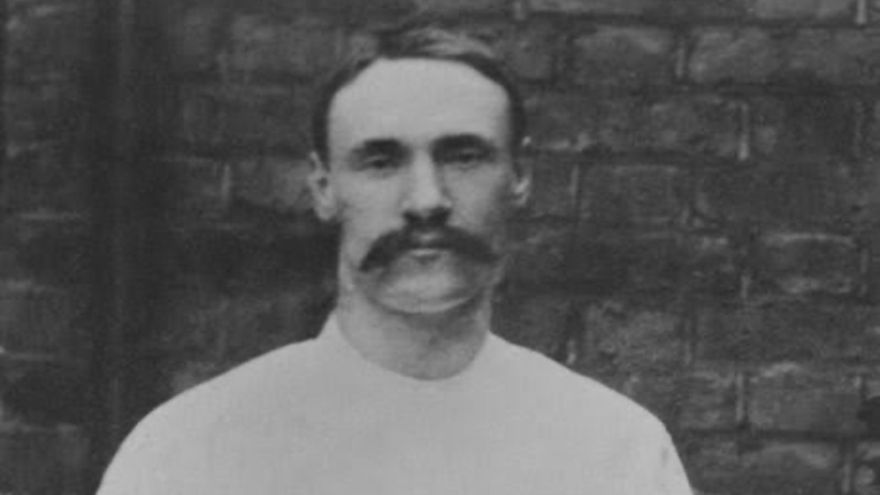
It was at the age of 7 that a young Jack Southworth had aspirations in the game of football, which saw him join a junior club named Inkerman Rangers. This was followed by moves to Brookhouse Perseverance F.C. and eventually Blackburn Olympic in 1883.
It was at Blackburn Olympic that Southworth took the leap to professional football, having been promoted to the first-team. The English Centre-forward's promising potential saw him receive an offer from Blackburn Rovers, but he rejected it.
During his time at Olympic, Southworth ended up playing for several other clubs as well on a temporary basis. These included the likes of Higher Walton, Accrington, and Vale of Lune F.C. Southworth suffered serious knee injuries during his time at Vale of Lune, which threatened the progress of his career. The Englishman was even forced to play as a goalkeeper during those challenging times.
The next phase of his career took him to Chester, where he also turned out as a Goalkeeper. Another surprising reason behind move to Chester was his keen love for Music, as he excelled in playing the violin.
It was during the 1885–86 season that the player was involved in a huge controversy, as he played for Blackburn Olympic in their First Round FA Cup match despite signing a professional contract with Chester. This ultimately led to Southworth being suspended for four months.
Despite this controversy, the Englishman eventually returned to Blackburn Olympic and was restored to his old position of centre-forward. This was followed by a move to Blackburn Rovers F.C. in 1887.
Let us now rewind his legendary run with the Rovers, and a memorable last dance he had with a certain Merseyside club.
An all-time Rovers great
The first season of the English Football League began in September 1888, Blackburn facing Accrington in their first league game. Southworth and his teammates achieved victory in a ten-goal thriller, with the former scoring the club's first ever league goal. Blackburn managed to finish that season in 4th place, with Southworth missing only one league game and finishing as Blackburn's top scorer with 21 goals.
Southworth was considered as one of the Football League's finest goal-scorers at the time, with the English centre-forward being described by a contemporary as excellent when it came to passing, speed, accuracy, and shooting. He was also mentioned as an unselfish player, thus proving himself to be a role model both on and off the field.
Despite his brilliance at club level, Southworth only managed to make 3 appearances for the national side. However, he went on to score in all these 3 games.
The 1890–91 season was a memorable one for the player, as he managed to finish the campaign as Football League top scorer with 26 league goals. He scored another 6 in Cup games to finish the season with a remarkable 32 goals. Silverware success followed him at Blackburn as well, with Southworth and his men clinching the FA Cup twice (1890, 1891).
Southworth's legendary 6 year run at Blackburn saw him score 119 goals in just 129 appearances. He still holds the Blackburn record for the most individual hat-tricks in a season with five in 1890–91, and the record for the aggregate individual hat-tricks with thirteen.
The aftermath
After his glorious run with Blackburn, Everton fans were the lucky recipients who were able to witness Southworth's excellence for one final season. He replaced the injured Fred Geary at the club, making an instant impact and soon becoming a great favourite with the Everton supporters. Southworth's only season with Everton saw him score a remarkable 27 goals in just 22 games.
The highlight performance of his Everton career came in a 7-1 thrashing of West Bromwich Albion on 30th December 1893, during which the English centre-forward scored an unbelievable 6 goals. This still stands as an Everton record and was the first time a player had scored two hat-tricks in the same game in the Football League.
Southworth eventually bid farewell to football in 1894, closing the curtains on what was a remarkable career.