
The "No.9" Curse has been as real as it gets for Chelsea. Barring the likes of Diego Costa and Didier Drogba, most Chelsea fans of the current generation would fail to mention any other striker that made it big at the club. Whether it was Fernando Torres, Romelu Lukaku, or Alvaro Morata, they all failed to light up Stamford Bridge. Chelsea's current side are in desperate need for a top striker as well, and the one who arrives at the Bridge will have a tough task in their hands.
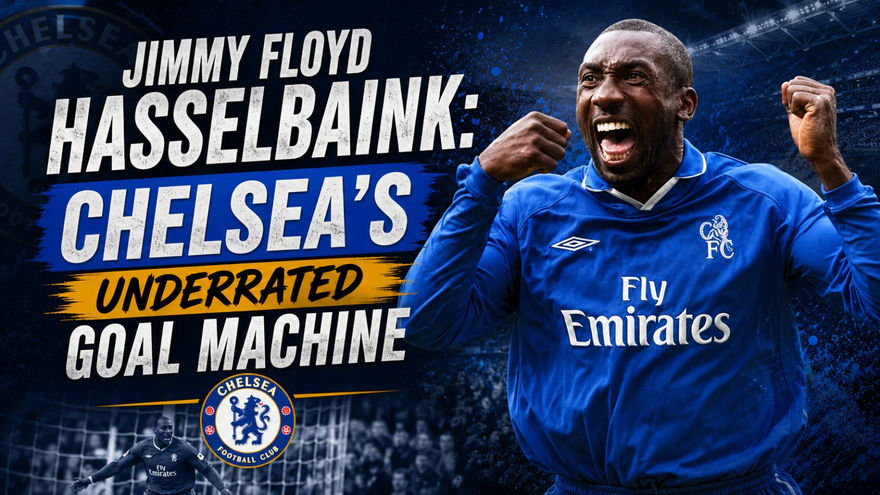
Despite the high number of striker failures, there are a select few who went to achieve greatness as well. Let us look back at the Chelsea career of Jimmy Floyd Hasselbaink, one of the club's most underrated strikers.
A return to the Premier League
After a single season at Atletico Madrid, Jimmy Floyd Hasselbaink was signed by Chelsea in 2000 for a then club-record £15 million. The move also marked his return to England, as Hasselbaink was a part of Leeds United from 1997 to 1999.
The Dutchman had a dream start at the club, as he scored on his debut to help Chelsea win 2-0 against Manchester United in the 2000 FA Charity Shield final. This was followed by a managerial change at Chelsea, which saw Manager Gianluca Vialli dismissed in September and replaced by Hasselbaink's former Madrid boss Claudio Ranieri. Hasselbaink ended the season in spectacular fashion, with 23 goals in 35 league appearances. Those heroics also saw him win the Premier League Golden Boot.
Continued goalscoring brilliance
The following 2001–02 season saw Hasselbaink continue from where he left, as the Dutchman kept on scoring goals at a ridiculous pace. He also performed a sensational partnership with fellow striker Eiður Guðjohnsen. Hasselbaink finished that season with a total of 29 goals, while Guðjohnsen managed to score 23 goals. With 52 goals between them, Chelsea's attacking duo was a nightmare for defenders at the time. 23 of Hasselbaink's 29 goals were in the league, which was only one fewer than eventual Golden Boot winner Thierry Henry.
Chelsea were able to reach the FA Cup finals that season, having overcome the likes of Norwich City, West Ham United, Preston North End, Tottenham Hotspur, and Fulham. Hasselbaink was a doubt for a final though, as he suffered from a hamstring injury.
Hasselbaink was still able to come from the bench in the final, but it wasn't enough as Arsenal beat Chelsea 2-0 in the final.
Final years
Hasselbaink's succeeding season at Chelsea was overshadowed due to his hamstring injury. This led to him requiring an operation as well. Upon his return to the club, manager Ranieri implemented a new squad rotation system and also built the team around Gianfranco Zola. All of this led to Hasselbaink's playing time being limited. He was on the verge of joining Barcelona during the January transfer window, but the move ultimately collapsed. Despite all the hurdles in front of him, the Dutchman finished the season with 15 goals. Those numbers were only one fewer than Zola, on whom the team was built around.
The 2003–04 season was one of seismic changes at Chelsea, as Russian billionaire Roman Abramovich took over the club. This resulted in the arrival of star strikers Adrian Mutu and Hernán Crespo at Stamford Bridge. Despite the new competition, Hasselbaink managed to finish the season as Chelsea's top-scorer. He also managed to achieve this feat for the third time in 4 years. It was a promising season of progress for Chelsea, as they finished second in the league and also managed to reach the Champions League semi-finals.
That was also the end of Hasselbaink at Chelsea, as his contract eventually expired and Abramovich had other plans for the team. He may not have won major accolades with the Blues, but true fans of the club would always remember him for being their shining light during the club's Pre-Abramovic years.