
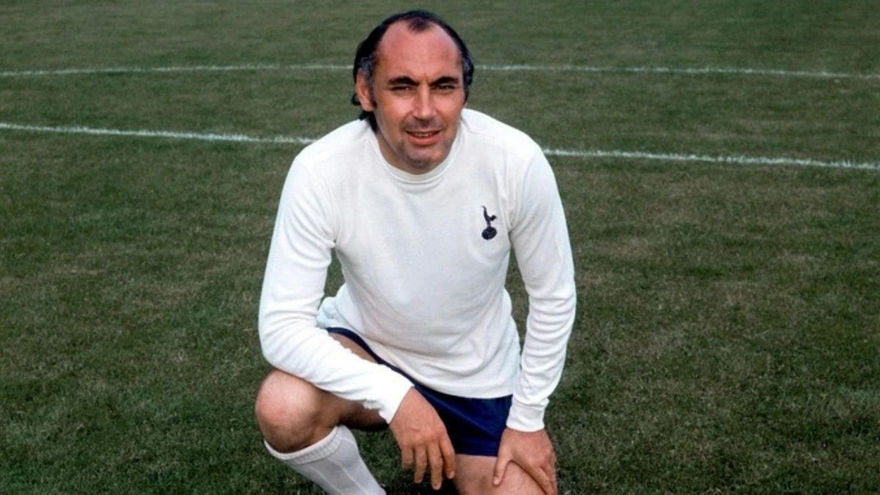
Alan Gilzean was a former Scottish striker who was active for almost 20 years in the game. He spent the majority of his career at Dundee and Tottenham Hotspur, in a magical journey that saw him score over 262 goals. This article will be mainly focusing on his time with those two clubs, and how he became a legend for both teams.
Made in Dundee
Alan Gilzean's football journey began with local side Coupar Angus Juniors, after which he signed a temporary contract with Dundee in January 1956 as a 17-year-old amateur. Gilzean played for Dundee's youth side, but he again returned to Coupar Angus. The Scotsman was living his football dream while also working as a despatch clerk for a carpet manufacturer in Perth.
February 1957 was a significant year for the player, as Dundee finally signed him on professional terms. Following the contract agreement, Gilzean had a short stint at Hampshire while he underwent National Service in the Royal Army Service Corps.
His professional debut for Dundee only came in August 1959, which was only the beginning of his legendary run with the side. Gilzean scored 169 goals in 190 appearances for Dundee in the Scottish top flight, helping them win the Scottish league championship in 1961–62 and reached the semi-finals of the 1962–63 European Cup.
Gilzean left the club in 1964 after a memorable 7 year stint. The fact that he was one of Dundee's first Hall of Fame inductees is a testament of the legendary status he earned with the club.
The King of White Hart Lane
It was in December 1964 that Gilzean was signed by Spurs for a transfer fee of £72,500. He made his debut a week later, when Tottenham faced Everton at White Hart Lane.
Gilzean went through a shift in playing style after Spurs, as he shifted from being a main goalscorer to a sharp and creative forward. The Scotsman went on to form a magnificent partnership with teammate Jimmy Greaves, with fans naming the popular duo as the "G-Men".
One of Gilzean's memorable games for Tottenham happened in 1966, When Spurs faced Burnley in the FA Cup 4th round. Gilzean ended up scoring a hat-trick in that match, including the winner that sealed a 4-3 victory for the London club. He continued to be a key member of the team, even though forward Martin Chivers who arrived from Southampton to provide competition.
The transfer of Jimmy Greaves to West Ham in 1970 spelled the end of his partnership with Gilzean. However, the Scotsman ended up forming a new formidable partnership with Chivers.
Both Gilzean and Chivers were instrumental in Tottenham's golden period during the first half of that decade. Spurs ended up winning the League Cup twice (1971, 1973) and also achieved European glory by winning the 1972 UEFA Cup. The 1972 European final saw Spurs face fellow English side Wolves, which ended in a 3-2 aggregate victory for Gilzean and his men.
It was due to his outstanding heroics and contributions for Spurs that Gilzean earned the moniker "The King of White Hart Lane" .
The 1973–74 was the Scottish forward's final one as a professional footballer. It was a heartbreaking farewell to the beautiful game for Gilzean, as Spurs lost against Feyenoord in the UEFA Cup final. Thus, robbing him of an opportunity to achieve European glory one last time.
Tottenham awarded Gilzean with a testimonial match, as a tribute to his ten years of service as a Tottenham player. The match took place in November 1974, as Spurs faced Red Star Belgrade.
After his departure from Tottenham, Gilzean returned to the football field for one final short run. He joined African club Highlands Park, where he played for only three months.
That was officially the end of his career, as he bid farewell to football.