
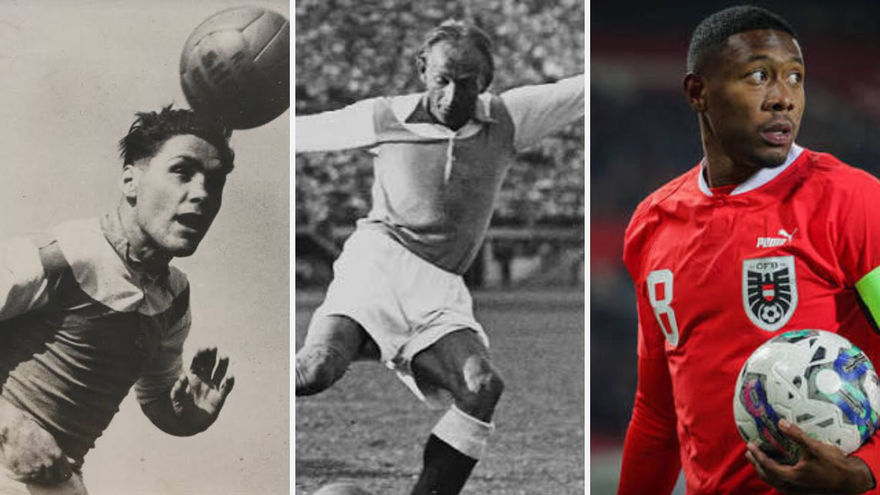
Austrian football’s prestige rests on two pillars: tactical innovation and aesthetic subtlety. Long before Total Football and modern positional fluidity, the Danube region produced the Wunderteam of the 1930s — a side that treated the pitch as a space for geometry, short passing and positional intelligence under Hugo Meisl. Though Austria’s modern footprint is modest compared with its larger neighbours, the country’s contribution to the tactical evolution of European football is outsized. From Matthias Sindelar’s pre-war artistry to David Alaba’s modern versatility, Austrian players have repeatedly influenced how the game is played.
This article ranks Austria’s ten greatest men’s footballers by balancing peak ability, career achievements, international impact, longevity, individual awards and influence on the sport. Players are assessed relative to their era and position, with an eye for historical significance as well as modern accomplishments.
The 10 Greatest Austrian Footballers
10. Karl Koller
Position: Central midfielder | Years active: 1949–1966 | Major club: First Vienna FC
Career overview
Karl Koller anchored Austria’s midfield during the golden post-war era. A superb tackler with exceptional positional sense, he started every match in Austria’s 1954 World Cup run to third place. A loyal club servant, his consistency and control under pressure made him Europe’s respected box-to-box prototype in the 1950s.
Why he’s here
Koller’s tournament consistency and role in Austria’s best World Cup campaign secure his ranking. He exemplified disciplined midfield industry at a continental level.
Legacy
A model of tactical discipline and midfield steadiness in central Europe.
9. Andreas Herzog
Position: Attacking midfielder | Years active: 1986–2004 | Major clubs: Rapid Wien, Werder Bremen, Bayern Munich
Career overview
Andreas Herzog combined a superb left foot with astute game intelligence. He excelled for Werder Bremen during their early-1990s revival, later lifting the UEFA Cup with Bayern Munich. For Austria he was a talisman across two World Cups and, until recent years, held the national appearance record.
Why he’s here
Herzog’s playmaking in top-level German football and durable international influence make him one of Austria’s finest creators.
Legacy
The modern prototype for the Austrian number 10: technical, clutch and tactically aware.
8. Toni Polster
Position: Striker | Years active: 1982–2000 | Major clubs: Austria Wien, Sevilla, 1. FC Köln
Career overview
Toni Polster was a prolific forward with an eye for double strikes—hence “Doppelpack.” He scored consistently in La Liga and the Bundesliga and led Austria at two World Cups. His club scoring records in Spain and Germany cemented his reputation across Europe.
Why he’s here
Polster’s sustained scoring in two top leagues elevates him above domestic-only profiles.
Legacy
Austria’s most dependable modern goalscorer and the nation’s leading international marksman for years.
7. Ernst Happel
Position: Centre-back / sweeper | Years active: 1942–1959 | Major club: Rapid Wien
Career overview
Before a legendary managerial career, Ernst Happel was a cerebral defender: impeccable reading of play, calmness and technique. He marshalled Rapid Wien and the national side in the post-war years, contributing to Austria’s 1954 World Cup third place.
Why he’s here
Happel’s defensive intelligence presaged the modern ball-playing centre-back and underpinned domestic dominance.
Legacy
A defensive thinker whose on-pitch approach foreshadowed his future tactical brilliance as a manager.
6. Gerhard Hanappi
Position: Midfielder / utility player | Years active: 1947–1965 | Major clubs: Wacker Wien, Rapid Wien
Career overview
Hanappi was the consummate all-rounder: technically gifted, tactically flexible and superb in multiple roles. He captained Rapid Wien and Austria, earning 93 caps in an era of sparse internationals.
Why he’s here
His positional versatility and sustained excellence across roles make him one of Austria’s most complete footballers.
Legacy
A blueprint of the “total” player who could fill several tactical needs at top level.
5. Herbert Prohaska
Position: Deep-lying playmaker | Years active: 1972–1989 | Major clubs: Austria Wien, Inter, AS Roma
Career overview
Prohaska combined Italian tactical smarts with Austrian technique. He played in Serie A during its golden era, winning the Scudetto with Roma and establishing himself as Austria’s midfield metronome. Internationally he steered Austrian campaigns in the late 1970s and 1980s.
Why he’s here
Prohaska’s ability to control elite games in Italy—then the world’s toughest league—earns him a top-five spot.
Legacy
He modernized Austria’s midfield identity: cerebral, composed and tactically sophisticated.
4. Hans Krankl
Position: Striker | Years active: 1970–1989 | Major clubs: Rapid Wien, Barcelona
Career overview
Hans Krankl’s 1978 calendar year remains legendary: European Golden Shoe winner, Ballon d’Or runner-up, and two stunning goals that helped Austria beat West Germany at the 1978 World Cup. He later starred at Barcelona, earning the Pichichi Trophy and continental silverware.
Why he’s here
Krankl’s extraordinary individual peak—European Golden Shoe, Pichichi and near-Ballon d’Or—places him among the most celebrated Austrians in modern memory.
Legacy
A cultural hero whose goals and charisma left indelible memories for Austrian fans.
3. Ernst Ocwirk
Position: Attacking wing-half / central midfielder | Years active: 1942–1963 | Major clubs: Austria Wien, Sampdoria
Career overview
Ocwirk is often named among the world’s best midfielders of the 1950s. Captaining Austria to third place in 1954, he combined sublime passing, aerial ability and leadership, and later became an icon in Italy with Sampdoria.
Why he’s here
Ocwirk’s status as a global midfield exemplar—captain of the FIFA World XI twice—confirms his top-tier place in Austrian and international football history.
Legacy
A formative influence on modern central midfield play: elegant, authoritative and tactically advanced.
2. David Alaba
Position: Left-back / centre-back / midfielder | Years active: 2009–present (active through 2026) | Major clubs: Bayern Munich, Real Madrid
Career overview
David Alaba represents Austria’s modern apex. From a dynamic full-back at Bayern to a ball-playing centre-back for Real Madrid, Alaba has won multiple Champions Leagues and domestic titles, amassing an unrivalled haul of club silverware while leading Austria with more than 110 caps.
Why he’s here
Alaba’s tactical versatility, consistency at elite clubs and record individual awards make him a defining global figure of Austrian football.
Legacy
He redefined the expectations for Austrian exports—world-class, multi-positional and trophy-laden.
1. Matthias Sindelar
Position: Centre-forward / deep-lying attacker | Years active: 1924–1939 | Major club: Austria Wien
Career overview
Matthias Sindelar, “Der Papierene,” captained the Wunderteam and practically invented a fluid, intelligent forward role akin to today’s false nine. His technical subtlety and spatial mastery dismantled rigid defenses across Europe. Beyond football, Sindelar’s refusal to play for Nazi Germany after the Anschluss and his tragic, mysterious death in 1939 made him an enduring cultural symbol.
Why he’s here
Sindelar’s tactical innovation and peerless artistry during an era that birthed modern European football place him at the summit of Austrian greatness.
Legacy
The spiritual architect of the Danubian School; an immortal symbol of aesthetic football and moral courage.
Honorable Mentions
Marko Arnautović: A mercurial forward with extensive international caps and club success, including early triumphs with Inter Milan.
Franz Binder: Rapid Wien legend credited with extraordinary scoring feats in the pre- and wartime eras.
Josef Bican: Vienna-born prolific scorer who starred for Austria before success with Czechoslovakia; one of football’s all-time goal machines.
Bruno Pezzey: Elegant sweeper with a UEFA Cup to his name and an influential international pedigree.
Friedrich Koncilia: Outstanding goalkeeper who anchored successful Austrian World Cup campaigns.
Walter Schachner: High-intensity forward who made his mark in World Cups and Serie A.
Biggest Ranking Debate: Sindelar vs. Alaba
The core debate contrasts Sindelar’s cultural and tactical primacy with Alaba’s modern dominance. Alaba’s unmatched club silverware across Champions League-winning dynasties and his versatility in several top roles answer the metrics-driven case for greatest-ever. Sindelar’s supporters argue that tactical invention and cultural impact — especially at a time when football itself was evolving — demand primacy. This list favors Sindelar for his transformational influence on football’s form and philosophy, while acknowledging Alaba’s extraordinary modern achievements.
How the Top Three Compare
Peak performance
Sindelar: Tactical innovator whose movement and intelligence remade forward play.
Alaba: World-class versatility and consistent elite performances across top clubs.
Ocwirk: Midfield general at a time when the position was global in stature.
Career achievements
Sindelar: Continental dominance with Austria Wien and the Wunderteam; cultural immortality.
Alaba: Multiple Champions Leagues, dozen-plus domestic titles across top European leagues.
Ocwirk: Key player in Austria’s 1954 run; high esteem in Italy with Sampdoria.
International success
Sindelar: Central to the Wunderteam’s European supremacy; 1934 World Cup semi-finalists.
Alaba: Long-serving captain and modern mainstay with numerous qualifiers and finals.
Ocwirk: Captain of Austria’s 1954 third-place finish and footballing world respect.
Individual awards
Sindelar: Voted Austria’s greatest player of the 20th century.
Alaba: Record Austrian Footballer of the Year wins and UEFA Team of the Year selections.
Ocwirk: Twice captain of the FIFA World XI.
Influence on football
Sindelar: Template for fluid attacking roles; an intellectual forebear to later tactical revolutions.
Alaba: Modern template for defensive versatility and ball-playing defenders.
Ocwirk: Redefined central midfield technique and leadership.
The Greatest Austrian Footballer: Matthias Sindelar
Matthias Sindelar stands above the rest because his achievements were not merely statistical but revolutionary. He reconstructed the forward’s role, introduced a cerebral approach to attacking play, and became a cultural symbol whose defiance transcended sport. While David Alaba’s modern trophy haul is unmatched, Sindelar’s tactical invention and moral standing place him at the apex of Austrian football history.
Conclusion
Austrian football history is a study in influence: the Danubian School’s delicacy, the post-war midfield artistry of Ocwirk and Hanappi, Krankl’s explosive modern peak, and Alaba’s global club dominance. Austria’s greatest players shaped how football is played, coached and imagined. In that lineage, Matthias Sindelar remains the defining figure — the player whose intelligence, skill and courage epitomize the country’s richest footballing contributions.
FAQs
Who is considered Austria’s greatest footballer?
Matthias Sindelar is widely regarded as Austria’s greatest due to his tactical innovation, leadership of the Wunderteam and enduring cultural legacy.
Which Austrian footballer has the most Champions League titles?
David Alaba has won multiple UEFA Champions League titles during his career with Bayern Munich and Real Madrid.
Who was Austria’s best midfielder in the post-war era?
Ernst Ocwirk is frequently cited as Austria’s finest post-war midfielder for his passing range, leadership and international acclaim.
Which Austrian striker won the European Golden Shoe?
Hans Krankl won the European Golden Shoe in 1978 after an extraordinary goalscoring season.
What is the “Danubian School” of football?
The Danubian School refers to Austria’s and Central Europe’s interwar football philosophy emphasizing short passing, positional fluidity and technical finesse—exemplified by Matthias Sindelar and the Wunderteam.
Also Read |