
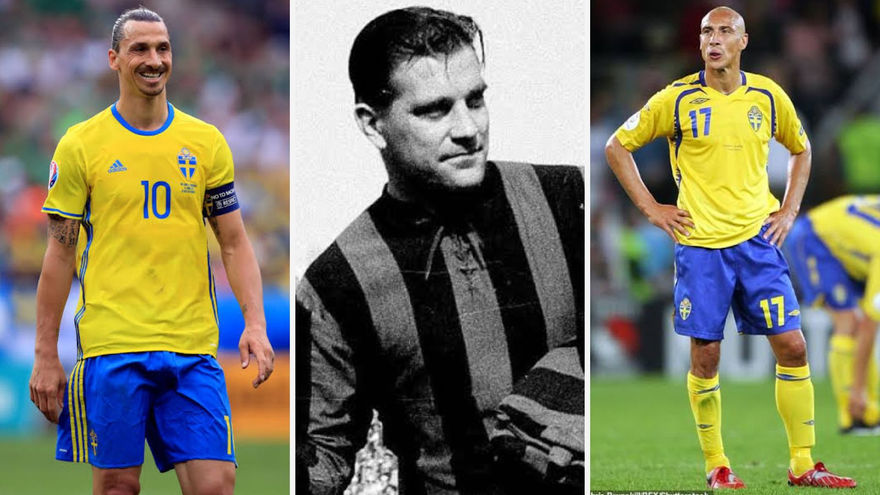
From frozen Scandinavian pitches to the grand stages of Milan, Barcelona, London, and Paris, Sweden has produced footballers who have left a lasting mark on the global game. For a nation of modest size, its record is remarkable: Olympic gold in 1948, a World Cup final appearance on home soil in 1958, and third-place finishes in 1950 and 1994. Sweden also helped shape modern football through players who excelled in Serie A, the Premier League, and beyond.
The debate over Sweden’s greatest footballers is a rich one. Should greatness be measured by international glory, pure scoring power, longevity, or the ability to dominate across multiple eras and leagues? This ranking weighs all of those factors to identify the ten finest men’s footballers Sweden has ever produced.
The 10 Greatest Footballers from Sweden
10. Glenn Hysén
Position: Central defender
Years Active: 1978–1993
Major Clubs: IFK Göteborg, PSV Eindhoven, Fiorentina, Liverpool
Glenn Hysén was one of the pillars of Swedish football in the 1980s. A commanding centre-back with strong aerial ability, sharp reading of the game, and a fearless approach to defending, he was central to IFK Göteborg’s rise in Europe. Under Sven-Göran Eriksson, he helped the club win two UEFA Cups, before later moving to Italy and then Liverpool, where he added an English league title to his résumé.
Major Achievements
Domestic: 3x Allsvenskan with IFK Göteborg, 1x English First Division with Liverpool, 2x FA Charity Shield.
Continental: 2x UEFA Cup (1982, 1987).
International: 68 caps, 7 goals; captained Sweden at the 1990 FIFA World Cup.
Individual: 2x Guldbollen (1983, 1988).
Why He Is Ranked Here
Hysén earns his place as one of Sweden’s finest pure defenders. His role in IFK Göteborg’s European success gave Swedish club football international credibility.
Legacy
He showed that Swedish defenders could combine physical strength with tactical intelligence at the highest level in Europe.
9. Patrik Andersson
Position: Central defender
Years Active: 1989–2005
Major Clubs: Malmö FF, Borussia Mönchengladbach, Bayern Munich, Barcelona
Patrik Andersson, known as “Bjärred,” was a model of calmness and control. Elegant in possession and disciplined without the ball, he became one of the Bundesliga’s most respected defenders before reaching his peak at Bayern Munich. His defining moment came on the final day of the 2000–01 Bundesliga season, when he scored a 94th-minute indirect free-kick to clinch the title for Bayern, days before lifting the Champions League.
Major Achievements
Domestic: 2x Bundesliga with Bayern Munich, 1x Allsvenskan with Malmö FF, 1x DFB-Pokal.
Continental: 1x UEFA Champions League (2001).
International: 96 caps, 3 goals; 3rd place at the 1994 FIFA World Cup, semi-finalist at Euro 1992.
Individual: 2x Guldbollen (1995, 2001), UEFA Team of the Year (2001).
Why He Is Ranked Here
Andersson combines elite club success with a major role in Sweden’s beloved 1994 World Cup side. His poise and leadership were hallmarks of a top-class defender.
Legacy
He represents the modern Swedish centre-back: calm, dependable, and technically secure under pressure.
8. Freddie Ljungberg
Position: Winger / attacking midfielder
Years Active: 1994–2014
Major Clubs: Halmstads BK, Arsenal, West Ham United, Seattle Sounders
Freddie Ljungberg brought energy, timing, and intelligent movement to every team he played for. At Arsenal, he became a vital part of Arsène Wenger’s golden era and one of the key figures in the Invincibles side that went unbeaten in the 2003–04 Premier League season. He also delivered in big moments, including a goal in the 2002 FA Cup final.
Major Achievements
Domestic: 2x English Premier League, 3x FA Cup with Arsenal, 1x Allsvenskan with Halmstad.
Continental: UEFA Champions League runner-up (2006).
International: 75 caps, 14 goals; played at two World Cups and three European Championships.
Individual: Premier League Player of the Season (2001–02), 2x Guldbollen (2002, 2006).
Why He Is Ranked Here
Ljungberg’s peak in the 2001–02 season was elite, and his place in one of English football’s greatest club sides gives him a strong case for the top 10.
Legacy
He became a global football figure whose style, image, and consistency helped expand the profile of Swedish players abroad.
7. Thomas Ravelli
Position: Goalkeeper
Years Active: 1978–1999
Major Clubs: Östers IF, IFK Göteborg
Thomas Ravelli was a charismatic and often eccentric presence in goal, but his quality was undeniable. He won nine league titles in Sweden and became a national hero at the 1994 World Cup, where his penalty shootout heroics against Romania sent Sweden into the semifinals and helped secure a memorable third-place finish.
Major Achievements
Domestic: 9x Allsvenskan, 1x Svenska Cupen.
International: 143 caps, 3rd place at the 1994 FIFA World Cup, semi-finalist at Euro 1992.
Individual: Guldbollen (1981), Sweden’s second-most capped player.
Why He Is Ranked Here
Ravelli’s international importance is enormous. Even without a major foreign club career, his longevity and World Cup legacy make him one of Sweden’s most iconic players.
Legacy
His reaction after saving Miodrag Belodedici’s penalty remains one of the defining images in Swedish sporting history.
6. Kurt Hamrin
Position: Winger / forward
Years Active: 1952–1972
Major Clubs: AIK, Juventus, Padova, Fiorentina, AC Milan
Kurt Hamrin was a winger with the instincts of a striker. Known for his acceleration, close control, and sharp finishing, he became one of Serie A’s most feared attacking players. He remains the ninth-highest scorer in Serie A history with 190 goals, a staggering total for a wide player. His greatest moment for Sweden came at the 1958 World Cup, where his solo goal against West Germany helped send the national team to the final.
Major Achievements
Domestic: 1x Serie A with AC Milan, 2x Coppa Italia with Fiorentina.
Continental: 1x European Cup (1969), 2x European Cup Winners’ Cup.
International: 32 caps, 17 goals; World Cup runner-up (1958).
Individual: Fiorentina all-time top scorer with 150 goals.
Why He Is Ranked Here
Hamrin’s longevity and productivity in one of football’s toughest leagues make his career exceptional. He was a wide player who produced numbers and moments on the scale of a true star forward.
Legacy
He helped redefine what a winger could be: direct, productive, and capable of deciding the biggest matches.
5. Gunnar Gren
Position: Inside forward / creative midfielder
Years Active: 1937–1964
Major Clubs: Gårda BK, IFK Göteborg, AC Milan, Fiorentina, Genoa
Gunnar Gren was the brain of Swedish football’s post-war rise. Nicknamed Il Professore in Italy, he had exceptional vision, passing range, and football intelligence. He was the creative centre of the celebrated Gre-No-Li trio at AC Milan and a key figure in Sweden’s Olympic gold in 1948. Even at 37, he returned to help Sweden reach the 1958 World Cup final.
Major Achievements
Domestic: 1x Allsvenskan with IFK Göteborg, 1x Serie A with AC Milan.
International: 57 caps, 32 goals; Olympic gold medal (1948), World Cup runner-up (1958).
Individual: inaugural Guldbollen winner (1946), AC Milan Hall of Fame.
Why He Is Ranked Here
Gren ranks highly because of his footballing intelligence and influence on two of Sweden’s most important eras: the Olympic champions of 1948 and the World Cup finalists of 1958.
Legacy
He helped shape the role of the playmaker in both Sweden and Italy, while his long career showed the value of intelligence over pure athleticism.
4. Nils Liedholm
Position: Midfielder
Years Active: 1938–1961
Major Clubs: IK Sleipner, IFK Norrköping, AC Milan
If Gren was the professor, Nils Liedholm was the conductor. A master of passing, timing, and tactical control, he formed the third part of the legendary Gre-No-Li trio. His Milan career brought major silverware, and he was also a central figure in Sweden’s 1958 World Cup final run, where he scored the opening goal against Brazil.
Major Achievements
Domestic: 2x Allsvenskan with IFK Norrköping, 4x Serie A with AC Milan.
Continental: 2x Latin Cup, European Cup runner-up (1958).
International: 23 caps, 12 goals; Olympic gold medal (1948), World Cup runner-up (1958).
Individual: AC Milan Hall of Fame, named Sweden’s greatest midfielder of the 20th century.
Why He Is Ranked Here
Liedholm edges above Gren for his longer, more decorated club career and lasting influence at AC Milan, where his intelligence and control became legendary.
Legacy
He brought grace and structure to the game and remains one of the clearest examples of the modern footballing midfielder before the modern era fully arrived.
3. Henrik Larsson
Position: Striker
Years Active: 1988–2009
Major Clubs: Helsingborgs IF, Feyenoord, Celtic, Barcelona, Manchester United
Henrik Larsson was a complete forward: intelligent, selfless, and ruthless when chances arrived. At Celtic, he became a legend, scoring 242 goals in 315 appearances and earning the nickname “The King of Kings.” Yet his quality extended far beyond Glasgow. He played a decisive role in Barcelona’s 2006 Champions League final comeback, producing two assists after coming off the bench, and later contributed to Manchester United’s Premier League title-winning campaign.
Major Achievements
Domestic: 4x Scottish Premier League, 2x La Liga, 1x English Premier League.
Continental: UEFA Champions League (2006).
International: 106 caps, 37 goals; 3rd place at the 1994 FIFA World Cup.
Individual: European Golden Shoe (2001), 2x Guldbollen (1998, 2004), Scottish Football Hall of Fame.
Why He Is Ranked Here
Larsson combines elite scoring, major trophies, and strong performances across different football cultures. His influence at club and international level makes him one of Sweden’s great all-round attackers.
Legacy
He is admired as the ultimate team forward, a player whose movement, intelligence, and professionalism remain a model for modern strikers.
2. Gunnar Nordahl
Position: Centre-forward
Years Active: 1937–1960
Major Clubs: Degerfors IF, IFK Norrköping, AC Milan, AS Roma
Gunnar Nordahl was a force of nature. Nicknamed Il Bisonte, he combined power, speed, and ruthless finishing in a way that terrorized defenders across Europe. At AC Milan, he became a legend, winning Serie A top scorer honours a record five times and scoring 221 goals in 268 matches. For Sweden, his numbers were even more astonishing: 43 goals in 33 appearances, an extraordinary strike rate by any standard.
Major Achievements
Domestic: 4x Allsvenskan with IFK Norrköping, 2x Serie A with AC Milan.
International: 33 caps, 43 goals; Olympic gold medal (1948).
Individual: 5x Serie A top scorer, Olympic top scorer (1948), AC Milan all-time top scorer.
Why He Is Ranked Here
Nordahl has the strongest scoring case of any Swedish player in history. His peak was devastating, and his efficiency remains one of football’s great statistical benchmarks.
Legacy
He modernized the role of the physical number nine and set the standard for Scandinavian forwards in Italy.
1. Zlatan Ibrahimović
Position: Striker
Years Active: 1999–2023
Major Clubs: Ajax, Juventus, Inter Milan, Barcelona, AC Milan, Paris Saint-Germain, Manchester United, LA Galaxy
Zlatan Ibrahimović is the most iconic footballer Sweden has ever produced. Over more than two decades at the top, he combined extraordinary physical presence with technique, improvisation, and a relentless sense of self-belief. He won titles in the Netherlands, Italy, Spain, France, and England, became Sweden’s all-time leading scorer with 62 goals, and produced moments that seemed to defy football logic.
Major Achievements
Domestic: 5x Serie A, 4x Ligue 1, 1x La Liga, 2x Eredivisie, 1x English League Cup.
Continental: UEFA Europa League, UEFA Super Cup, FIFA Club World Cup.
International: 122 caps, 62 goals; appeared in four European Championships and two World Cups.
Individual: 12x Guldbollen, FIFA Puskás Award (2013), 3x Serie A Footballer of the Year, 3x Ligue 1 Player of the Year.
Why He Is Ranked Here
Ibrahimović takes first place because of his unmatched longevity, modern club success, and global influence. He performed across four decades and remained decisive at the highest level long after most elite forwards had declined.
Legacy
Zlatan changed the way the world viewed Swedish footballers. He was not just the best in Sweden’s history — he became a global sporting personality who redefined what it meant to be a modern superstar.
Honorable Mentions
Sven Rydell: Sweden’s all-time top scorer for decades before Ibrahimović, and a major figure of the pre-professional era.
Tomas Brolin: A brilliant attacker whose peak came too briefly before injuries interrupted his career.
Martin Dahlin: A sharp and effective striker who starred at the 1994 World Cup.
Anders Svensson: Sweden’s most-capped player and a major national-team servant.
Olof Mellberg: A warrior-like defender with enormous leadership and tournament experience.
Biggest Ranking Debate
The toughest decision in Swedish football history is Nordahl versus Ibrahimović. Nordahl’s scoring rate is extraordinary, and his dominance in Serie A and with Sweden was almost unmatched for his era. Traditionalists argue that his peak efficiency was superior and that his numbers remain the clearest sign of greatness.
Supporters of Ibrahimović point to breadth, longevity, and adaptability. He succeeded in multiple leagues, across multiple tactical systems, and remained elite for longer than almost any forward in modern football. Nordahl may have the purer scoring case, but Zlatan’s total body of work gives him the edge.
How the Top Three Compare
Criterion | Henrik Larsson | Gunnar Nordahl | Zlatan Ibrahimović |
Peak performance | Intelligent, clutch forward play | Ruthless, physically dominant scorer | Acrobatic, unpredictable match-winner |
Career achievements | Major titles in Scotland, Spain, and England | Scudetti, Allsvenskan titles, Milan scoring records | 34 trophies across Europe and beyond |
International success | 1994 World Cup third place, consistent tournament performer | 1948 Olympic gold, elite goalscoring rate | Sweden’s all-time top scorer, four Euros, two World Cups |
Individual awards | European Golden Shoe, 2x Guldbollen | 5x Serie A top scorer | 12x Guldbollen, Puskás Award |
Overall legacy | The ultimate team forward | Sweden’s greatest pure number nine | Sweden’s greatest football icon |
The Greatest Footballer from Sweden
Zlatan Ibrahimović is Sweden’s greatest footballer. He stands above the rest because he combined elite performance, longevity, and global reach in a way no other Swedish player has matched. Nordahl’s scoring record is extraordinary, and Larsson’s trophy haul and big-game quality are impressive, but Zlatan’s overall influence is unmatched.
His return to AC Milan near the end of his career, and the role he played in helping a younger side win the 2022 Scudetto, showed the scale of his mentality. He did not simply adapt to football’s changing landscape — he helped define it. Zlatan was a star, a finisher, a showman, and a symbol of modern Swedish football.
Conclusion
Sweden’s football history is a story of distinct eras and extraordinary personalities. From the Olympic triumph of 1948 to the Gre-No-Li generation, from the heroic 1994 World Cup side to Zlatan’s two-decade reign, the country has consistently produced players of class and character.
At the top of that list stands Zlatan Ibrahimović. He combined power, skill, longevity, and charisma in a way that made him a global icon and the standard-bearer for Swedish football. For nearly a quarter of a century, he was not just part of the story — he was the story.
FAQs
Who is the greatest Swedish footballer ever?
Zlatan Ibrahimović is widely regarded as Sweden’s greatest footballer because of his longevity, trophies, and global influence.
Who is Sweden’s greatest pure goalscorer?
Gunnar Nordahl is often considered Sweden’s greatest pure goalscorer thanks to his remarkable strike rate for both club and country.
Which Swedish player had the biggest impact in the Premier League?
Freddie Ljungberg and Zlatan Ibrahimović both made major Premier League impacts, but Zlatan achieved the broader global legacy.
Who was the best Swedish defender of all time?
Glenn Hysén and Patrik Andersson are the leading names, with Hysén slightly ahead here for his European and domestic influence.
Why is Swedish football historically so important?
Sweden produced elite players across multiple eras and helped shape modern football through its Olympic success, World Cup runs, and Serie A pioneers.
Also Read |