
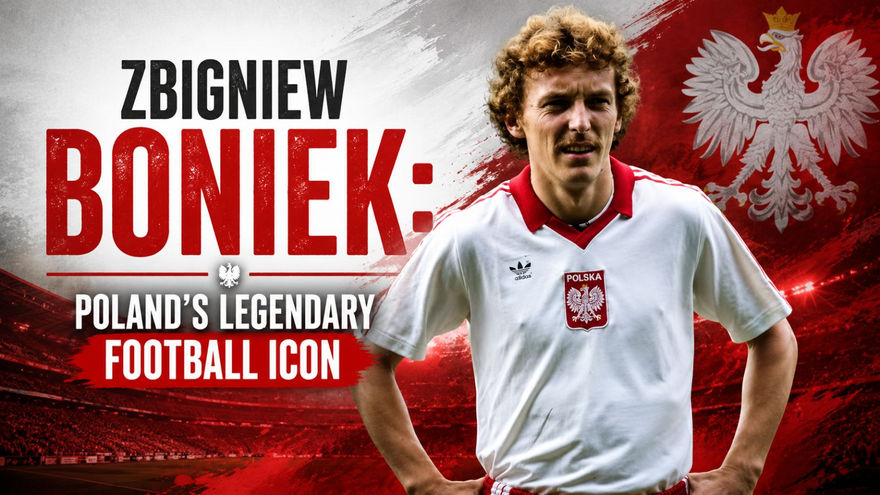
For the modern football fan, no football would come close to Robert Lewandowski as the greatest player to have come from Poland. However, hardcore fans with extensive knowledge of the game might have a certain different name in their minds for that title. The player is Zbigniew Boniek, who is widely considered by many to be the greatest Polish player ever.
The former Polish star is one of the most versatile players in football history. Despite being primarily played as a midfielder, Boniek was capable of playing as a forward as well. His favorite position was a free role, which allowed him to operate between the lines with no restrictions.
Boniek's immense versatility saw him play in different positions over the years, which ranged from attacking midfielder, right winger, central midfielder, or even a centre-forward. The latter years of his career even saw him play in a defensive role as a sweeper to make up for his lost pace.
In addition to his ability to play in different positions, Boniek's elite dribbling skills and finishing ability made him stand out. The former Polish legend's extroverted personality and his trademark moustache also made him one of the most highly recognized players at the time.
Let us now look back at his magical career.
Club career
The first decade of Zbigniew Boniek was mainly based in Poland. He began his career with Polish club Zawisza Bydgoszcz, which was followed by a move to another Polish club known as Widzew Łódź. Boniek spent 7 years at Widzew Łódź, and scored a decent 50 goals in 172 appearances.
His excellent performances in Poland sparked transfer interest from top European sides, and this led to Juventus signing the player in 1982. Boniek won the Coppa Italia in his debut campaign, in what was a promising campaign that saw the Bianconeri achieve a second-place finish in the league and reach the 1983 European Cup Final.
It was in the next season however, where Boniek proved vital to helping Juventus achieve glory. The Old Lady won both the Serie A title and the Cup Winners' Cup in 1984, with Boniek scoring the matching-winning goal in the 2–1 victory over Porto in the European final. This was followed by Juve clinching the European Super Cup later that year.
While most would guess the golden era was. Over for Boniek and Juventus, they went on to achieve even bigger things. The year of 1985 saw them win the ultimate prize in club football, as Juventus became the Champions of Europe. Boniek was instrumental yet again, as he won the penalty that Michel Platini subsequently converted to win the match.
Boniek spent the final years of his football career at Roma, where he won his second Coppa Italia in 1986. The Polish star eventually ended his professional career with the club in 1988.
International career
It was during the 1978 World Cup that Boniek brought himself to the limelight of the football world. Although the Polish star initially only appeared as a substitute in Poland's two opening group matches at the 1978 FIFA World Cup, his brace against Mexico in the final group stage match brought him huge attention. Despite his heroics, Poland finished third in their group and were eliminated from the tournament.
The 1982 World Cup was the peak of his success with Poland, as he starred in the Polish team that won a bronze medal at the 1982 FIFA World Cup. Boniek was instrumental in helping Poland reach the semi-finals, scoring 4 goals in the process. Unfortunately for Poland, Boniek got suspended after being booked in the 88th minute of a 0–0 draw against the Soviet Union.
This led to his absence for the semi-final against Italy, and Polan couldn't overcome their strong rival without their star man. Despite the heartbreak, his performances saw him named in the team of the tournament.
The 1986 FIFA World Cup was less successful, and was his final major tournament for Poland. Boniek left the national side after earning 80 caps with his country, and to this date is widely seen by many to be the greatest footballer to come from Poland.