

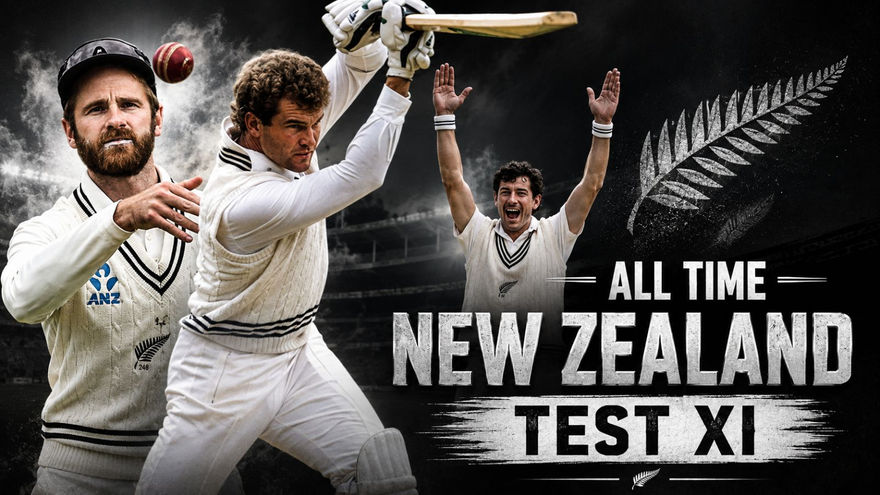
New Zealand’s Test cricket story is built on grit, discipline, and a habit of punching above its weight. Despite a smaller player pool and fewer resources than many major cricket nations, the Blackcaps have stayed competitive for decades and reached the top of the red-ball game by winning the inaugural 2021 ICC World Test Championship.
This All Time New Zealand Test XI is designed to reflect that legacy. The selection balances technique, endurance, bowling variety, and pressure-handling ability to create a side that can survive the new ball, bat long enough to control sessions, and take 20 wickets in any conditions.
The Openers
A Test opening pair must protect the innings from the new ball and build a platform for the middle order. Glenn Turner and Tom Latham offer exactly that blend of patience, technique, and resilience.
Player | Role | Batting Style |
Glenn Turner | Technical anchor | Right-handed |
Tom Latham | Modern powerplay protector | Left-handed |
Glenn Turner
Glenn Turner remains one of the most technically gifted openers New Zealand has produced. He played in an era without modern protective gear, so his success was built on patience, sound judgment outside off stump, and excellent wristwork.
In 41 Test matches, Turner scored 2,991 runs at an average of 44.64, including seven centuries. His 259 against the West Indies is a reminder of how long he could stay at the crease against high-quality pace.
Pros: exceptional patience, strong defense against fast bowling, and a high average of 44.64.
Cons: played fewer Tests because of overseas county commitments.
Tactical value: shields the middle order from the new ball and wears down seamers.
Tom Latham
Tom Latham gives this XI a left-handed counterweight at the top of the order. He is New Zealand’s most successful modern Test opener and has scored more than 5,000 Test runs with 13 centuries.
Latham is especially effective in home conditions, where he handles the movement of the red ball well, and he has also shown solid footwork against spin in Asia. His ability to bat through long sessions makes him a natural fit in Test cricket.
Pros: strong home and away record, reliable against spin, and a good conversion rate.
Cons: can be vulnerable to inswing early in his innings.
Tactical value: changes the angle for bowlers and adds another senior leadership presence.
The Middle Order
A great Test middle order has to do two things well: absorb pressure after early wickets and convert starts into commanding totals. Kane Williamson, Martin Crowe, and Ross Taylor bring the right mix of class, discipline, and scoring power.
Player | Role | Batting Style |
Anchor and captain | Right-handed | |
Visionary stroke maker | Right-handed | |
Dynamic counter-attacker | Right-handed |
Kane Williamson
Kane Williamson is widely regarded as New Zealand’s greatest Test batter. He has scored 32-plus Test centuries and averages more than 54.00 across over 100 Tests, which places him among the finest red-ball batters of his era.
He also led New Zealand to victory in the 2021 World Test Championship final against India. At No. 3, Williamson gives this XI calm authority, elite technique, and the ability to rebuild or accelerate as conditions demand.
Pros: outstanding average, elite conversion rate, and composed captaincy.
Cons: none of note; he is the complete Test batter.
Tactical value: anchors the innings, absorbs pressure, and leads the side.
Martin Crowe
The late Martin Crowe was one of New Zealand cricket’s most gifted batters. He scored 5,444 Test runs at an average of 45.36 and made 17 centuries while facing some of the toughest fast-bowling attacks in the game.
Crowe’s 299 against Sri Lanka at the Basin Reserve remained New Zealand’s highest individual Test score for more than 20 years. Beyond the numbers, his technical awareness and tactical intelligence make him a major asset in the middle order.
Pros: excellent technique, strong against pace, and a sharp cricketing mind.
Cons: knee injuries limited his career.
Tactical value: controls the innings through the middle sessions and handles spin with authority.
Ross Taylor
Ross Taylor adds power, experience, and big-match temperament at No. 5. He scored 7,683 Test runs and 19 centuries in 112 matches, placing him among New Zealand’s leading red-ball run-scorers.
His 290 against Australia in Perth showed that he could dominate elite pace even on difficult wickets. Taylor also brought value as a slip fielder and had the ability to change momentum with aggressive scoring against spin.
Pros: proven match-winner, huge run tally, and elite slip fielding.
Cons: sometimes needed time against quality spin early in his innings.
Tactical value: stabilizes the middle order and shifts the scoring rate when needed.
The All-Rounder and Wicketkeeper
A strong Test XI needs one player who can extend the batting and another who can hold the innings together from behind the stumps. Chris Cairns and BJ Watling fill those roles perfectly.
Player | Primary Role | Key Asset |
Seam-bowling all-rounder | Dynamic hitting and pace | |
BJ Watling | Specialist wicketkeeper-batter | Crisis resistance |
Chris Cairns
Chris Cairns is New Zealand’s finest genuine pace-bowling all-rounder since Sir Richard Hadlee. In 62 Tests, he scored 3,320 runs, including five centuries, and took 218 wickets.
Cairns was a destructive lower-order batter who often rescued New Zealand from difficult positions. With the ball, his high-arm action generated seam movement and reverse swing, giving him genuine impact in difficult conditions.
Pros: dual-threat value, 140 km/h pace, and powerful lower-order batting.
Cons: injuries reduced his total Test appearances.
Tactical value: acts as a fifth bowler and strengthens the batting down to No. 6.
BJ Watling
BJ Watling is selected as the wicketkeeper-batter for his reliability, not flash. While Brendon McCullum brought more aggression, Watling offered world-class glovework, strong defensive batting, and exceptional patience under pressure.
He averaged 37.52 in Tests and scored eight centuries, mostly from the lower middle order. Watling became New Zealand’s crisis manager, especially in long rescue partnerships and high-pressure situations.
Pros: excellent keeping, strong temperament, and a Test batting average above 37.
Cons: slower scoring rate than attacking keeper-batters.
Tactical value: gives the lower order batting security and safe hands behind the stumps.
The Bowling Attack
New Zealand’s best Test side needs pace, swing, control, and spin. Sir Richard Hadlee, Daniel Vettori, Tim Southee, and Trent Boult give this team a complete red-ball attack across eras.
Player | Bowling Style | Specialty |
Right-arm fast | Seam and new ball | |
Left-arm orthodox spin | Accuracy and control | |
Right-arm fast-medium | Outswing and mileage | |
Left-arm fast-medium | Powerplay inswing |
Sir Richard Hadlee
Sir Richard Hadlee is widely regarded as New Zealand’s greatest cricketer. He was the first player in Test history to reach 400 wickets and finished with 431 wickets in 86 Tests at an average of 22.29.
Hadlee carried New Zealand’s attack for nearly two decades and took 36 five-wicket hauls. He also scored 3,124 Test runs, including two centuries, which adds real depth to the lower order.
Pros: extraordinary average, elite accuracy, and world-class match impact.
Cons: none.
Tactical value: leads the attack, takes early wickets, and contributes with the bat.
Daniel Vettori
Daniel Vettori gave New Zealand control for more than a decade and a half. He took 362 Test wickets in 112 matches and often restricted scoring through subtle changes in flight, pace, and angle.
He was also a genuine all-rounder, scoring 4,523 Test runs with six centuries. That makes him one of the most complete cricketers in New Zealand history.
Pros: elite control, huge wicket tally, and useful batting depth.
Cons: less effective on flat pitches with little turn.
Tactical value: holds one end, controls run rate, and supports the lower order.
Tim Southee
Tim Southee is New Zealand’s second-highest Test wicket-taker with 380-plus wickets in more than 100 matches. His ability to swing the ball away from right-handers has made him a consistent threat in all conditions.
Southee’s longevity and leadership were central to New Zealand’s rise to the top of Test cricket, including the WTC title run. He is also a valuable lower-order hitter, with more than 80 Test sixes.
Pros: excellent outswing, strong wicket tally, durability, and batting depth.
Cons: can become expensive once the ball loses shine on flat pitches.
Tactical value: shares the new ball with Hadlee and adds quick runs late.
Trent Boult
Trent Boult completes the pace attack with left-arm angle and new-ball strike power. He has taken 317 Test wickets in 78 matches at an average of 27.49.
His late inswing makes him dangerous from the first over, and his partnership with Southee became one of the most productive opening bowling combinations in modern Test cricket. Boult gives the XI immediate wicket-taking threat.
Pros: lethal left-arm inswing, strong average, and a high strike rate.
Cons: later in his career, he opted out of a central contract to play franchise cricket.
Tactical value: produces early breakthroughs and offers a different angle to the attack.
New Zealand Test XI at a Glance
No. | Player | Role | Career Highlight |
1 | Glenn Turner | Right-hand opener | 44.64 average |
2 | Tom Latham | Left-hand opener | 13 Test centuries |
3 | Kane Williamson | Anchor / captain | WTC-winning captain |
4 | Martin Crowe | Middle-order batter | 299 highest score |
5 | Ross Taylor | Middle-order batter | 7,683 Test runs |
6 | Chris Cairns | Pace all-rounder | 218 wickets and 3,320 runs |
7 | BJ Watling | Wicketkeeper-batter | 37.52 average and eight hundreds |
8 | Sir Richard Hadlee | Fast bowler / all-rounder | 431 wickets at 22.29 |
9 | Daniel Vettori | Left-arm orthodox spinner | 362 wickets and six hundreds |
10 | Tim Southee | Fast-medium bowler | 380-plus Test wickets |
11 | Trent Boult | Left-arm fast bowler | 317 wickets at 27.49 |
Notable Omissions
Any all-time New Zealand Test XI will leave out excellent players. The toughest omissions here are Brendon McCullum, Stephen Fleming, Neil Wagner, John Wright, and Bert Sutcliffe.
Brendon McCullum: scored 6,453 Test runs, including New Zealand’s first triple-century, 302 against India.
Stephen Fleming: New Zealand’s longest-serving Test captain, with 6,620 runs in 104 Tests.
Neil Wagner: took 260 Test wickets and was a key part of the WTC-winning era.
John Wright and Bert Sutcliffe: classic openers who scored heavily in tougher eras.
Why This Team Works
This XI has a clear red-ball structure. Turner and Latham can survive the new ball, Williamson provides control at No. 3, and Crowe and Taylor give the middle order quality and flexibility.
Watling and Cairns deepen the batting, while Hadlee, Boult, Southee, Vettori, and Cairns ensure the team has enough bowling options to take 20 wickets anywhere. It is a balanced Test side rather than a collection of isolated stars.
Conclusion
The All Time New Zealand Test XI reflects the best qualities of Blackcaps cricket: resilience, discipline, and the ability to win under pressure. It includes technical openers, a world-class middle order, a dependable wicketkeeper, and a bowling attack capable of working in any conditions.
With Hadlee, Vettori, Southee, and Boult leading the attack, and Williamson, Crowe, and Taylor anchoring the batting, this remains one of the strongest red-ball dream teams in New Zealand cricket history.
Also Read | Greatest New Zealand Cricketers of all time