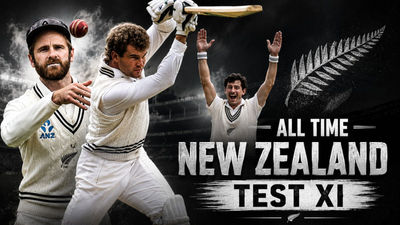


New Zealand has built one of the most respected records in One Day International cricket. Despite a smaller player pool than some major nations, the Blackcaps have reached two World Cup finals, won an ICC Champions Trophy, and produced several all-time greats.
This All Time New Zealand ODI XI is built around batting depth, tactical balance, strike bowling, and fielding quality. The aim is simple: select a side that can compete in any 50-over conditions while preserving the strongest possible mix of skill and temperament.
The Opening Pair
The top order must give New Zealand fast starts without losing structure. Martin Guptill and Nathan Astle provide exactly that mix: one is a modern powerplay destroyer, the other a technically sound opener who also adds a bowling option.
Player | Key Role | Batting Style |
Explosive boundary hitter | Right-handed | |
Technical starter and medium pace option | Right-handed |
Martin Guptill
Martin Guptill is one of the most feared ODI openers of the modern era. He scored 7,346 runs in 198 ODIs, placing him among New Zealand’s greatest one-day run-scorers.
His 237 not out against the West Indies in the 2015 World Cup quarter-final remains the highest individual score in New Zealand ODI history. Guptill’s clean power, especially through the off side and over the rope in the powerplay, makes him the ideal aggressor at the top.
Pros: elite boundary-hitting range, strong strike rate of 87.58, and excellent deep fielding.
Cons: can be vulnerable early against high-quality inswinging pace.
Tactical value: sets a rapid tempo in the first 10 overs and punishes powerplay bowling.
Nathan Astle
Nathan Astle was a dependable presence at the top of New Zealand’s order for more than a decade. He scored 7,090 runs in 223 matches and made 16 ODI centuries, the third-most in New Zealand history.
Astle also offered genuine value with the ball, taking 99 ODI wickets with his medium pace. That extra skill gives this XI another layer of flexibility, especially on seam-friendly surfaces.
Pros: dependable technique, 16 ODI hundreds, and useful medium pace.
Cons: strike rate of 72.64 is slower than modern opening standards.
Tactical value: stabilizes the innings and offers a sixth bowling option.
The Middle Order
A strong ODI middle order must absorb pressure, rotate strike, and accelerate when the innings demands it. Kane Williamson, Ross Taylor, and Martin Crowe give this side control, class, and tactical intelligence.
Player | Key Role | Batting Style |
Kane Williamson | Anchor and captain | Right-handed |
Ross Taylor | Middle-order engine | Right-handed |
Martin Crowe | Stabilizer and innovator | Right-handed |
Kane Williamson
Kane Williamson is the tactical anchor of this team and the natural captain. He has scored 7,235 ODI runs at an outstanding average of 49.21, which reflects both consistency and composure.
His standout 2019 World Cup campaign, which ended with Player of the Tournament honors, showed his value in the biggest games. Williamson’s ability to rotate strike against spin and manage tempo makes him a perfect No. 3.
Pros: elite average, low dot-ball rate, and calm leadership.
Cons: can slow down if boundary options are limited.
Tactical value: prevents collapses and builds partnerships through the middle overs.
Ross Taylor
Ross Taylor is New Zealand’s all-time leading ODI run-scorer with 8,607 runs in 236 matches. He also made 21 centuries, the most by any New Zealand batter in the format.
Taylor’s strength was his ability to control chases and rescue difficult innings. Over a long career, he became one of the most reliable middle-order players in world cricket.
Pros: New Zealand’s highest run-scorer and century-maker.
Cons: sometimes needed time to find rhythm, especially later in his career.
Tactical value: provides sustained scoring between overs 11 and 40.
Martin Crowe
Martin Crowe brought vision as well as runs. He scored 4,704 runs in 143 ODIs at an average of 38.55, but his impact went beyond numbers.
Crowe helped shape modern ODI thinking, especially during the 1992 World Cup, when he pushed tactical ideas that were ahead of their time. His elegance, intelligence, and adaptability make him a valuable glue player in this lineup.
Pros: sharp reader of the game, strong against pace and spin, and highly dependable under pressure.
Cons: chronic knee injuries limited his career.
Tactical value: connects the top order with the finishers and adds leadership depth as vice-captain.
Finishers and All-Rounders
This phase of the XI needs power, versatility, and insurance. Brendon McCullum and Chris Cairns bring exactly that: one is a fearless wicketkeeper-finisher, the other a rare seam-bowling all-rounder.
Player | Primary Skill | Secondary Skill |
Brendon McCullum | Wicketkeeper and explosive batter | Tactical innovator |
Chris Cairns | Pace-bowling all-rounder | Lower-order power |
Brendon McCullum
Brendon McCullum was a match-changer in every sense. He scored 6,083 ODI runs at a career strike rate of 96.37, one of the best figures in New Zealand’s ODI history.
He keeps wickets in this XI, which allows the batting order to stay aggressive without sacrificing balance. McCullum also captained New Zealand to their first World Cup final in 2015, underlining his value as both leader and finisher.
Pros: elite strike rate, athletic wicketkeeping, and fearless batting.
Cons: aggressive approach sometimes led to early dismissals.
Tactical value: finishes games late and adds dynamism behind the stumps.
Chris Cairns
Chris Cairns is one of New Zealand’s greatest ODI all-rounders. In 214 matches, he scored 4,881 runs and took 200 wickets, becoming one of only two New Zealanders to complete the 4,000-run and 200-wicket double.
His century against India in the 2000 ICC KnockOut Trophy final helped New Zealand win its first major ICC global title. Cairns offers both lower-order hitting and seam-bowling depth, making him indispensable in a balanced ODI side.
Pros: fast seam bowling, powerful hitting, and rare all-round output.
Cons: injury issues affected his career.
Tactical value: gives the team a reliable fifth bowler and late-innings power.
The Bowling Attack
New Zealand’s best ODI XI needs pace, swing, control, and spin. Sir Richard Hadlee, Daniel Vettori, Shane Bond, and Trent Boult provide that mix across different eras and conditions.
Player | Bowling Style | Specialty |
Right-arm fast | Control and movement | |
Left-arm orthodox spin | Miserly control | |
Right-arm express fast | Yorker and pace | |
Left-arm fast-medium | Powerplay inswing |
Sir Richard Hadlee
Sir Richard Hadlee is widely regarded as New Zealand’s greatest bowler. He took 158 wickets in 115 ODIs at an average of 21.56 and an economy rate of 3.30.
Hadlee combined relentless accuracy with movement off the pitch, which made him difficult to score against in any phase. He also contributed useful lower-order runs, adding value beyond his bowling.
Pros: world-class economy, superb average, and unmatched accuracy.
Cons: played in an era with fewer ODIs and different pitch conditions.
Tactical value: controls the powerplay and middle overs with precision.
Daniel Vettori
Daniel Vettori is New Zealand’s leading ODI wicket-taker with 297 wickets in 291 matches. His economy rate of 4.12 reflects the control he brought over nearly two decades.
Vettori also scored 2,201 ODI runs, giving this XI genuine lower-order depth. That batting contribution matters in a team already packed with specialists.
Pros: record wicket-taker for New Zealand and highly economical.
Cons: less effective on dead, flat pitches with little assistance.
Tactical value: ties down the middle overs and strengthens the tail.
Shane Bond
Shane Bond was one of the most dangerous fast bowlers of his generation. He took 147 wickets in just 82 ODIs, using pace above 150 km/h and late swing to overwhelm batters.
His strike rate of 29.2 and average of 20.88 are exceptional in 50-over cricket. Even though injuries shortened his career, Bond’s peak value was undeniable.
Pros: express pace, toe-crushing yorkers, and elite wicket-taking numbers.
Cons: recurring back injuries cut his career short.
Tactical value: the main strike bowler in the middle overs and at the death.
Trent Boult
Trent Boult is the modern master of powerplay swing. He has 211 wickets in 114 ODIs, with an average of 25.21 and an economy rate under 5.
His left-arm swing gives New Zealand an early wicket-taking threat, especially in opening spells. Boult was also the joint-leading wicket-taker at the 2015 World Cup, which shows how well he performs on the biggest stage.
Pros: elite powerplay swing, left-arm angle, and useful death bowling.
Cons: less dangerous when there is no seam or swing movement.
Tactical value: strikes early and remains dangerous late in the innings.
All Time New Zealand ODI XI at a Glance
No. | Player | Role | Key Asset |
1 | Martin Guptill | Right-hand opener | 237* and powerplay hitting |
2 | Nathan Astle | Opener / medium pace | 16 ODI centuries |
3 | Kane Williamson | Anchor / captain | 49.21 ODI average |
4 | Ross Taylor | Middle-order engine | 8,607 ODI runs |
5 | Martin Crowe | Middle-order batter | Tactical genius |
6 | Brendon McCullum | Keeper / finisher | 96.37 strike rate |
7 | Chris Cairns | Pace all-rounder | 200 wickets and 4,881 runs |
8 | Sir Richard Hadlee | Fast bowler / all-rounder | 3.30 economy rate |
9 | Daniel Vettori | Left-arm spinner | 297 ODI wickets |
10 | Shane Bond | Express fast bowler | 20.88 bowling average |
11 | Trent Boult | Left-arm fast bowler | 211 ODI wickets |
Notable Omissions
A team this strong inevitably leaves out great players. The hardest omissions include Stephen Fleming, Chris Harris, Kyle Mills, and Jacob Oram.
Stephen Fleming: New Zealand’s iconic captain scored 8,007 ODI runs in 279 matches. He narrowly misses out to Nathan Astle, who offered more centuries and an extra bowling option.
Chris Harris: A reliable all-rounder who scored 4,379 runs and took 203 ODI wickets.
Kyle Mills: New Zealand’s second-highest ODI wicket-taker with 240 wickets at an economy of 4.72.
Jacob Oram: A strong all-rounder with 173 wickets and 2,434 runs in 160 ODIs.
Why This XI Works
This side is built for modern ODI demands. Guptill and Astle attack early, Williamson and Taylor hold the innings together, Crowe adds tactical depth, and McCullum and Cairns give the lower order real power.
\
The bowling unit is equally balanced. Hadlee and Boult offer movement with the new ball, Bond brings pace and strike power, Vettori controls the middle overs, and Cairns plus Astle create a practical six-bowler safety net.
Conclusion
The All Time New Zealand ODI XI combines explosive openers, high-class middle-order batters, powerful finishers, and a world-class bowling attack. It has enough balance to handle both high-scoring surfaces and more demanding conditions.
With Guptill and Astle at the top, Williamson, Taylor, and Crowe providing control, and Hadlee, Vettori, Bond, and Boult leading the attack, this Blackcaps dream team stands among the strongest ODI XIs possible.