

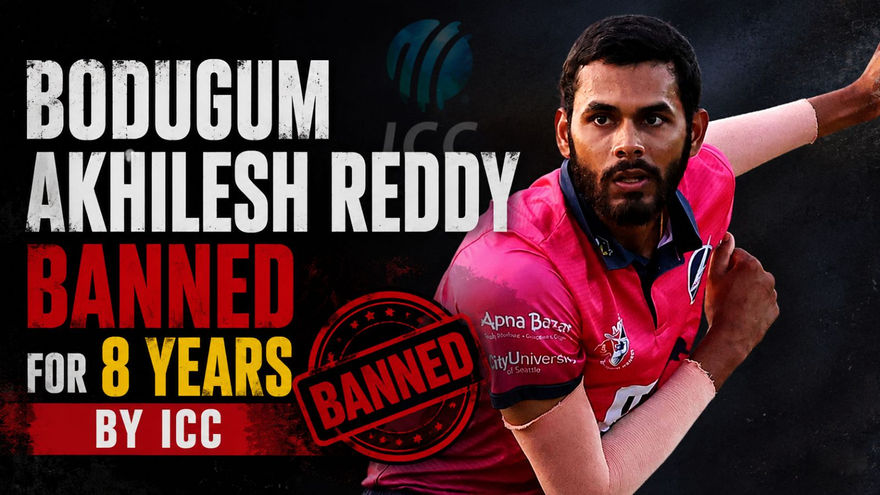
United States international cricketer Bodugum Akhilesh Reddy has been banned from all cricket for eight years after an independent ICC Anti-Corruption Tribunal found him guilty of multiple breaches of the sport's anti-corruption regulations.
The punishment follows an investigation into alleged corruption during the 2025 Abu Dhabi T10 League, where the International Cricket Council (ICC) served as the Designated Anti-Corruption Official (DACO) on behalf of the Emirates Cricket Board (ECB).
Reddy's suspension has been backdated to November 21, 2025, when he was provisionally suspended, meaning he will remain ineligible to participate in any cricket-related activity until November 20, 2033.
ICC Tribunal Finds Reddy Guilty of Three Anti-Corruption Code Breaches
Following a detailed investigation and disciplinary hearing, the independent three-member tribunal found the 26-year-old guilty of violating three key provisions of the ICC Anti-Corruption Code.
The charges include:
Article 2.1.1: Attempting to fix, influence, or manipulate the outcome, progress, or conduct of matches during the 2025 Abu Dhabi T10 League.
Article 2.1.4: Soliciting or encouraging another participant to engage in match-fixing activities.
Article 2.4.7: Obstructing the ICC's investigation by deliberately deleting data and messages from a mobile phone relevant to the inquiry.
The tribunal imposed two concurrent seven-year bans for the attempted match-fixing and solicitation offences. An additional one-year suspension was added consecutively for tampering with evidence, resulting in a total eight-year ban.
How the Match-Fixing Attempt Came to Light
According to documents released by the ICC, the incident occurred on November 19, 2025, ahead of an Abu Dhabi T10 League fixture involving Reddy's franchise, the Aspin Stallions.
Tribunal findings revealed that Reddy invited a teammate, identified as "Player A," to his hotel room before the match. During the meeting, he allegedly asked the player to deliberately concede runs while bowling, claiming the instruction had come from members of the team management.
Player A rejected the proposal, left the room, and reported the approach to both his agent and the ICC Anti-Corruption Unit (ACU) within an hour.
The prompt reporting of the incident became a crucial piece of evidence during the investigation.
Investigation Revealed Deleted WhatsApp Messages
Investigators also discovered that after becoming aware of the anti-corruption investigation, Reddy manually deleted his WhatsApp chat history and call logs involving Player A.
Reddy argued that the deletion was part of routine phone maintenance. However, the tribunal rejected that explanation, noting that his WhatsApp account was already configured to automatically delete messages after 24 hours, making his defense inconsistent with the available evidence.
The tribunal concluded that the deletion was an intentional attempt to obstruct the investigation.
Timeline of the Case
Date | Event |
November 19, 2025 | Reddy allegedly approached "Player A" before an Abu Dhabi T10 match. |
November 19, 2025 | Player A refused the proposal and informed the ICC Anti-Corruption Unit. |
November 21, 2025 | ICC provisionally suspended Reddy. |
August 3, 2026 | Independent ICC Tribunal imposed an eight-year ban. |
Breakdown of ICC Sanctions
Violation | ICC Code | Suspension |
Attempted match manipulation | Article 2.1.1 | 7 years (concurrent) |
Soliciting another player to participate | Article 2.1.4 | 7 years (concurrent) |
Obstructing investigation by deleting evidence | Article 2.4.7 | 1 year (consecutive) |
Total Ban | — | 8 years (until November 20, 2033) |
Impact on USA Cricket
Reddy, who is of Indian origin, made his international debut for the United States in 2025 and represented the national team in four T20 Internationals.
The eight-year suspension is among the most significant corruption-related punishments handed to an Associate Nation player in recent years. The ruling also comes at an important time for USA Cricket, which has been working to strengthen its international reputation following recent appearances on the global stage.
The case highlights the ICC's continued focus on safeguarding the integrity of cricket and reinforcing strict anti-corruption standards across all levels of the game.
ICC Reaffirms Zero-Tolerance Policy
In its official statement, the ICC emphasized that offences involving attempted match-fixing and encouraging teammates to participate in corrupt activities rank among the most serious violations under the Anti-Corruption Code.
The governing body also praised the prompt reporting of the incident and reiterated its commitment to protecting whistleblowers while maintaining the integrity of cricket worldwide.