
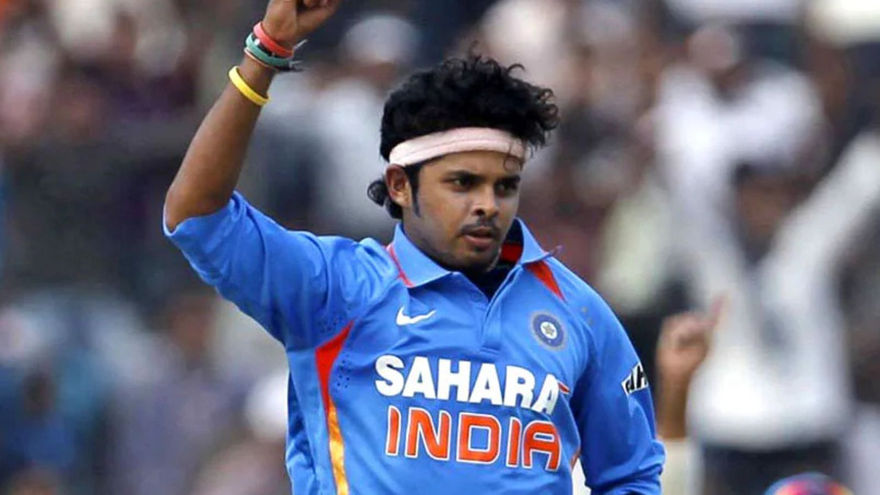
In the dramatic history of Indian cricket, few players have experienced the highs and lows that defined the career of S. Sreesanth. Gifted with exceptional swing bowling and remembered for his fiery personality, the Kerala pacer was one of the most unpredictable yet talented cricketers of his era.
From taking the winning catch in the 2007 ICC T20 World Cup final to being arrested during the infamous 2013 IPL spot-fixing scandal, Sreesanth’s journey became one of Indian cricket’s most debated stories. While public opinion quickly labeled him guilty, the legal reality behind the controversy was far more complicated.
This is the untold story of Sreesanth’s fall, exploring his rise, the IPL scandal, the court verdict, and the lasting impact on his cricket career.
The Rise of Sreesanth: India’s Aggressive Swing Specialist
Before controversy overshadowed his career, Sreesanth was considered one of India’s most naturally gifted fast bowlers. He made his international debut in 2005 against Sri Lanka and immediately stood out for his aggression, confidence, and ability to move the ball both ways.
Cricket experts frequently praised his upright seam position, calling it one of the best in world cricket during that period. Unlike defensive bowlers focused purely on economy rates, Sreesanth was an attacking wicket-taker who thrived under pressure.
Sreesanth Career Stats and Major Achievements
Format | Matches | Wickets | Best Bowling | Major Achievement |
Test Cricket | 27 | 87 | 5/40 | Key performer in India’s historic 2006 Test win in South Africa |
ODI Cricket | 53 | 75 | 6/55 | Member of India’s 2011 ODI World Cup-winning squad |
T20I Cricket | 10 | 7 | 2/12 | Took the winning catch in the 2007 T20 World Cup final |
One of the defining moments of his career came during India’s historic Test victory at Johannesburg in 2006, where he dismantled South Africa with a sensational 5/40 spell.
Fans also remember his famous on-field clash with Andre Nel, where Sreesanth responded to aggressive sledging by smashing the South African fast bowler for a memorable straight six.
Despite his emotional personality and inconsistency, Sreesanth remained part of two World Cup-winning Indian squads — a rare achievement in Indian cricket history.
Check Here: Best Bowling Performances by Sreesanth
The IPL Spot-Fixing Scandal That Changed Everything
The turning point of Sreesanth’s life came during the 2013 Indian Premier League season while playing for the Rajasthan Royals under captain Rahul Dravid.
On May 16, 2013, Delhi Police arrested Sreesanth along with teammates Ankeet Chavan and Ajit Chandila over allegations of IPL spot-fixing connected to illegal bookmakers.
The accusations shocked Indian cricket and dominated headlines across the country.
The Allegations Against Sreesanth
According to investigators, Sreesanth allegedly agreed to concede a specific number of runs during a match against Kings XI Punjab in exchange for money.
The police claimed:
He used a white towel tucked into his waistband as a secret signal to bookmakers.
He allegedly agreed to give away 14 or more runs in an over.
He intentionally delayed the start of the over to allow betting syndicates enough time to place bets.
The controversy immediately damaged his reputation, and public opinion largely turned against him before the case even reached court.
Why the Case Against Sreesanth Became Weak
As the legal proceedings progressed, several inconsistencies in the prosecution’s argument began to emerge.
The “14 Runs” Problem
Investigators alleged that Sreesanth agreed to concede at least 14 runs in the over. However, the actual over produced only 13 runs.
The prosecution argued that Sreesanth tried to bowl a deliberate no-ball on the final delivery to complete the arrangement, but the umpire failed to call it.
The defense countered this by arguing that a professional international bowler intentionally fixing an over would not bowl multiple competitive deliveries before suddenly attempting a suspicious no-ball at the end.
This became one of the major weaknesses in the case.
The Financial Logic Never Made Sense
One of the biggest unanswered questions surrounding the scandal was financial motive.
At the time, Sreesanth was:
A World Cup-winning Indian cricketer
A high-profile IPL player
Earning crores through contracts and endorsements
Investigators claimed he risked his entire cricket career and public image for approximately ₹10 lakh.
For many analysts and former players, the alleged amount seemed disproportionately small compared to what Sreesanth was already earning as an international cricketer.
Court Verdict: Sreesanth Was Cleared
In July 2015, the Patiala House Court in Delhi discharged Sreesanth, Ankeet Chavan, and Ajit Chandila from all criminal charges.
The court ruled that:
There was insufficient evidence to prosecute the players.
Investigators failed to prove deliberate manipulation of play.
Charges under the Maharashtra Control of Organised Crime Act (MCOCA) could not be sustained.
Legally, Sreesanth was no longer guilty of criminal conspiracy or spot-fixing.
However, the battle was far from over.
Why the BCCI Still Punished Sreesanth
Even after the court verdict, the Board of Control for Cricket in India refused to immediately revoke his punishment.
The BCCI operates under its own anti-corruption code, where the standard of proof is lower than criminal law. Instead of proving guilt “beyond reasonable doubt,” disciplinary decisions rely on “preponderance of probability.”
As a result, Sreesanth remained banned from cricket despite being cleared in court.
The lifetime ban effectively isolated him from Indian cricket for years.
Sreesanth’s Life After Cricket Ban
During his suspension, Sreesanth transitioned into entertainment and reality television.
He appeared in:
Bigg Boss
Khatron Ke Khiladi
Multiple Malayalam, Hindi, and Kannada films
Despite exploring acting and television, Sreesanth consistently expressed his desire to return to professional cricket.
Supreme Court Relief and Cricket Comeback
In 2019, the Supreme Court of India set aside the BCCI’s lifetime ban and asked the board to reconsider the punishment.
The ban was later reduced to seven years, officially ending in September 2020.
Sreesanth returned to domestic cricket for Kerala and participated in tournaments like:
Syed Mushtaq Ali Trophy
Vijay Hazare Trophy
Although he briefly attempted a professional comeback, age and years away from competitive cricket limited his chances of returning to the IPL or Indian national team.
He officially retired from domestic cricket in 2022 but continued playing in veteran T20 competitions like Legends League Cricket.
The Legacy of Sreesanth: Genius, Chaos, and Tragedy
The story of Sreesanth remains one of the most controversial chapters in Indian cricket history.
To some fans, he symbolizes wasted talent and emotional self-destruction. To others, he represents a player whose reputation was permanently damaged despite never being criminally convicted.
What makes the story truly tragic is that Sreesanth was not an ordinary cricketer. He was a match-winner capable of producing brilliance on the biggest stages.
His rise and fall continue to serve as a cautionary tale about fame, pressure, media trials, and the unforgiving nature of modern sport.
Even today, the image of the white towel remains one of the most debated symbols in IPL history — a reminder that in cricket, perception can sometimes become stronger than proof.