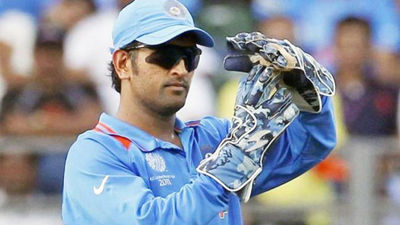

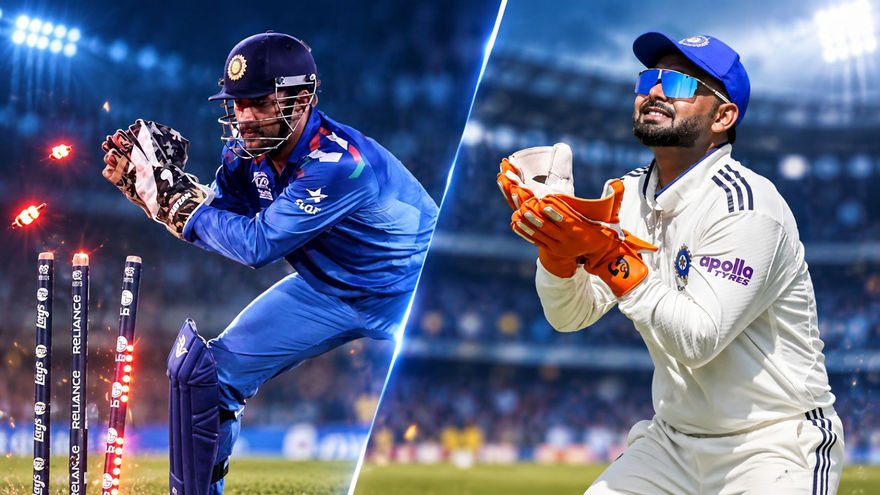
Replacing an established great is one of the toughest challenges in sport. When MS Dhoni retired from Test cricket in 2014 and ended his international career in 2020, India had to find a wicket-keeper batter capable of succeeding one of the most influential players of his generation.
Rishabh Pant eventually made the role his own. Instead of copying Dhoni, Pant developed a contrasting style built around aggressive batting, unconventional stroke play and counter-attacking performances, particularly in Test cricket.
The Rishabh Pant vs MS Dhoni comparison therefore goes beyond career runs. Dhoni built an extraordinary white-ball record and became renowned for his glovework, while Pant has produced some of the most significant overseas Test innings by an Indian wicket-keeper.
Here is how their batting records, wicket-keeping styles and roles compare.
Rishabh Pant vs MS Dhoni: Career Stats
Dhoni's international career is complete, while Pant's record remains active. That distinction is important when comparing their overall numbers.
Format | Player | Matches | Runs | Average | Strike Rate | 100s |
Tests | MS Dhoni | 90 | 4,876 | 38.09 | 59.11 | 6 |
Rishabh Pant | 50 | 3,557 | 43.38 | 74.06 | 8 | |
ODIs | MS Dhoni | 350 | 10,773 | 50.57 | 87.56 | 10 |
Rishabh Pant | 31 | 871 | 33.50 | 106.22 | 1 | |
T20Is | MS Dhoni | 98 | 1,617 | 37.60 | 126.13 | 0 |
Rishabh Pant | 76 | 1,209 | 23.25 | 127.26 | 0 |
Pant's statistics are active and can change as he plays further international cricket.
The numbers immediately reveal the central difference. Pant has stronger Test batting numbers at this stage of his career, while Dhoni holds a substantial advantage in ODIs and has a far larger completed white-ball body of work.
Test Cricket: Pant's Biggest Strength
Test cricket provides the strongest statistical case for Pant.
Dhoni was a valuable lower-order batter who scored 4,876 Test runs at 38.09, including six centuries. His highest score of 224 came against Australia in Chennai.
Pant reached eight Test hundreds within his first 50 matches while averaging above 43 and scoring at a strike rate above 74.
The location of those centuries also matters.
Pant's Overseas Test Impact
Pant became the first Indian wicket-keeper to score a Test century in England when he made 114 at The Oval in 2018. A few months later, his unbeaten 159 in Sydney made him the first Indian wicket-keeper to score a Test hundred in Australia.
He later added a Test century in South Africa.
Dhoni, despite playing 90 Tests, did not score a Test century outside Asia. His overseas record still included important innings, but Pant has produced more hundreds in traditionally difficult conditions for Indian batters.
The Gabba 89*
Pant's unbeaten 89 against Australia at the Gabba in January 2021 remains one of the defining innings of his Test career.
India successfully chased 328 on the final day and ended Australia's long unbeaten Test run at the Brisbane venue. Pant's willingness to attack while managing the chase illustrated why his Test role differs from Dhoni's.
Dhoni often provided stability from the lower middle order. Pant is more frequently used as a counter-attacker capable of changing the tempo of a Test within a session.
ODI Comparison: Dhoni Holds the Clear Statistical Advantage
The comparison changes dramatically in ODI cricket.
Dhoni finished his career with 10,773 ODI runs at an average of 50.57, including 10 centuries and 73 fifties. Maintaining an average above 50 across 350 matches is especially notable because he spent much of his career batting in the middle and lower-middle order.
His role often required him to rebuild an innings before accelerating late.
Pant has shown greater scoring speed, with an ODI strike rate above 106, but his record is based on a much smaller sample. Through 31 ODIs, he had 871 runs at 33.50, including one century.
That makes the contrast straightforward:
Dhoni: greater longevity, consistency and proven finishing output.
Pant: faster scoring rate and a more naturally aggressive approach.
Context: Pant's ODI career is still active, so comparing final career totals would be misleading.
T20I Comparison
Their T20I strike rates are surprisingly close.
Dhoni scored 1,617 runs at a strike rate of 126.13, while Pant's first 76 T20Is produced 1,209 runs at 127.26. Pant's average of 23.25, however, remains below Dhoni's 37.60.
Neither player scored a T20I century.
The numbers again reflect different roles. Dhoni frequently batted as a finisher, while Pant has been used at several positions depending on India's combination and match situation.
MS Dhoni vs Rishabh Pant as Wicket-Keepers
Batting statistics tell only half the story. Their approaches behind the stumps are also noticeably different.
MS Dhoni: Minimal Movement and Fast Hands
Dhoni developed an unconventional but highly effective wicket-keeping method.
Rather than always following textbook technique, he relied on anticipation, economical hand movement and exceptional speed when breaking the stumps. He finished his international career with 195 stumpings, including 123 in ODIs.
His career international wicket-keeping record included:
Tests: 256 catches and 38 stumpings
ODIs: 321 catches and 123 stumpings
T20Is: 57 catches and 34 stumpings
Total: 829 dismissals, including 195 stumpings
Dhoni's stumping of Keemo Paul against West Indies in 2018 is widely quoted as taking 0.08 seconds. However, that figure should not be presented as an official world record. Cricket's governing bodies do not maintain an officially standardized database of stumping reaction times, and the figure comes from broadcast timing.
Rishabh Pant: Athleticism and Reach
Pant's keeping relies more visibly on athletic movement.
His ability to move laterally and take catches away from his body is particularly valuable when standing back to fast bowlers on pitches offering bounce and seam movement.
His keeping to spin has also developed significantly since the early stages of his international career. That development matters in India, where wicket-keepers frequently have to manage sharp turn, uneven bounce and close-in stumping opportunities.
Frequently Asked Questions
Who has more Test centuries, Rishabh Pant or MS Dhoni?
Rishabh Pant has eight Test centuries, compared with MS Dhoni's six. Pant reached eight hundreds within his first 50 Tests.
Who has the higher Test batting average?
Pant has the higher average. Through 50 Tests, he averaged 43.38, while Dhoni finished his Test career at 38.09.
Who has the stronger ODI record?
Dhoni has the substantially larger completed ODI record, with 10,773 runs at 50.57 across 350 matches. Pant's ODI career remains active and is based on far fewer matches.
Did MS Dhoni officially record a 0.08-second stumping?
The figure is widely associated with his 2018 stumping of Keemo Paul, but it is a broadcast timing rather than an officially ratified ICC world record.
How do Pant and Dhoni compare in the IPL?
Dhoni built a long IPL career primarily as a middle-order batter and finisher for Chennai Super Kings. Pant has generally scored faster and has produced two IPL centuries, including his famous unbeaten 128 against Sunrisers Hyderabad in 2018.
Conclusion
The Rishabh Pant vs MS Dhoni comparison is best understood through their different roles and career stages.
Dhoni's completed record is distinguished by extraordinary ODI longevity, middle-order finishing and prolific wicket-keeping numbers. Pant's strongest case comes in Test cricket, where his higher average, faster scoring rate and overseas centuries have already created a distinctive record.
Rather than treating Pant as a direct replacement for Dhoni, their careers show two different ways a wicket-keeper batter can influence a cricket match. Dhoni established the benchmark for India's modern white-ball wicket-keeper batter; Pant has expanded the attacking possibilities of the role in Test cricket.
Also Read |