
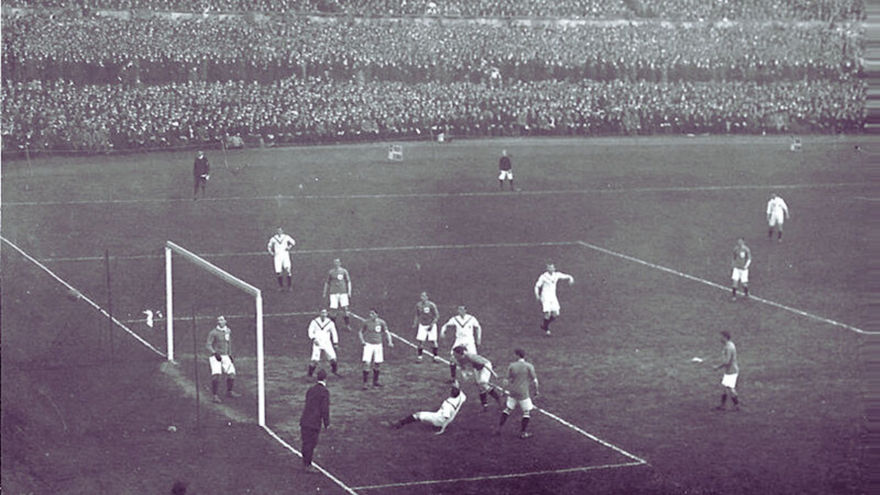
It was the April 2nd of 1915, on the occasion of Good Friday that English football had one of its darkest days in early history. The incident occurred during a Football League First Division match between Manchester United and Liverpool at Old Trafford. It later turned out that the match was fixed in United's favour, with players from both sides benefiting from bets placed upon the result. A total of seven players were involved in the infamous scheme.
Let us now unravel how the scandal occurred, and its aftermath.
The match
This was a time when Manchester United were struggling to avoid relegation, while Liverpool were languishing mid-table without challenging for any major honours. In addition to this, the aftereffects of World War I gave further motivation for the said players to commit the illegal act.
Due to the war situation, it was certain that the league would suspend operations after the 1914–15 finishes by March end. The devastating scenario would interrupt and possibly end the footballing careers of everyone playing in the league back then. Players were also of the opinion that the intense situation at the time would make people less attentive to the match.
The match ended in a 2-0 win for Manchester United, with George Anderson scoring a brace. However, certain incidents caught the attention of both the referee and spectators. Liverpool's surprising lack of commitment in the game was especially seen as suspicious, including the way in which they missed a penalty.
An incident where Liverpool star Fred Pagnam hit the Manchester United crossbar late in the match, and his teammates publicly arguing with him was seen as quite shocking as well.
A shocking aftermath
The appearance of certain handbills became the catalyst that exposed the scandal, as it alleged that a large amount of money had been bet at odds of 7/1 on a 2–0 win to United. This led the The Football Association to launch an investigation, which ended with shocking revelations.
Following players from both sides were involved in rigging the match: Sandy Turnbull, Arthur Whalley and Enoch West of United, and Jackie Sheldon, Tom Miller, Bob Pursell and Thomas Fairfoul of Liverpool.
Jackie Sheldon was believed to be the mastermind behind the plot, and was ironically an ex-United player as well. Certain players had refused to take part in the illegal affair, which included Fred Pagnam. This explained the player's late shot against the crossbar.
All seven players were given a lifetime ban from playing for life in an official decision that was made on 27th December 1915. The most ironic part of the ban was that it had no immediate effect on the career of players, as football was suspended due to the war.
Sandy Turnbull died while serving in the war, but all the other players except West had their bans lifted by the FA in 1919. The ban was lifted for their services to the country, with Turnbull receiving a posthumous reinstatement.
Due to war, the football League did not resume until the 1919–20 season. Other than West ( who was still banned) and Fairfoul who did not return to football, the other four players resumed their careers after the war. West only had his ban lifted in 1945, who by then was 45.
Effect on succeeding season
The scandal resulted in United finishing the previous season in 18th, which saved them from relegation. This led to Chelsea dropping to 19th and being relegated. However, the League decided to expand the First Division by two teams before the 1919–20 season. Thus, Chelsea and Arsenal reclaimed their place in the First Division and survived relegation.
It was indeed an unforgettable moment in football history that resulted in drastic consequences both on and off the field.
Also Read |