

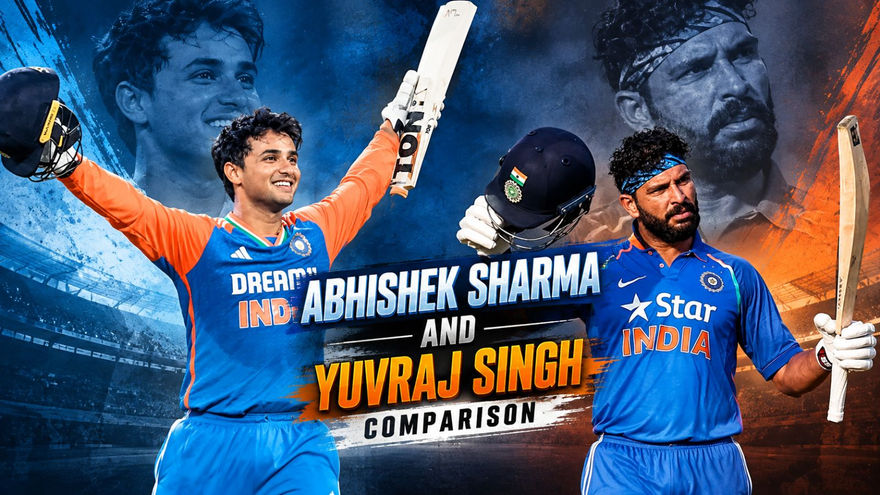
Few images in Indian cricket create as much nostalgia as a fluent left-hander launching spin over mid-wicket. For more than a decade, Yuvraj Singh made that style his trademark, combining power, timing and attacking strokeplay while playing a major role in India's two World Cup triumphs.
The rise of Punjab-born all-rounder Abhishek Sharma has naturally brought those memories back. Like Yuvraj, Abhishek is a left-handed batter from Punjab who bowls slow left-arm orthodox spin. Both are aggressive stroke-makers, comfortable against spin and capable of contributing with the ball.
The comparison, however, goes beyond playing style. Yuvraj has also played a direct mentoring role in Abhishek's development. At the same time, their roles are fundamentally different: Yuvraj built his reputation as a middle-order match-winner, while Abhishek has developed into an ultra-aggressive top-order batter in the T20 era.
So, is Abhishek Sharma the next Yuvraj Singh? The similarities are striking, but his career is taking shape around a very different version of limited-overs cricket.
Yuvraj Singh vs Abhishek Sharma: Quick Comparison
The basic profiles of the two Punjab left-handers explain why the comparison has become so prominent.
Career Attribute | Yuvraj Singh | Abhishek Sharma |
Origin | Punjab (Chandigarh) | Punjab (Amritsar) |
Batting Style | Left-handed middle-order batter | Left-handed top-order/opening batter |
Bowling Style | Slow left-arm orthodox | Slow left-arm orthodox |
U-19 World Cup | Star of 2000 tournament | Winner of 2018 tournament |
IPL Identity | Kings XI Punjab, SRH, RCB, MI | Sunrisers Hyderabad |
Mentorship | Trained under Yograj Singh | Mentored by Yuvraj Singh |
The similarities are clear, but their cricketing environments and responsibilities are not identical.
Yuvraj Singh's Influence on Abhishek Sharma
One of the strongest links between the two players is their mentorship relationship.
During the COVID-19 lockdown, Yuvraj Singh worked with a select group of young Punjab cricketers, including Abhishek Sharma and Shubman Gill, through specialized off-season training camps. The relationship gave Abhishek access to one of India's most experienced limited-overs players.
Yuvraj's influence has extended beyond technical batting advice. His guidance has focused on areas such as shot selection, handling high-velocity pace and developing the mental approach required for high-pressure matches.
That connection helps explain why comparisons between the two players are more meaningful than a simple visual resemblance. Abhishek has developed while receiving guidance from someone who experienced international cricket at the highest level.
The Yuvraj-Abhishek Development Timeline
2018: Abhishek Sharma wins the Under-19 World Cup under Rahul Dravid.
2020: Yuvraj Singh begins specialized off-season training camps involving young Punjab cricketers.
2022: Abhishek develops into a regular SRH opening option with Yuvraj's advice.
2024: He scores a 47-ball T20I century against Zimbabwe in his second international match.
2025-26: His aggressive Powerplay batting establishes him among the leading T20I strike-rate performers.
Abhishek Sharma vs Yuvraj Singh: Technical Differences
Both players rely on natural power and left-handed strokeplay, but their techniques are designed for different roles.
Technical Area | Yuvraj Singh | Abhishek Sharma |
Batting position | Primarily No. 4 or No. 5 | Primarily opener |
Backlift | High and flowing | Compact, quick-handed setup |
Power generation | Hip rotation and extended arc | Stable base and rapid hands |
Attacking areas | Down the ground, mid-wicket and against spin | Mid-wicket, cover and straight boundaries |
Tactical role | Middle-order enforcer | Powerplay aggressor |
Yuvraj's batting often involved building an innings before taking control during the middle and later stages. As a middle-order batter, he had to respond to different match situations, including recovering from early wickets.
Abhishek's role is more straightforward in T20 cricket: attack early. As an opener, he can take advantage of fielding restrictions and put pressure on bowlers before the field spreads.
That difference is central to understanding why Abhishek should not simply be viewed as a modern replica of Yuvraj.
How Their Power-Hitting Compares
Both left-handers have shown a particular ability to attack spin.
Yuvraj was renowned for getting down the pitch or onto one knee and using his reach to hit lofted drives and sweeps. His ability to clear the boundary against spin made him a dangerous middle-overs batter.
Abhishek uses a more contemporary T20 approach. His quick hands allow him to turn back-of-a-length deliveries into powerful pulls, while his ability to loft through or over the off side gives him another scoring option.
The result is a similar attacking intent expressed through different roles and technical methods.
Yuvraj and Abhishek as Left-Arm Spin Bowlers
Batting is the obvious area of comparison, but both players also offer slow left-arm orthodox spin.
Yuvraj's bowling became particularly valuable in India's limited-overs campaigns. At the 2011 ICC Cricket World Cup, he claimed 15 wickets and played a significant all-round role in India's title-winning campaign.
Abhishek's bowling has a different purpose. In T20 cricket, his left-arm spin provides captains with an additional matchup option, particularly when a lineup contains several right-handed batters. He can be used for economical overs in the Powerplay or middle overs depending on the match situation.
This dual-skill profile gives Abhishek an important similarity with Yuvraj, even though their bowling workloads and roles have differed.
T20 Impact: Yuvraj Singh vs Abhishek Sharma
The evolution of T20 cricket makes direct statistical comparisons difficult. Yuvraj played in an era when T20 batting generally placed less emphasis on sustained Powerplay aggression, while Abhishek has developed in a period where teams routinely attack from the first ball.
Performance Metric | Yuvraj Singh | Abhishek Sharma |
Primary Role | Middle-order batter/finisher | Opening batter/all-rounder |
Typical T20 Strike Rate Profile | Around 130–140 | Around 170–200+ |
Powerplay Approach | Consolidation followed by acceleration | Immediate boundary-hitting |
Spin Bowling Role | Middle-overs wicket-taking option | Tactical matchup option |
The numbers in this comparison should be viewed in the context of their respective eras and roles rather than as a direct measure of who was the better player.
Yuvraj's value came partly from his ability to change the course of an innings from the middle order. Abhishek's value comes from how quickly he can alter the game during the Powerplay.
Frequently Asked Questions
Is Abhishek Sharma related to Yuvraj Singh?
No. Abhishek Sharma and Yuvraj Singh are not blood relatives. Their connection comes through cricket, with Yuvraj serving as an important mentor in Abhishek's development.
Where is Abhishek Sharma from?
Abhishek Sharma was born in Amritsar, Punjab, and represents Punjab in domestic cricket competitions such as the Ranji Trophy and Syed Mushtaq Ali Trophy.
Which IPL team does Abhishek Sharma play for?
Abhishek Sharma plays for Sunrisers Hyderabad (SRH) in the Indian Premier League.
Does Abhishek Sharma bowl the same type of spin as Yuvraj Singh?
Yes. Both players bowl slow left-arm orthodox spin, giving their teams an additional bowling option alongside their batting.
What is Abhishek Sharma's highest T20I score?
Abhishek Sharma's career-high T20I score is 135 runs from 54 balls, scored against England at Wankhede Stadium in February 2025.
Is Abhishek Sharma the Next Yuvraj Singh?
The comparison makes sense, but the two careers should not be treated as identical.
Abhishek Sharma shares several defining characteristics with Yuvraj Singh: Punjab roots, left-handed power hitting, left-arm spin and an attacking approach against spin. His relationship with Yuvraj also gives the comparison a genuine mentorship dimension.
Yet Abhishek's cricket is built around the demands of modern T20 batting. He operates at the top of the order, attacks during the Powerplay and embraces a level of early-innings aggression that reflects the evolution of the format.
Yuvraj's legacy was built across Tests, ODIs, T20Is and two World Cup-winning campaigns. Abhishek is still developing his international career and therefore faces a very different task.
Rather than asking whether Abhishek can replace Yuvraj, it is more useful to see the comparison as a link between two generations of Punjab left-handers. Yuvraj established the template of the explosive Indian all-rounder. Abhishek has the opportunity to build his own identity within the faster, more aggressive T20 era.


