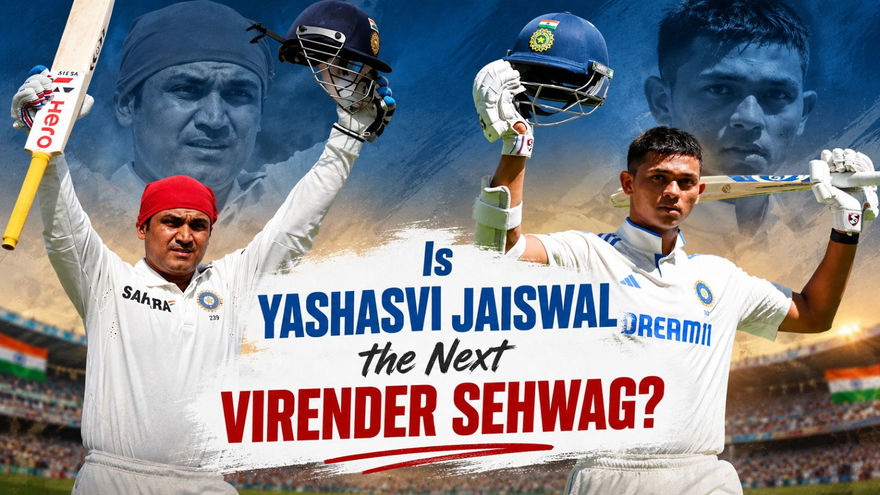
Virender Sehwag changed the way an opening batter could approach Test cricket. He attacked from the outset, trusted his hand-eye coordination, and regularly put bowlers under pressure before they could settle into a spell.
Yashasvi Jaiswal has brought a similar sense of aggression to the modern game. His double centuries against England and his willingness to attack in overseas conditions have naturally drawn comparisons with Sehwag.
But is Jaiswal really the next Virender Sehwag?
The similarities are obvious: both openers play with high intent, score quickly and can turn a Test session in their team's favor. Their techniques, however, are different. Sehwag relied on minimal footwork and exceptional timing, while Jaiswal combined a more conventional base with dynamic movement and modern stroke-making.
A closer comparison shows why Jaiswal is better viewed as his own kind of aggressive opener rather than a direct Sehwag replica.
Yashasvi Jaiswal vs Virender Sehwag: Key Differences
The simplest way to understand the comparison is to look at how each batter creates scoring opportunities.
Metric | Yashasvi Jaiswal (Early Career) | Virender Sehwag (Test Career) |
Batting stance | Left-handed | Right-handed |
Test matches | 31 | 104 |
Test runs | 2,612 | 8,586 |
Batting average | ~47.50 | 49.34 |
Test strike rate | ~66.50 | 82.23 |
Highest score | 214* | 319 |
Test double centuries | 2 | 6, including 2 triple centuries |
The numbers need context. Jaiswal's figures represent an early stage of his Test career, whereas Sehwag's figures cover his complete 104-match career.
The biggest statistical difference is strike rate. Sehwag finished with a remarkable Test strike rate of 82.23, while Jaiswal's early-career rate of around 66.50 reflects an aggressive approach without matching Sehwag's extraordinary scoring tempo.
How Virender Sehwag Built His Aggressive Batting Style
Sehwag's batting looked simple, but its effectiveness came from exceptional timing, balance and judgment.
He did not depend heavily on conventional footwork. Instead, he often stayed relatively still, watched the ball closely and used his hands to access his scoring areas.
Three characteristics defined his approach:
Exceptional hand-eye coordination: Sehwag could pick up length quickly and commit to attacking strokes.
Minimal foot movement: Rather than constantly moving down the pitch or deep into the crease, he created room for his hands to work.
Powerful off-side scoring: His square cut and upper cut were particularly effective when fast bowlers offered width.
This approach allowed Sehwag to attack without appearing to make major technical adjustments before every delivery. His intent itself became a tactical challenge for opposing bowlers.
He also produced huge Test scores. His six double centuries included two triple centuries, with a career-best 319.
How Yashasvi Jaiswal's Technique Differs
Jaiswal shares Sehwag's attacking instinct but uses a different technical framework.
As a left-handed opener, he combines a strong base with more active footwork. He can move down the pitch to attack spin, while also transferring his weight back to play short deliveries.
His batting is also more adaptable from situation to situation. Jaiswal can absorb an early period of movement before increasing the scoring rate once he becomes comfortable at the crease.
His scoring range is another important part of the comparison. Along with attacking strokes through the off side, he can target fine leg and mid-wicket and play lofted shots straight down the ground.
That gives him a broad scoring map without requiring him to copy Sehwag's method.
Key difference: Sehwag's aggression was built around unconventional movement, extraordinary hand-eye coordination and immediate pressure. Jaiswal combines high intent with a more structured technical base and the ability to adjust his approach.
Jaiswal and Sehwag's Approach to Big Scores
One of the strongest links between the two openers is their appetite for converting starts into major innings.
Jaiswal scored two Test double centuries early in his career against England. His highest Test score is 214*, achieved at Rajkot in February 2024.
Sehwag went considerably further over the course of his career. He recorded six Test double centuries and two triple centuries, including his career-best 319.
The comparison therefore works best when discussing their willingness to keep attacking after reaching three figures. Both have demonstrated that an aggressive opener does not necessarily have to slow down dramatically after reaching a century.
At the same time, Jaiswal's career is still developing. His early double centuries provide evidence of his ability to construct massive innings, but they cannot yet be used to predict whether he will reproduce Sehwag's long-term record.
Strengths and Limitations of Both Openers
Their similarities become clearer when their strengths and vulnerabilities are considered separately.
Virender Sehwag
Strengths
Put immediate psychological pressure on opening bowlers.
Could disrupt bowling plans before conditions became easier to exploit.
Produced exceptional high-impact innings, including two Test triple centuries.
Maintained an unusually high scoring rate for a Test batter.
Limitations
Moving balls in swing-friendly overseas conditions could expose technical vulnerabilities.
His high-risk attacking approach sometimes resulted in early dismissals.
Yashasvi Jaiswal
Strengths
Can move between defense and attack depending on the situation.
His left-handedness creates different angles for bowlers.
Uses decisive footwork against spin and short-pitched bowling.
Brings strong athleticism to running between the wickets and fielding.
Limitations
Aggressive short-pitched bowling can challenge him early in an innings.
During difficult spells, he can occasionally appear caught between defending and maintaining his attacking intent.
These differences matter because aggression alone does not define a batter. How that aggression is managed against different conditions, bowlers and match situations is equally important.
Sehwag's Fearless Mindset vs Jaiswal's Calculated Aggression
Sehwag's approach was built around freedom. He was known for not allowing milestones, pitch conditions or match situations to fundamentally change his attacking instincts.
That mindset could make field settings difficult to control. A bowler attempting to build pressure could see Sehwag attack a delivery that another batter might simply defend.
Jaiswal's approach is aggressive but more situational. His game allows him to absorb pressure when fast bowlers are getting assistance before increasing the tempo as conditions become more favorable.
This distinction explains why the two can look similar without being technically identical.
Sehwag often made aggression look instinctive. Jaiswal's aggression is more closely tied to adapting his technique and shot selection to the circumstances.
Also Read |