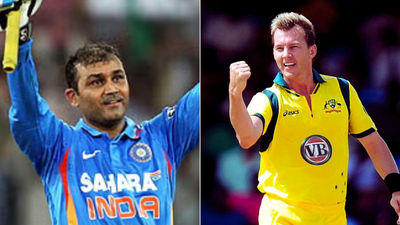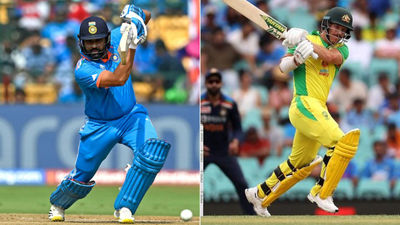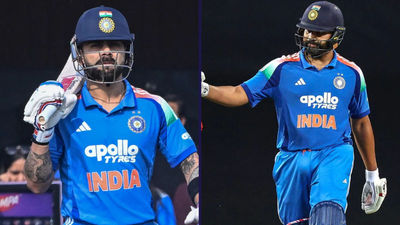

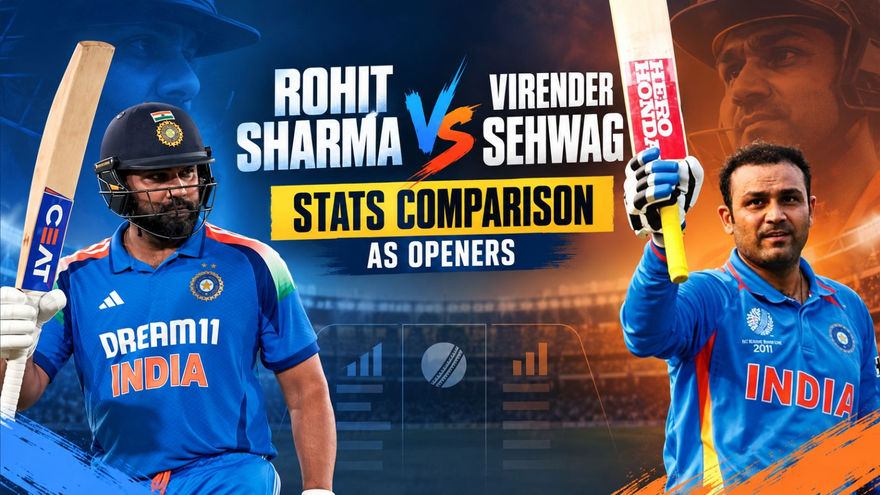
Indian cricket has produced several outstanding opening batters, but Virender Sehwag and Rohit Sharma stand out for changing how teams approach the start of an innings. Both began their international careers in the middle order before moving to the top, where they developed into prolific run-scorers with contrasting batting philosophies.
Sehwag revolutionised opening in Test and ODI cricket with his fearless, boundary-focused approach. He attacked bowlers from the outset, often putting opposition teams under pressure before they could settle into a bowling rhythm. Rohit, meanwhile, built his reputation through a combination of timing, calculated aggression and explosive acceleration, particularly in limited-overs cricket.
This Rohit Sharma vs Virender Sehwag stats comparison as openers examines their international records across Tests, ODIs and T20Is, alongside their playing styles, achievements and influence on Indian cricket.
Overall Opening Career Comparison
Both batters established impressive records at the top of the order, crossing 16,000 international runs as openers according to the figures presented in this comparison. However, their contributions differed across formats.
Career Metric (As Opener) | Rohit Sharma | Virender Sehwag |
International matches opened | 360+ | 332 |
Total international opening runs | 16,135+ | 16,119 |
International centuries as opener | 43 | 36 |
Combined opening average | ~46.50 | ~41.30 |
International sixes | 500+ | 230+ |
Note: The stats may change as Rohit Sharma is still playing international cricket.
The numbers highlight three important differences:
Run accumulation: Rohit leads the comparison in total opening runs and centuries.
Scoring speed: Sehwag's Test strike rate and ODI strike rate demonstrate his preference for attacking cricket.
Power hitting: Rohit's ability to clear the boundary across formats has made six-hitting a defining feature of his batting.
Test Cricket: Rohit Sharma vs Virender Sehwag
Test cricket provides one of the clearest contrasts between the two players. Sehwag established himself as an aggressive opener during the early 2000s, while Rohit moved to the top of India's Test batting order in 2019.
Test Opening Metric | Rohit Sharma | Virender Sehwag |
Matches and innings | 38 matches, 60+ innings | 99 matches, 170 innings |
Test opening runs | 2,690+ | 8,207 |
Batting average | ~45.30 | 50.04 |
Strike rate | ~56.00 | 83.10 |
Centuries / half-centuries | 9 / 7 | 22 / 30 |
Highest score | 212 vs South Africa | 319 vs South Africa |
Virender Sehwag's Test Opening Legacy
Sehwag challenged traditional expectations of Test opening by attacking deliveries that many batters would approach more cautiously. His aggressive stroke play allowed India to score quickly against both pace and spin, creating pressure on opposition captains and bowlers.
His achievements include two landmark triple centuries:
309 against Pakistan: One of the defining innings of Sehwag’s Test career.
319 against South Africa: Another triple century that demonstrated his ability to dominate an attack over an extended period.
Sehwag's opening strike rate of 83.10 is particularly significant. He combined sustained run production with a scoring rate rarely associated with conventional Test batting, helping India establish strong positions in matches.
Rohit Sharma's Transition to Test Opening
Rohit's move to Test opening in 2019 marked an important phase of his red-ball career. He adapted by showing greater discipline outside off stump, assessing conditions before attacking loose deliveries and using his timing to score boundaries.
His 212 against South Africa demonstrated his ability to convert a start into a substantial Test innings. His century at The Oval in 2021 also highlighted his capacity to succeed in challenging overseas conditions.
Test verdict: Sehwag holds the stronger record as an opener in terms of runs, average, strike rate and centuries. Rohit's later transition to the role, however, provides important context when comparing their longevity and opportunities at the top of the order.
ODI Cricket: Rohit Sharma vs Virender Sehwag
Both batters enjoyed considerable success in One Day Internationals, but Rohit's record is particularly distinguished by his consistency and ability to produce exceptionally large innings.
ODI Opening Metric | Rohit Sharma | Virender Sehwag |
Matches opened | 198+ | 212 |
Opening runs | 9,690+ | 7,518 |
Batting average | ~50.80 | 36.49 |
Strike rate | ~93.50 | 104.33 |
Centuries / half-centuries | 29 / 45 | 14 / 35 |
ODI double centuries | 3 | 1 |
Highest score | 219 vs West Indies |
Rohit Sharma's ODI Dominance
Rohit's ODI opening record combines a high batting average with the ability to convert starts into match-defining innings. His three double centuries distinguish him from other batters, while his 264 against Sri Lanka remains the highest individual score in men's ODI cricket.
His double centuries came against Australia, Sri Lanka and Sri Lanka again, with scores of 209, 264 and 208 not out. These innings illustrate his ability to accelerate after building a foundation, maintaining control while increasing the scoring rate.
Rohit's 29 ODI centuries as an opener also underline his consistency in the format. His approach allows him to balance early assessment with sustained aggression once he becomes established.
Virender Sehwag's ODI Approach
Virender Sehwag prioritised attacking cricket from the beginning of an innings. His ODI strike rate of 104.33 reflects that philosophy, particularly his willingness to target boundaries during the powerplay and prevent bowlers from controlling the tempo.
His highest ODI score of 219 against the West Indies demonstrated his ability to produce a monumental innings. Although Rohit leads the supplied figures for opening runs, average and centuries, Sehwag's scoring rate remains a major part of his legacy.
ODI verdict: Rohit leads in run accumulation, batting average and double centuries, while Sehwag's higher strike rate highlights his more consistently aggressive approach.
T20 International Records as Openers
T20I cricket became an established international format during the later stages of Sehwag's career. Rohit spent considerably longer opening in the format, so their records must be interpreted in the context of their different opportunities.
T20I Opening Metric | Rohit Sharma | Virender Sehwag |
Matches and innings | 125 / 125 | 18 / 18 |
Opening runs | 3,750+ | 394 |
Batting average | ~32.50 | 21.88 |
Strike rate | 140.89 | 145.38 |
Centuries / half-centuries | 5 / 27 | 0 / 2 |
T20 World Cup titles | 2007, 2024 | 2007 |
Rohit's T20I record reflects sustained success over a much larger sample of matches. His five centuries and 27 half-centuries in the supplied comparison demonstrate his ability to produce both quick starts and substantial innings.
Sehwag's strike rate of 145.38 is higher than Rohit's listed figure of 140.89. However, his 18 matches as an opener represent a considerably smaller sample, making direct comparisons less conclusive.
Their T20 World Cup achievements also reflect different roles. Sehwag was part of India's 2007 title-winning campaign. Rohit won the inaugural T20 World Cup in 2007 as a middle-order batter and captained India to the 2024 title.
Final Verdict: Rohit Sharma or Virender Sehwag?
Rohit Sharma and Virender Sehwag transformed opening batting through different methods. Sehwag challenged conventional Test cricket by attacking from the outset, while Rohit combined technical control with sustained scoring and exceptional limited-overs achievements.
Test cricket: Sehwag has the stronger opening record, with more than 8,200 runs, a 50.04 average and two triple centuries.
ODI cricket: Rohit leads the supplied comparison in opening runs, average and centuries, and holds the record for three ODI double centuries.
T20I cricket: Rohit has the larger body of work, while Sehwag's higher listed strike rate reflects his aggressive approach in a smaller sample.
There is no single measure that captures the full value of either batter. Sehwag's defining contribution was to make relentless aggression a viable opening strategy in Test cricket. Rohit's legacy rests on consistency, adaptability and extraordinary limited-overs scoring.
Both changed expectations for Indian opening batters, but their records are best appreciated in the context of their respective eras, formats and roles.
Also Read | Virat Kohli vs Rohit Sharma ODI Stats Comparison