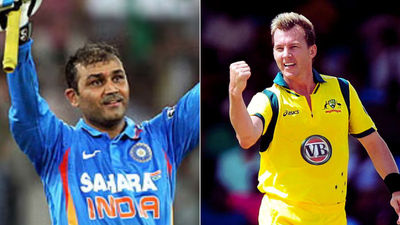


Few opening batters have changed the tempo of international cricket quite like Virender Sehwag. Nicknamed the “Sultan of Multan” and the “Nawab of Najafgarh,” Sehwag challenged the traditional idea that Test openers needed to survive first and score later.
His approach was remarkably simple: watch the ball closely, trust his hand-eye coordination and attack whenever the opportunity appeared. That philosophy produced two Test triple centuries, an ODI double century and some of the fastest scoring ever seen from a Test opener.
This guide covers the most important Virender Sehwag records and achievements, including his Test milestones, ODI and World Cup performances, IPL records and the batting principles behind his success.
Virender Sehwag Career Statistics
Sehwag’s numbers show how effectively he maintained an aggressive style across formats.
Format | Matches | Innings | Runs | High Score | Average | Strike Rate | 100s / 50s |
Tests | 104 | 180 | 8,586 | 319 | 49.34 | 82.23 | 23 / 32 |
ODIs | 251 | 245 | 8,273 | 219 | 35.05 | 104.33 | 15 / 38 |
T20Is | 19 | 18 | 394 | 68 | 21.88 | 145.38 | 0 / 2 |
IPL | 104 | 104 | 2,728 | 122 | 27.55 | 155.44 | 2 / 16 |
His Test record stands out in particular. Sehwag scored 8,586 runs at an average of 49.34 while maintaining a strike rate above 82—figures that reflect the unusual combination of volume and scoring speed that defined his career.
Virender Sehwag Test Records and Milestones
Sehwag’s most significant individual records came in Test cricket. Instead of treating aggression as something reserved for limited-overs matches, he used it to put bowlers under pressure during long-form cricket.
Two Test Triple Centuries
Sehwag remains the only Indian cricketer to score two Test triple centuries. He is also part of a select group alongside Sir Donald Bradman, Brian Lara and Chris Gayle to have passed 300 twice in Tests.
His two triple hundreds were:
309 vs Pakistan, Multan, 2004: Sehwag became the first Indian to score a Test triple century. He reached 300 in characteristic fashion, hitting Saqlain Mushtaq for six over deep mid-wicket.
319 vs South Africa, Chennai, 2008: Sehwag produced an even bigger innings four years later. His 319 remains the highest individual Test score by an Indian batter.
The Chennai innings also produced another major record. Sehwag reached 300 from only 278 balls, the fastest Test triple century by balls faced.
Sehwag’s 293 Against Sri Lanka
Sehwag came remarkably close to achieving something unprecedented in December 2009.
Against Sri Lanka at Mumbai’s Brabourne Stadium, he hammered 293 from 254 balls before Muttiah Muralitharan dismissed him caught and bowled.
Had he reached 300, Sehwag would have become the first batter to score three Test triple centuries.
The innings still produced a record: he reached 250 from 207 balls, setting the mark for the fastest Test 250.
Turning Centuries Into Huge Scores
Sehwag’s ability to continue attacking after reaching three figures separated him from many other high-scoring batters.
Of his 23 Test centuries, 14 were scores of 150 or more. He also produced a remarkable sequence in which 11 consecutive Test hundreds were converted into scores above 150.
Rather than protecting a milestone once he reached 100, Sehwag often continued playing with the same attacking intent.
Virender Sehwag ODI Records and Achievements
Sehwag’s aggressive style was naturally suited to ODI cricket, particularly after he moved from the middle order to the top of the batting lineup.
He finished his ODI career with 8,273 runs, 15 centuries and 38 half-centuries, striking at 104.33.
219 Against West Indies
One of Sehwag’s greatest ODI innings came against the West Indies in Indore on December 8, 2011.
Playing as captain, he scored 219 from 149 balls, including 25 fours and seven sixes.
The innings made Sehwag only the second male cricketer after Sachin Tendulkar to score an ODI double century. His performance also helped India reach 418/5, the country’s highest ODI team total at the time.
Sehwag’s 2011 World Cup Record
Sehwag played an important role at the top of the order during India’s victorious 2011 ICC Cricket World Cup campaign.
One unusual pattern became a memorable feature of his tournament: in five consecutive group matches, Sehwag hit a boundary from the first ball of India’s innings.
It perfectly captured his approach. He did not need several overs to settle into an innings. If the opening delivery offered a scoring opportunity, he attacked it.
Sehwag was also part of India’s 2007 ICC T20 World Cup-winning squad, giving him winners’ medals from both of India’s major limited-overs world titles during that era.
Virender Sehwag T20 and IPL Records
Sehwag’s natural attacking game transferred comfortably to T20 cricket.
One of his earliest milestones came in 2006, when he captained India in the country’s first official T20 International against South Africa in Johannesburg.
Five Consecutive IPL Fifty-Plus Scores
Playing for Delhi Daredevils in the 2012 IPL, Sehwag recorded five consecutive scores of 50 or more.
The sequence demonstrated that his attacking method could produce sustained consistency rather than isolated explosive innings.
122 Against Chennai Super Kings
One of Sehwag’s finest IPL performances came for Kings XI Punjab in the 2014 Qualifier 2 against Chennai Super Kings.
He smashed 122 from 58 balls, helping Punjab reach their first IPL final.
The innings was particularly significant because it came in a knockout match, combining Sehwag’s trademark scoring rate with the pressure of a major playoff fixture.
What Made Virender Sehwag’s Batting Style Different?
Sehwag’s technique did not follow the conventional template for an international opener. His success relied on several interconnected strengths.
Minimal Trigger Movement
Sehwag generally remained still at the crease rather than using a large pre-delivery movement. A stable head helped him judge line and length quickly and allowed his hands to work freely.
Strong Back-Foot Game
His cut and square shots made shortening the length risky for fast bowlers. Sehwag could create scoring opportunities from deliveries that more defensive openers might simply leave or block.
Clear Attacking Mindset
Perhaps his most distinctive strength was mental simplicity. Sehwag judged each delivery as a scoring opportunity or a ball to defend rather than allowing milestones, bowling reputations or match situations to completely dictate his approach.
Frequently Asked Questions
What is Virender Sehwag’s highest Test score?
Sehwag’s highest Test score is 319, made from 304 balls against South Africa in Chennai in March 2008.
How many Test triple centuries did Sehwag score?
Sehwag scored two Test triple centuries: 309 against Pakistan in Multan in 2004 and 319 against South Africa in Chennai in 2008. He narrowly missed a third when dismissed for 293 against Sri Lanka in 2009.
Did Sehwag score the fastest Test triple century?
Yes. Sehwag reached 300 from 278 balls against South Africa in Chennai, the fastest Test triple century by balls faced.
What is Virender Sehwag’s highest ODI score?
His highest ODI score is 219 from 149 balls against the West Indies at Indore on December 8, 2011.
Did Virender Sehwag win the World Cup?
Yes. Sehwag was part of India’s 2011 ICC Cricket World Cup-winning team and the squad that won the inaugural 2007 ICC T20 World Cup.
Conclusion
Virender Sehwag’s records tell only part of his story. His greater influence came from demonstrating that an opener could attack relentlessly without abandoning the demands of Test cricket.
Two triple centuries, an ODI double hundred, 8,586 Test runs and major contributions to India’s World Cup-winning teams underline the scale of his career.
For developing batters, the most useful lesson is not to imitate every Sehwag stroke. It is to understand the foundations behind his success: clear decision-making, stable head position, decisive hand speed and the confidence to capitalize when a scoring opportunity appears.
Also Read | Virender Sehwag vs Shoaib Akhtar Head to Head