
Spin bowling is one of cricket’s most demanding disciplines. Instead of relying primarily on pace, spinners use flight, drift, turn, bounce, changes of pace, and tactical variation to create mistakes.
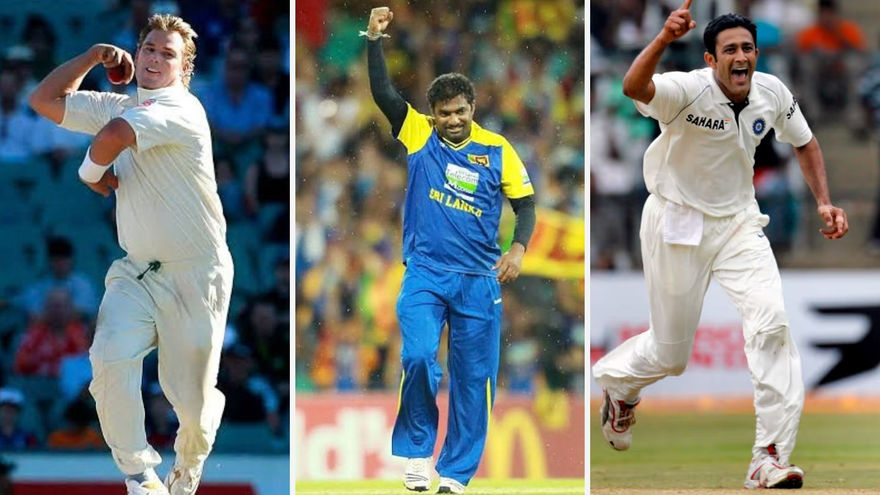
Across generations and conditions, a select group of bowlers have taken spin bowling to another level. From Muttiah Muralitharan’s relentless accuracy and Shane Warne’s attacking leg-spin to the control of Nathan Lyon and the variations of Ravichandran Ashwin, these bowlers have left a lasting mark on international cricket.
This list of the top 10 greatest spinners of all time in cricket considers their wicket-taking records, technical strengths, signature deliveries, career achievements, and influence on the game.
Top 10 Greatest Spinners in Cricket History
Rank | Bowler | Country | Primary Style | Test Wickets | ODI Wickets |
1 | Muttiah Muralitharan | Sri Lanka | Off-spin / Wrist-spin | 800 | 534 |
2 | Shane Warne | Australia | Leg-spin | 708 | 293 |
3 | Anil Kumble | India | Right-arm leg-spin | 619 | 337 |
4 | Ravichandran Ashwin | India | Off-spin | 537+ | 156 |
5 | Nathan Lyon | Australia | Off-spin | 530+ | 29 |
6 | Rangana Herath | Sri Lanka | Left-arm orthodox | 433 | 74 |
7 | Harbhajan Singh | India | Off-spin | 417 | 269 |
8 | Daniel Vettori | New Zealand | Left-arm orthodox | 362 | 305 |
9 | Lance Gibbs | West Indies | Off-spin | 309 | 2 |
10 | Abdul Qadir | Pakistan | Leg-spin | 236 | 132 |
1. Muttiah Muralitharan
Muttiah Muralitharan stands at the top of the list on the strength of an extraordinary Test record. The Sri Lankan spinner combined exceptional wrist flexibility, accuracy, stamina, and the ability to extract sharp turn even from pitches that offered limited assistance.
Muralitharan's Test record
Test wickets: 800 in 133 matches
Five-wicket hauls: 67, a world record
Ten-wicket match hauls: 22, a world record
His doosra, which turns away from a right-handed batter, added another layer to an already difficult bowling package. In 2010, Muralitharan dismissed Pragyan Ojha to become the first and only bowler to reach 800 Test wickets.
His 67 five-wicket hauls underline how consistently he changed matches with the ball during a career spanning nearly two decades.
2. Shane Warne
Shane Warne helped restore leg-spin to the center of world cricket during an era when fast bowling dominated much of the conversation. His control of the leg-break, combined with drift, side-spin, the flipper, and tactical awareness, made him one of the game's most influential wrist-spinners.
Warne became the first bowler to reach 700 Test wickets.
His defining moment came in 1993 when he bowled the delivery famously known as the "Ball of the Century" to Mike Gatting. The ball pitched outside leg stump, turned sharply and clipped the top of off stump.
Warne also demonstrated that wrist-spin could be both an attacking wicket-taking weapon and an effective method of controlling scoring on Australia's fast, bouncy pitches.
3. Anil Kumble
Anil Kumble offered a different interpretation of leg-spin. Rather than depending on huge amounts of turn, India's "Jumbo" relied on pace through the air, steep bounce, accuracy, and relentless pressure.
His major strengths included a high release point, top-spin bounce, stamina, and an uncompromising approach.
In 1999, Kumble became only the second bowler in Test history to take all 10 wickets in an innings, recording 10/74 against Pakistan in Delhi.
With 619 Test wickets, Kumble remains India's highest Test wicket-taker. His career also spanned 18 years, during which he played a central role in India's Test success at home and away.
4. Ravichandran Ashwin
Ravichandran Ashwin represents the analytical side of modern spin bowling. Alongside conventional off-spin, he has used changes of pace, crease angles, flight, and variations such as the carrom ball to challenge batters.
He has been particularly effective at setting up left-handed batters through changes in line, angle, and delivery speed.
Ashwin also became the fastest Indian bowler to reach 250, 300, 350, 400, 450, and 500 Test wickets.
His impact extends beyond conventional subcontinental conditions. His ability to combine tactical planning with technical variation has made him a significant modern Test spinner.
5. Nathan Lyon
Nathan Lyon, known as "Garry," became Australia's most successful finger spinner by building his game around bounce, over-spin, drift, and durability.
Rather than depending heavily on large amounts of side-spin or mystery deliveries, Lyon has used his high arm slot to generate bounce and challenge batters even on surfaces that do not offer substantial turn.
His key strengths include:
High arm slot
Bounce and over-spin
Drift away from right-handed batters
Durability across long series
With more than 530 Test wickets, Lyon has played a central role in Australia's bowling attack across Ashes campaigns and overseas tours.
6. Rangana Herath
Rangana Herath followed Muralitharan as Sri Lanka's lead spinner and established a remarkable legacy of his own.
The left-arm orthodox bowler relied on accuracy rather than excessive variation. His subtle pace changes, arm ball, and ability to read a batter's footwork allowed him to create pressure consistently.
Herath finished his Test career with 433 wickets, while helping Sri Lanka achieve notable series victories against Australia and South Africa.
His career showed how effective disciplined line-and-length bowling can be when executed with precision.
7. Harbhajan Singh
Harbhajan Singh, known as "The Turbanator," was one of India's leading match-winning spinners during the 2000s. His sharp off-break, bounce, aggressive approach, and doosra made him a difficult opponent.
He took 32 wickets in India's 2001 home Test series against Australia, including India's first Test hat-trick.
Harbhajan finished with 417 Test wickets and 269 ODI wickets and played an important role in India's 2011 ICC ODI World Cup campaign.
8. Daniel Vettori
Daniel Vettori became a key part of New Zealand's bowling attack across all three formats. He made his international debut at 18 and developed from a traditional flighted left-arm spinner into a highly adaptable tactical bowler.
His strengths included:
Precise speed control
Deceptive changes of pace
A sharp arm ball
Tight line and length
Vettori finished with 362 Test wickets and more than 4,000 Test runs, giving New Zealand an unusually valuable spin-bowling all-rounder.
9. Lance Gibbs
Lance Gibbs was the first spin bowler to pass 300 Test wickets. Playing for the West Indies during an era known for fast bowling, Gibbs built his success around accuracy, high flight, long spells, and economy.
His long fingers helped him generate turn, while his high trajectory created dip and uncertainty for batters.
Gibbs finished with 309 Test wickets at an economy rate below 2.00 runs per over, establishing an important benchmark for the finger spinners who followed.
10. Abdul Qadir
Abdul Qadir played a major role in keeping the attacking leg-spin prominent during the 1970s and 1980s. His variations included the googly, flipper, and fast leg-break, complemented by a distinctive bowling action.
Qadir famously took 9/56 against England in Lahore in 1987, one of the standout leg-spin performances of his era.
His influence extended beyond his statistics. He helped restore excitement and prestige to wrist-spin when finger spin was dominating the international game and paved the way for later leg-spinners, including Shane Warne and Mushtaq Ahmed.
Frequently Asked Questions
Who has taken the most wickets among spinners in Test cricket?
Muttiah Muralitharan holds the record with 800 Test wickets in 133 matches, followed by Shane Warne with 708.
What is the difference between a googly and a doosra?
A googly is a leg-spinner's variation that turns from off to leg for a right-handed batter. A doosra is an off-spinner's variation that turns from leg to off, moving away from a right-handed batter.
Why is Shane Warne's delivery to Mike Gatting called the "Ball of the Century"?
Warne's 1993 Ashes delivery drifted outside leg stump, gripped the pitch, turned sharply across Mike Gatting, and hit off stump. The delivery became a defining example of the possibilities of attacking leg-spin.
Can spin bowlers succeed on fast, bouncy pitches?
Yes. Shane Warne and Nathan Lyon demonstrated how spinners can succeed in Australia by using over-spin, bounce, and top-spin. Extra bounce and dip can force mistakes even when a pitch offers limited side-turn.
Who is the best active spin bowler in Test cricket right now?
Ravichandran Ashwin and Nathan Lyon are identified in the source article as the leading active Test spinners, with both having passed 500 Test wickets and continued to play major roles for their national teams.