
Fast bowling is one of cricket’s most demanding disciplines. It combines physical endurance, explosive athleticism, accuracy, movement and the ability to maintain pressure against elite batters.
Ranking the greatest fast bowlers of all time requires more than counting wickets or measuring pace. Bowling average, strike rate, longevity, adaptability in different conditions and match impact all provide useful context. Different eras also presented different challenges, so statistics need to be considered alongside the bowler’s role and influence on matches.
Based on those factors, here are the top 10 greatest fast bowlers in cricket history, with their key statistics, defining skills and career legacies.
Top 10 Greatest Fast Bowlers: At a Glance
Rank | Player | Country | Test Wickets | Test Average | Defining Trait |
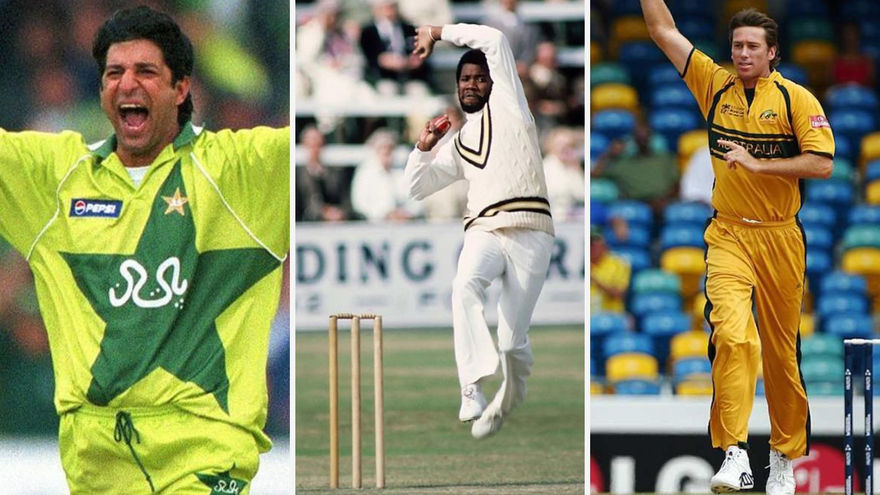
1 | Malcolm Marshall | West Indies | 376 | 20.94 | Complete pace, swing, seam and tactical intelligence |
2 | Wasim Akram | Pakistan | 414 | 23.62 | Conventional and reverse swing |
3 | Glenn McGrath | Australia | 563 | 21.64 | Relentless accuracy and steep bounce |
4 | Dale Steyn | South Africa | 439 | 22.95 | Express pace and elite strike rate |
5 | Curtly Ambrose | West Indies | 405 | 20.99 | Height, bounce and ruthless line |
6 | Richard Hadlee | New Zealand | 431 | 22.29 | Control, seam movement and consistency |
7 | Imran Khan | Pakistan | 362 | 22.81 | Reverse swing and high-speed yorkers |
8 | Dennis Lillee | Australia | 355 | 23.92 | Technical skill and adaptability |
9 | James Anderson | England | 704 | 26.45 | Longevity and conventional swing |
10 | Jasprit Bumrah | India | 170+ | Under 21.00 | Unique action, pace and yorkers |
1. Malcolm Marshall — West Indies
Malcolm Marshall represents the complete fast-bowling package. Although shorter than several of his West Indian contemporaries, he generated sharp pace from an open-chested action and combined it with outstanding control.
Marshall could swing the new ball, move it off the seam and produce a dangerous bouncer. His tactical awareness also allowed him to remain effective across different surfaces, including the slower pitches of the subcontinent.
Test wickets: 376 in 81 matches
Test bowling average: 20.94
Defining moment: Against England in 1984, Marshall bowled with a broken left thumb and claimed 7/53.
His ability to combine pace, movement, accuracy and tactical intelligence makes him the benchmark at the top of this list.
2. Wasim Akram — Pakistan
Wasim Akram transformed left-arm fast bowling through his unusual angle, quick arm speed and mastery of swing. The Pakistan great could move the ball conventionally with the new ball before using reverse swing as it aged.
His skill set made him dangerous in both Test and limited-overs cricket.
Test wickets: 414
ODI wickets: 502
Defining achievement: Akram was Player of the Match in the 1992 World Cup final, where two successive deliveries played a decisive role in Pakistan’s victory.
Akram’s combination of pace, movement and variation made him one of the most influential fast bowlers of his generation.
3. Glenn McGrath — Australia
Glenn McGrath showed that devastating fast bowling does not require extreme pace. Standing around 6'5", McGrath used his height, accuracy and ability to extract bounce to repeatedly challenge the outside edge.
His method was straightforward but exceptionally difficult for batters to overcome: attack the off-stump corridor, maintain a disciplined length and allow movement or bounce to create mistakes.
Test wickets: 563 at 21.64
ODI wickets: 381
World Cups: Three consecutive titles with Australia in 1999, 2003 and 2007
McGrath’s repeatable accuracy and control became the foundation of Australia’s dominant bowling attacks.
4. Dale Steyn — South Africa
Dale Steyn combined genuine pace with late swing and an aggressive approach. He regularly operated around the 150 km/h mark while retaining the ability to move the ball away from right-handers.
Steyn also excelled in conditions that traditionally offered less assistance to fast bowlers. His performance against India in Nagpur in 2010, where he took 7/51, remains a notable example.
Test wickets: 439
Test strike rate: 42.3 balls per wicket
Key achievement: Spent 263 consecutive weeks as the No. 1-ranked Test bowler.
His ability to attack at high pace without sacrificing wicket-taking efficiency placed him among the defining fast bowlers of the modern era.
5. Curtly Ambrose — West Indies
At 6'7", Curtly Ambrose created an intimidating combination of height, bounce and accuracy. He rarely needed to chase wickets with loose deliveries. Instead, he built pressure with a disciplined line before using bounce and seam movement to force mistakes.
Test wickets: 405 in 98 matches
Test bowling average: 20.99
Defining spell: 7/1 against Australia in Trinidad in 1993.
Ambrose was particularly effective because his economy and accuracy allowed pressure to build even when the pitch offered limited assistance.
6. Richard Hadlee — New Zealand
Sir Richard Hadlee carried much of New Zealand’s bowling responsibility during the 1970s and 1980s. He developed his game around seam movement, late swing and precise control rather than relying solely on raw pace.
Hadlee also became the first bowler to reach 400 Test wickets.
Test wickets: 431 in 86 matches
Five-wicket hauls: 36
Key strength: Seam movement combined with exceptional control
His record is especially significant because of the leading role he played in New Zealand’s attack throughout his career.
7. Imran Khan — Pakistan
Imran Khan evolved significantly during his international career, developing from a fast bowler with raw pace into a highly skilled seamer capable of exploiting reverse swing.
He became known for fast inswinging yorkers and was an important figure in the development of reverse swing as a weapon in international cricket.
Test wickets: 362
Career peak: During the final 10 years of his international career, he averaged under 19 with the ball while also captaining Pakistan.
His combination of bowling skill and leadership made him an important figure in Pakistan cricket.
8. Dennis Lillee — Australia
Dennis Lillee was renowned for his technical understanding of fast bowling as well as his competitiveness. After suffering serious back stress fractures early in his career, he rebuilt his bowling action and adapted his approach.
Lillee relied on seam position, cutters, changes of pace and sustained pressure rather than depending exclusively on speed.
Test wickets: 355 in 70 matches
Key strength: Technical variation and adaptability
His career demonstrated how a fast bowler could evolve physically and tactically while remaining a major wicket-taking threat.
9. James Anderson — England
James Anderson’s career stands out for longevity and technical precision. He became one of the finest exponents of conventional swing, particularly in conditions that offered assistance to seam and movement.
Anderson played international cricket for two decades and finished with a Test record that few fast bowlers have approached.
Test wickets: 704 in 188 matches
Major milestone: The only fast bowler to surpass 700 Test wickets.
His wicket tally reflects extraordinary longevity, while his ability to continue producing swing and movement across different stages of his career established his place among the greats.
10. Jasprit Bumrah — India
Jasprit Bumrah brought a distinctive approach to fast bowling. His short run-up, unusual release point and ability to generate high pace make him difficult for batters to read.
He combines pace with control and has developed into a dangerous bowler with the new ball, at the death and when operating with an older ball.
Test wickets: 170+
Test bowling average: Under 21.00
Key weapons: Pace, yorkers, unusual release and control
Conditions: Effective in Australia, England, South Africa and India
Bumrah’s inclusion also reflects the changing nature of elite fast bowling, with modern pacers expected to perform across formats and conditions.
Fast-Bowling Styles Compared
Style | Strengths | Challenges | Examples |
Express pace | Forces late reactions and creates intimidation | Can affect control and physical workload | Dale Steyn, Shoaib Akhtar |
Seam and control | Builds pressure and creates mistakes | Can depend on bounce and surface conditions | Glenn McGrath, Curtly Ambrose |
Swing and reverse swing | Produces movement through the air | Depends on ball and atmospheric conditions | Wasim Akram, James Anderson |
Frequently Asked Questions
Who is the greatest fast bowler of all time?
Malcolm Marshall is placed first in this ranking, based on his combination of a 20.94 Test average, 376 wickets, versatility and ability to succeed across different conditions.
Who has taken the most Test wickets among fast bowlers?
James Anderson finished his career with 704 Test wickets in 188 matches, the highest Test wicket tally for a fast bowler.
What is the difference between conventional and reverse swing?
Conventional swing generally occurs with a newer ball, while reverse swing develops with an older ball and can produce late movement in the opposite direction. Ball condition, pace and other environmental factors influence how much movement a bowler can generate.
Which fast bowler had the best Test strike rate?
Dale Steyn recorded a Test strike rate of 42.3 balls per wicket, one of the most destructive figures among leading Test fast bowlers.
Why were West Indies fast bowlers so dominant in the 1980s?
The West Indies combined several high-quality fast bowlers who could maintain pace, bounce and pressure in succession. Batters often faced sustained pace rather than a single bowler before moving to a different style of attack.