

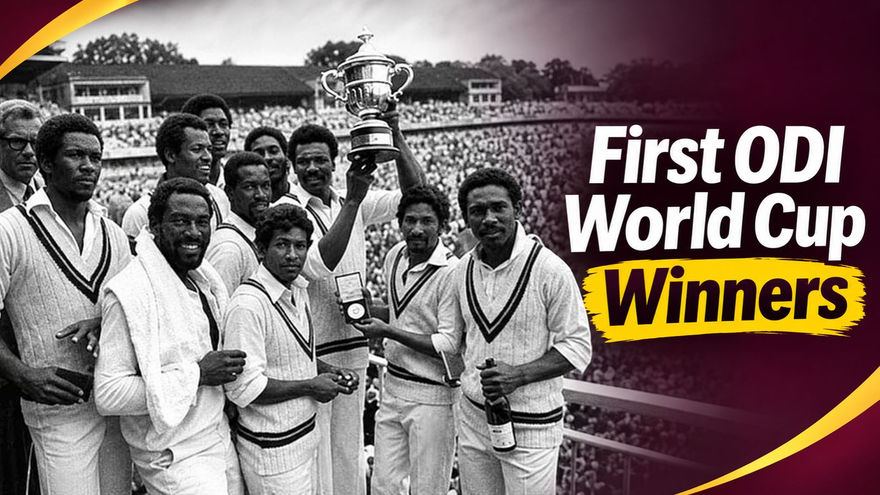
The West Indies won the first-ever One Day International (ODI) Cricket World Cup in 1975, defeating Australia by 17 runs in the final at Lord’s Cricket Ground in London on June 21. Led by captain Clive Lloyd, the Caribbean side scored 291/8 in 60 overs before bowling Australia out for 274 in 58.4 overs.
Lloyd’s commanding century and Vivian Richards’ exceptional fielding helped secure the inaugural title. The victory marked the beginning of the West Indies’ dominance in World Cup cricket, a period that continued with another championship in 1979.
Officially known as the Prudential Cup, the 1975 tournament introduced international cricket’s leading teams to a major global limited-overs competition. Its 60-over format, traditional white clothing and red balls reflected a very different era from modern ODI cricket.
1975 Cricket World Cup: Tournament Overview
England hosted the inaugural Cricket World Cup in June 1975. Eight teams competed across the tournament, with the top two sides from each group progressing to the semi-finals.
The competition featured established Test-playing nations alongside associate teams, including East Africa and Sri Lanka, which participated before gaining Test status.
Tournament Detail | Information |
Official name | 1975 Prudential Cup |
Host country | England |
Winner | West Indies |
Runner-up | Australia |
Final date | June 21, 1975 |
Final venue | Lord’s Cricket Ground, London |
Final result | West Indies won by 17 runs |
West Indies score | 291/8 in 60 overs |
Australia score | 274 all out in 58.4 overs |
Format | 60 overs per side |
Number of teams | Eight |
Teams and Tournament Format
The eight participating teams were Australia, England, India, New Zealand, Pakistan, the West Indies, Sri Lanka and East Africa. The East African team represented Kenya, Uganda, Tanzania and Zambia.
Organisers divided the teams into two groups of four. Each team played the others in its group, and the top two advanced to the semi-finals. The winners of those matches met in the final at Lord’s.
Matches used red leather cricket balls, and players wore traditional white clothing. Each side had 60 overs to bat, making the tournament different from the 50-over World Cups familiar to modern fans.
West Indies’ Road to the 1975 World Cup Final
The West Indies entered the competition among the leading contenders, alongside England and Australia. Their performances throughout the tournament demonstrated the strength of a side capable of combining aggressive batting, quality bowling and sharp fielding.
Group Stage Performance
The West Indies began their campaign with a nine-wicket victory over Sri Lanka at Old Trafford. The comfortable result gave them an encouraging start to their World Cup journey.
Their match against Pakistan at Edgbaston proved considerably more challenging. Chasing 267, the West Indies found themselves in danger before Deryck Murray and Andy Roberts produced a crucial lower-order partnership. Their efforts secured a narrow one-wicket victory.
The West Indies then defeated Australia by seven wickets at The Oval in their final group match. That result helped them finish at the top of Group B with an unbeaten record.
Semi-Final Against New Zealand
The West Indies faced New Zealand at The Oval in the semi-final. Their bowlers restricted New Zealand to 158, leaving the Caribbean side with a manageable target.
The West Indies completed the chase in 40.1 overs, winning by five wickets and booking their place in the final.
Australia reached the championship match after defeating England at Headingley. Australian all-rounder Gary Gilmour delivered a remarkable bowling performance, taking six wickets for just 14 runs. His spell played a decisive role in England’s defeat.
1975 World Cup Final: West Indies vs Australia
The final took place at Lord’s on June 21, 1975, before a reported crowd of 26,765. Australia won the toss and elected to field, giving the West Indies the opportunity to set a target.
The match featured an outstanding century from Clive Lloyd, a strong contribution from Rohan Kanhai and a dramatic Australian chase shaped by run-outs.
1975 World Cup Final Scorecard
Batting and Bowling Details | Performance |
West Indies | 291/8 in 60 overs |
Clive Lloyd | 102 off 85 balls |
Rohan Kanhai | 55 off 105 balls |
Gary Gilmour (Australia) | 5/48 in 12 overs |
Australia | 274 all out in 58.4 overs |
Ian Chappell | 62 off 93 balls |
Alan Turner | 40 off 54 balls |
Keith Boyce (West Indies) | 4/50 in 12 overs |
Final result | West Indies won by 17 runs |
Clive Lloyd’s Match-Winning Century
The West Indies lost early wickets and reached 50/3, leaving their innings in need of stability. Captain Clive Lloyd responded with an aggressive innings that changed the direction of the match.
Lloyd scored 102 runs from just 85 deliveries, hitting 12 fours and two sixes. His attacking approach put pressure on Australia’s bowlers and gave the West Indies the platform to post a competitive total.
Rohan Kanhai supported his captain with a patient 55 off 105 balls. Their contributions helped the West Indies reach 291/8, despite Gary Gilmour claiming five wickets for Australia.
Lloyd’s century earned him the Player of the Match award. It remains one of the defining batting performances in the history of the first Cricket World Cup.
Vivian Richards’ Fielding Changes the Game
Australia needed 292 runs to win. Ian Chappell scored 62, while Alan Turner contributed 40, keeping the chase competitive.
However, Vivian Richards produced a remarkable fielding display. The young West Indian helped execute three direct-hit run-outs, dismissing Alan Turner, Ian Chappell and Greg Chappell.
Australia lost five wickets through run-outs during the innings. Those dismissals disrupted the chase and placed increasing pressure on the lower order.
Keith Boyce finished with four wickets for 50 runs, helping bowl Australia out for 274 in 58.4 overs. The West Indies secured a 17-run victory and became the first ODI World Cup champions.
Leading Individual Performers of the 1975 World Cup
Although the West Indies lifted the trophy, several players delivered outstanding individual performances during the tournament.
Top Run-Scorers
Player | Team | Runs | Average |
Glenn Turner | New Zealand | 333 | 111.00 |
Dennis Amiss | England | 243 | 60.75 |
Clive Lloyd | West Indies | 158 | — |
Glenn Turner finished as the tournament’s leading run-scorer, accumulating 333 runs in four matches, including two centuries. His average of 111.00 highlighted his consistency throughout the competition.
Dennis Amiss ranked among the leading batters with 243 runs at an average of 60.75. Lloyd scored 158 runs across five matches, with his century in the final providing the tournament’s most memorable batting contribution.
Top Wicket-Takers
Player | Team | Wickets |
Gary Gilmour | Australia | 11 |
Bernard Julien | West Indies | 10 |
Keith Boyce | West Indies | 10 |
Gilmour took 11 wickets in just two matches. His figures of 6/14 against England in the semi-final and 5/48 against the West Indies in the final made him one of the tournament’s standout bowlers.
West Indian bowlers Bernard Julien and Keith Boyce each claimed 10 wickets across five matches, providing important support throughout the campaign.
Frequently Asked Questions
Which team won the first-ever ODI World Cup?
The West Indies won the inaugural ODI Cricket World Cup in 1975, defeating Australia by 17 runs in the final at Lord’s.
Who captained the West Indies in the 1975 World Cup?
Clive Lloyd captained the West Indies to their first World Cup title in 1975. He also led the team to a second consecutive championship in 1979.
Who was Player of the Match in the 1975 World Cup final?
Clive Lloyd received the award after scoring 102 runs off 85 balls, including 12 fours and two sixes.
How many overs were played per side in the 1975 World Cup?
Each team had 60 overs to bat. The tournament format differed from the modern 50-over ODI World Cup.
Where was the first Cricket World Cup held?
England hosted the tournament, with matches played at Lord’s, The Oval, Edgbaston, Headingley, Old Trafford and Trent Bridge.
How many teams participated in the 1975 World Cup?
Eight teams participated: Australia, England, India, New Zealand, Pakistan, the West Indies, Sri Lanka and East Africa.


