
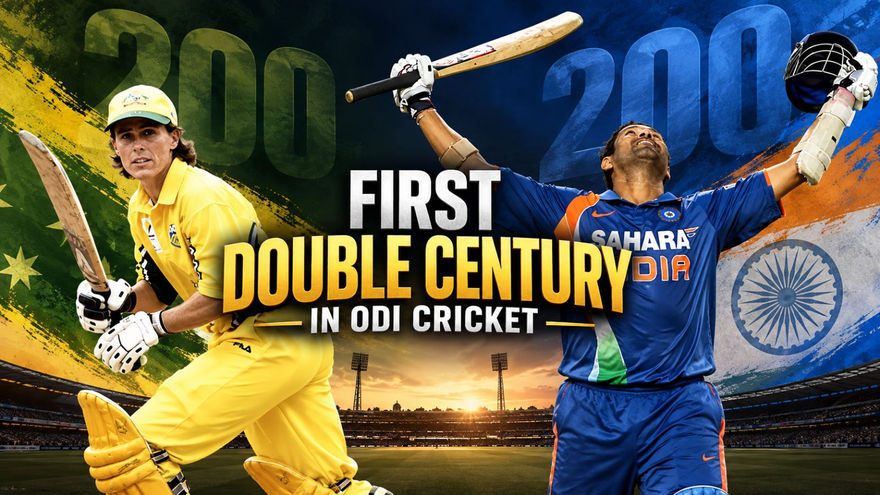
The first double century in ODI cricket was scored by Belinda Clark of Australia, who made an unbeaten 229 against Denmark on December 16, 1997. More than 12 years later, Sachin Tendulkar became the first male cricketer to score an ODI double century, making 200* against South Africa on February 24, 2010.
Both innings changed perceptions of what was possible in 50-over cricket. Clark established the overall record in women's ODI cricket, while Tendulkar broke the 200-run barrier in the men's game.
First ODI Double Century Milestones
Milestone | Player | Score | Opposition | Date |
First overall ODI double century | Belinda Clark | 229* | Denmark | December 16, 1997 |
First men's ODI double century | Sachin Tendulkar | 200* | South Africa | February 24, 2010 |
These two performances provide the starting point for understanding how ODI batting evolved and why individual scores above 200 eventually became more common.
Belinda Clark Scored the First Double Century in ODI Cricket
Belinda Clark made ODI history during the 1997 ICC Women's World Cup in Mumbai, India. Representing Australia, the captain scored an unbeaten 229 from 155 balls against Denmark at the MIG Club Ground on December 16.
At the time, a score of 200 in a 50-over international was almost uncharted territory. Clark went well beyond that mark, combining boundary hitting with aggressive running between the wickets.
Category | Match Statistics |
Player | Belinda Clark (Australia) |
Opposition | Denmark Women |
Date | December 16, 1997 |
Venue | MIG Club Ground, Mumbai, India |
Score | 229* off 155 balls |
Boundaries | 22 fours |
Australia total | 412/3 in 50 overs |
Result | Australia won by 363 runs |
One notable feature of Clark's innings was her running between the wickets. She scored 141 of her 229 runs through singles and twos, showing that a massive ODI total does not depend entirely on hitting boundaries.
Her 229* also became a landmark score across both men's and women's ODI cricket. It remained the highest individual ODI score for nearly 17 years, until Rohit Sharma scored 264 against Sri Lanka in 2014.
Sachin Tendulkar Became the First Male ODI Double Centurion
The men's ODI record stood at 194 before Sachin Tendulkar finally crossed the 200-run mark. Saeed Anwar and Charles Coventry had both reached 194, with Coventry remaining unbeaten.
On February 24, 2010, Tendulkar changed the record books at the Captain Roop Singh Stadium in Gwalior. Batting against South Africa, he became the first male player to score 200 in an ODI, finishing unbeaten on 200 from 147 balls.
Category | Match Statistics |
Player | Sachin Tendulkar (India) |
Opposition | South Africa |
Date | February 24, 2010 |
Venue | Captain Roop Singh Stadium, Gwalior, India |
Score | 200* off 147 balls |
Boundaries | 25 fours, 3 sixes |
India total | 401/3 in 50 overs |
Result | India won by 153 runs |
Tendulkar's innings combined controlled strokeplay with sustained acceleration. He faced a South African attack that included Dale Steyn, Wayne Parnell and Jacques Kallis, yet maintained the scoring rate required to reach the landmark.
His 200 came from 147 deliveries, with 25 fours and three sixes, giving him a strike rate of 136.05.
The innings was particularly significant because it demonstrated that the 200-run barrier was not simply a theoretical possibility in men's ODI cricket. Once Tendulkar reached the milestone, other elite batters began to challenge it with increasing frequency.
Complete List of ODI Double Centuries
The 200-run mark has now been reached by several batters in men's and women's ODI cricket. The major scores listed in the original record are:
Player | Country | Score | Opposition | Year |
Belinda Clark | Australia | 229* | Denmark | 1997 |
Sachin Tendulkar | India | 200* | South Africa | 2010 |
Virender Sehwag | India | 219 | West Indies | 2011 |
Rohit Sharma | India | 209 | Australia | 2013 |
Rohit Sharma | India | 264 | Sri Lanka | 2014 |
Chris Gayle | West Indies | 215 | Zimbabwe | 2015 |
Martin Guptill | New Zealand | 237* | West Indies | 2015 |
Rohit Sharma | India | 208* | Sri Lanka | 2017 |
Amelia Kerr | New Zealand | 232* | Ireland | 2018 |
Fakhar Zaman | Pakistan | 210* | Zimbabwe | 2018 |
Ishan Kishan | India | 210 | Bangladesh | 2022 |
Shubman Gill | India | 208 | New Zealand | 2023 |
Glenn Maxwell | Australia | 201* | Afghanistan | 2023 |
Pathum Nissanka | Sri Lanka | 210* | Afghanistan | 2024 |
Frequently Asked Questions
Who scored the first double century in ODI cricket history?
Belinda Clark scored the first ODI double century overall on December 16, 1997. She made 229 from 155 balls against Denmark* during the ICC Women's World Cup in Mumbai.
Who was the first male player to score an ODI double century?
Sachin Tendulkar became the first male player to score an ODI double century on February 24, 2010. He made 200 from 147 balls against South Africa in Gwalior*.
What is the highest individual score in ODI cricket?
Rohit Sharma holds the highest individual score in ODI cricket, with 264 from 173 balls against Sri Lanka at Eden Gardens in Kolkata in November 2014.
How many ODI double centuries has Rohit Sharma scored?
Rohit Sharma has scored three ODI double centuries: 209 against Australia in 2013, 264 against Sri Lanka in 2014, and 208* against Sri Lanka in 2017.
Who scored the fastest double century in ODI cricket?
Ishan Kishan holds the record for the fastest ODI double century, reaching 200 from 126 balls against Bangladesh in December 2022.
Conclusion
The answer to who scored the first double century in ODI cricket depends on whether men's cricket alone is being considered.
Belinda Clark was the first overall, scoring 229* for Australia against Denmark in 1997. Thirteen years later, Sachin Tendulkar became the first male ODI double centurion, scoring 200* against South Africa in 2010.
Those innings helped redefine the limits of ODI batting. Since then, players such as Rohit Sharma, Chris Gayle, Martin Guptill, Amelia Kerr, Fakhar Zaman, Ishan Kishan and others have joined the exclusive 200-run club, turning a once extraordinary milestone into an established part of modern ODI cricket.