
Few achievements in cricket carry the drama of a hat-trick. A bowler has to dismiss three batters with three consecutive deliveries, making it one of the rarest and most memorable feats in the sport.
So, who took the first hat-trick in Test cricket history?
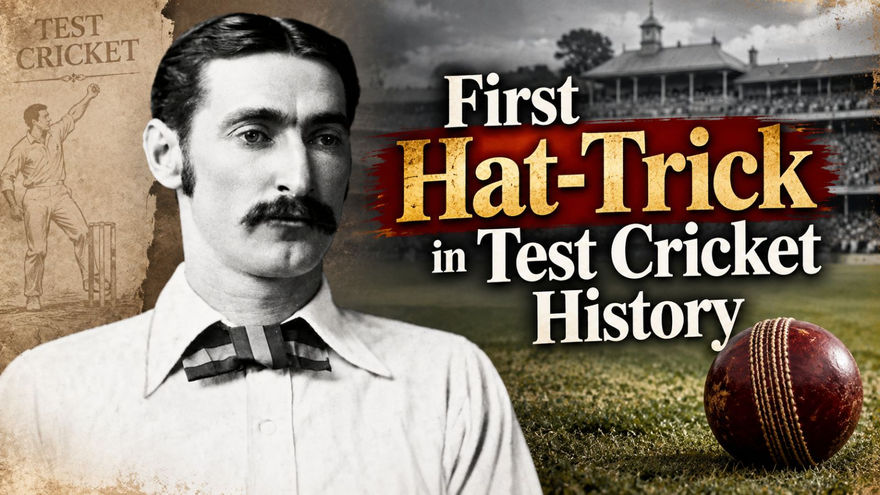
The answer is Fred Spofforth of Australia, who achieved the feat against England at the Melbourne Cricket Ground (MCG) on January 2, 1879. It was only the third Test match ever played, making Spofforth the first bowler to put his name in this particular chapter of Test history.
Known as “The Demon Bowler,” Spofforth was already regarded as one of the leading bowlers of his era. His hat-trick came during a dominant performance in which he took six wickets for 48 runs in England’s first innings and finished the match with 13 wickets for 110 runs. Australia won the Test by 10 wickets.
Fred Spofforth’s Historic Test Hat-Trick
The match between Australia and England took place at the MCG from January 2 to 4, 1879. It was a timeless Test, meaning it was not restricted to the fixed number of days used in modern Test cricket.
England won the toss and batted first, but Australia’s bowlers kept the touring side under pressure. England were eventually dismissed for 113, with Spofforth claiming 6/48.
Spofforth’s hat-trick came when England were reduced to 26 for five wickets. He dismissed Vernon Royle, Francis MacKinnon and Tom Emmett with three successive deliveries, completing the first hat-trick in Test cricket.
The Three Wickets
Ball | Batter | Dismissal | Score |
First | Vernon Royle | Bowled Spofforth | 26 |
Second | Francis MacKinnon | Bowled Spofforth | 26 |
Third | Tom Emmett | Caught Tom Horan, bowled Spofforth | 26 |
The three wickets all fell without a run being added. Emmett was caught by Tom Horan, completing the historic sequence.
Spofforth then continued to trouble England in the match. He took another seven wickets in the second innings, finishing with match figures of 13/110. Australia needed only 18 runs in its second innings and reached 19 without losing a wicket to win by 10 wickets.
Who Was Fred Spofforth?
Frederick Robert Spofforth was one of the defining bowlers of early Australian cricket. His reputation extended beyond raw pace. Contemporary assessments highlighted his ability to change pace, vary his flight and make the ball move from the pitch.
That versatility helped explain why he was so difficult to face on the uncovered and often unpredictable pitches of 19th-century cricket.
Spofforth was later widely known as “The Demon Bowler.” His most famous performances came in the early years of international cricket, including his extraordinary display against England at The Oval in 1882.
His career statistics underline his importance to early Australian Test cricket. Spofforth took 94 wickets in 18 Tests, with an average of 18.41.
First Hat-Tricks in Test, ODI and T20I Cricket
Spofforth’s achievement can also be placed alongside the first hat-tricks in the other major international formats.
Format | Bowler | Country | Date | Opponent |
Test | Fred Spofforth | Australia | January 2, 1879 | England |
ODI | Jalal-ud-Din | Pakistan | September 20, 1982 | Australia |
T20I | Australia | September 16, 2007 | Bangladesh |
The Test milestone came decades before limited-overs international cricket was established. Jalal-ud-Din recorded the first ODI hat-trick in 1982, while Brett Lee became the first bowler to achieve the feat in men's T20 internationals in 2007.
Does a Test Hat-Trick Have to Happen in One Over?
No.
A hat-trick is based on three consecutive deliveries from the bowler, not necessarily three balls from the same over. The sequence can therefore cross an over, provided the bowler takes a wicket with each of his next three deliveries.
In Test cricket, the sequence can even extend across innings of the same match. A bowler can take two wickets with consecutive deliveries at the end of one innings and complete the hat-trick with his next delivery when his team bowls again.
However, the sequence cannot carry over from one match to another.
Who Has Taken Multiple Test Hat-Tricks?
Spofforth was the first, but he was not the only Australian to achieve the feat more than once.
Hugh Trumble took two Test hat-tricks against England at Melbourne, while Jimmy Matthews produced one of the most unusual achievements in Test history by taking two hat-tricks in the same Test against South Africa in 1912.
Other bowlers have also joined the multiple-hat-trick group, including Pakistan’s Wasim Akram and England’s Stuart Broad.
The Origins of the Term “Hat-Trick”
The term itself predates Test cricket.
It is traditionally associated with English cricketer H. H. Stephenson, who took three wickets with three consecutive deliveries in 1858. Supporters reportedly collected money to present him with a hat in recognition of the achievement.
The phrase subsequently became part of cricket's vocabulary and eventually spread into other sports and everyday language.
Fred Spofforth’s Place in Test Cricket History
When asking who took the first hat-trick in Test cricket history, there is no ambiguity: it was Fred Spofforth of Australia.
On January 2, 1879, at the MCG, Spofforth dismissed Vernon Royle, Francis MacKinnon and Tom Emmett with three consecutive deliveries. The sequence formed the first Test hat-trick, while his six-wicket first-innings haul and 13-wicket match performance helped Australia secure a 10-wicket victory.
More than a century later, the feat remains one of the defining milestones from Test cricket's earliest years. Spofforth's name sits at the beginning of a list that has grown only slowly, underlining just how difficult three wickets in three consecutive balls can be in the longest format.