
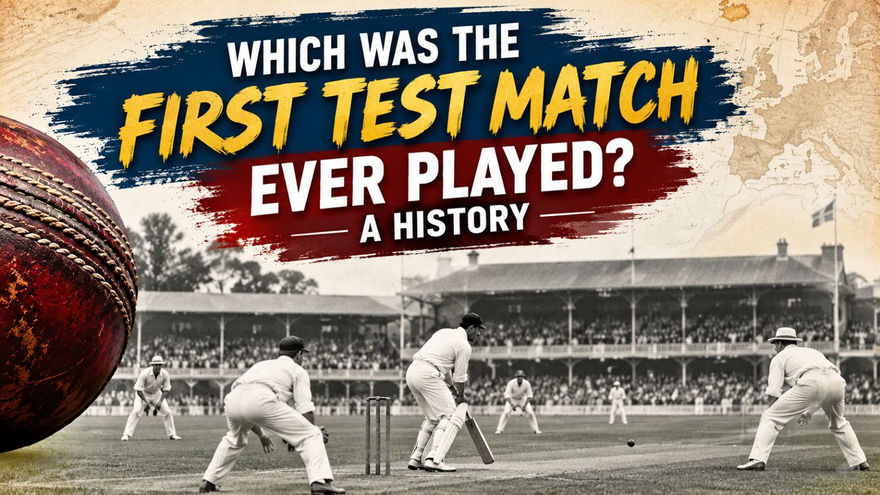
The answer to which was the first Test match ever played takes us back to March 15, 1877, when an Australian XI faced a touring team of English professional cricketers at the Melbourne Cricket Ground (MCG).
The match, played from March 15 to March 19, 1877, is widely recognized as the first Test match in cricket history. Australia won by 45 runs, beginning a rivalry with England that would later become one of the defining contests in international cricket.
At the time, however, nobody called it a "Test match." The game was promoted as the "Great Combination Match," and the terminology of Test cricket developed only later.
First Test Match: Quick Facts
Match Detail | Historic Record |
Date | March 15–19, 1877 |
Venue | Melbourne Cricket Ground (MCG), Australia |
Teams | Australia XI vs James Lillywhite's XI |
Format | Timeless match |
Result | Australia won by 45 runs |
First Delivery | Alfred Shaw to Charles Bannerman |
First Test Century | Charles Bannerman – 165 |
First Five-Wicket Haul | Billy Midwinter – 5/78 |
Match-Winning Bowling | Tom Kendall – 7/55 in England's second innings |
The match lasted four days, with no fixed time limit. That was typical of early first-class cricket, when matches could continue until both sides had completed their required innings.
How Did the First Test Match Come About?
International cricket looked very different in the 19th century. Before 1877, touring English teams regularly travelled to Australia for commercial cricket matches.
These tours were not always played under the conditions used in modern international cricket. English professional sides could face local teams with 18 or even 22 players, giving the Australians a numerical advantage designed to balance the contest.
By the mid-1870s, Australian cricket had developed considerably. The country's leading players were increasingly capable of competing against experienced English professionals on equal terms.
When James Lillywhite brought his touring team to Australia in late 1876, the conditions were therefore right for a match between two sides of 11 players each.
That contest began at the MCG on March 15, 1877.
From Exhibition Matches to International Cricket
The progression can be summarized simply:
English teams toured Australia for commercial matches.
Australian sides gained experience and improved their standard.
Equal 11-a-side contests became possible.
Lillywhite's touring team met an Australian XI at the MCG.
The March 1877 match later became recognized as the first Test.
This development helped establish the foundation for international long-format cricket.
What Happened in the First Test Match?
Australia won the historic match by 45 runs, but the result was only one part of its significance.
The game produced several milestones that remain important in Test cricket history. Australian opener Charles Bannerman dominated the first innings, while Billy Midwinter and Tom Kendall made important contributions with the ball.
Charles Bannerman Scores the First Test Century
Charles Bannerman made history as the first batter to score a century in Test cricket.
He scored 165 runs, making him the leading contributor in Australia's first innings total of 245. Bannerman eventually retired hurt after suffering a split index finger.
His innings was remarkable for another reason. He scored approximately 67.3% of Australia's runs scored off the bat in that innings, an extraordinary share of a completed team innings.
Bannerman's 165 remains one of the most recognizable individual performances from the earliest days of Test cricket.
The First Test Match's Historic Firsts
The 1877 match produced several milestones that shaped the statistical history of Test cricket.
Historic First | Player | Significance |
First Ball | Alfred Shaw | Bowled the opening delivery to Charles Bannerman |
First Run | Charles Bannerman | Recorded the first run in Test cricket |
First Century | Charles Bannerman | Scored 165 |
First Wicket | Allen Hill | Dismissed Nat Thomson for 1 |
First Five-Wicket Haul | Billy Midwinter | Took 5/78 in England's first innings |
First Match Seven-Wicket Haul | Tom Kendall | Took 7/55 in England's second innings |
These achievements give the match a unique place in cricket's record books.
Tom Kendall's Match-Winning Spell
Australia's victory was secured in the fourth innings.
England needed 154 runs to win, but the visitors were bowled out for just 108. Australian left-arm orthodox spinner Tom Kendall played the central role, taking 7 wickets for 55 runs.
His spell ended England's chase and gave Australia a 45-run victory.
Kendall's performance is particularly significant because it came in the decisive innings of the match. His seven-wicket haul helped establish Australia's first major victory in what would become Test cricket.
Was the 1877 Match Really Called a Test?
Not at the time.
This is one of the most important points when discussing the first Test match. The March 1877 contest was promoted as the "Great Combination Match." The phrase "Test match" was adopted more widely only later as international cricket became more organized.
Therefore, describing the MCG encounter as the first Test is a historical classification applied retrospectively.
The match itself was still an international contest between Australia and England, but the formal language and structure associated with Test cricket developed over subsequent decades.
Was the First Test Match Part of the Ashes?
No.
The Ashes did not exist in 1877. The famous England-Australia rivalry had already begun, but the Ashes name came later.
The term originated after Australia's victory over England at The Oval in London in 1882. The famous mock obituary published afterward referred to English cricket being "dead," with the implication that its ashes would be taken to Australia.
That incident eventually gave the England-Australia rivalry its most famous name.
So, while the 1877 match is part of the historical foundation of the rivalry, it was not an Ashes Test.
Was It the First International Cricket Match?
No.
International cricket predates the 1877 Australia-England match. Canada and the United States played an international cricket match in New York in 1844, more than three decades earlier.
The distinction is that the 1844 fixture was not granted official Test status.
The March 1877 Australia-England match is instead recognized as the first Test match, making it the starting point of Test cricket as an international format.
Why Was the First Test a Timeless Match?
The 1877 contest did not have the fixed five-day structure associated with modern Test cricket.
It was played as a timeless match, meaning there was no predetermined limit on the number of days. The game continued until the required innings were completed.
This approach was common in early cricket. The modern five-day Test format developed much later.
The first Test therefore provides a useful reminder of how different international cricket was in the 19th century. There were no modern restrictions on playing time, no limited-overs formats, and none of the standardized scheduling familiar to today's fans.
The Legacy of the First Test Match
The significance of March 15, 1877 goes beyond the result.
Australia's 45-run victory established an early international cricket rivalry and provided the foundation for what became Test cricket. The match also produced a collection of historic firsts, from Bannerman's opening-century milestone to Kendall's decisive seven-wicket haul.
The importance of the match was reinforced exactly 100 years later, when Australia and England returned to the MCG for the Centenary Test in 1977.
Australia again won by 45 runs, matching the margin of victory from the original 1877 encounter.
That remarkable coincidence connected the first Test with its centenary celebration and highlighted the enduring importance of the Australia-England rivalry.
Frequently Asked Questions
Which was the first Test match ever played?
The first Test match ever played was Australia vs England at the Melbourne Cricket Ground, beginning on March 15, 1877. Australia won by 45 runs.
Who won the first Test match in cricket history?
Australia won the first Test match, defeating England by 45 runs at the MCG in 1877.
Who scored the first century in Test cricket?
Charles Bannerman of Australia scored the first Test century. He made 165 in Australia's first innings.
Who bowled the first ball in Test cricket?
English bowler Alfred Shaw delivered the first ball of Test cricket to Australian opener Charles Bannerman.
Who took the first five-wicket haul in Test cricket?
Billy Midwinter of Australia recorded the first five-wicket haul, taking 5/78 in England's first innings.
Who took seven wickets in the first Test match?
Australian bowler Tom Kendall took 7/55 in England's second innings, helping Australia secure its 45-run victory.
Why was the first Test match played without a time limit?
The match followed the timeless Test format. There was no fixed number of playing days, and the contest continued until the required innings were completed.
Also Read |