

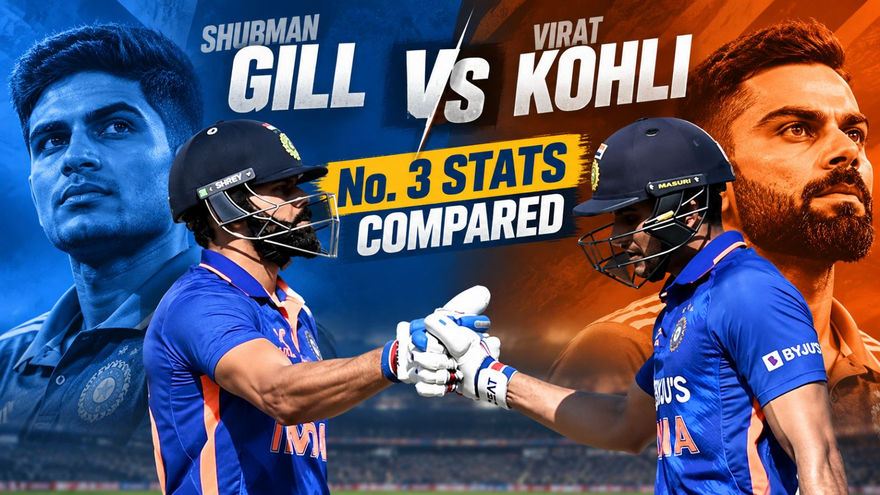
Batting at No. 3 demands a rare combination of technique, judgment and adaptability. A batter can be walking in during the opening overs with the new ball still moving, or arriving after a strong start with the job of turning it into a big total. The role changes quickly, often within the same innings.
Virat Kohli made No. 3 his defining position in ODI cricket, building one of the strongest statistical records in the format. Shubman Gill, meanwhile, has taken on No. 3 in Test cricket after moving away from the opening role. That makes a direct comparison interesting, but also requires context because their workloads at the position are very different.
This Shubman Gill vs Virat Kohli comparison looks at their records at No. 3 across Test and ODI cricket, along with their batting styles, tactical strengths and the limitations of comparing players with such different sample sizes.
Shubman Gill vs Virat Kohli: Test Stats at No. 3
The Test comparison needs an important qualification. Virat Kohli spent most of his Test career at No. 4 rather than No. 3, while Shubman Gill has embraced No. 3 as part of India's changing top order.
Gill moved from opening to No. 3 in red-ball cricket during the 2023–2025 World Test Championship cycle. The move helped accommodate Yashasvi Jaiswal as an opener alongside Rohit Sharma and placed Gill in a position traditionally associated with India's specialist top-order batters.
Test Cricket Comparison at No. 3
Metric | Shubman Gill | Virat Kohli |
Innings batted | 20+ | 6 |
Runs scored | 900+ | 167 |
Batting average | ~42.50 | 19.75 |
Centuries | 3 | 0 |
Half-centuries | 3 | 1 |
Highest score | 110 | 58 |
Figures reflect the records cited in the original comparison and refer specifically to innings at No. 3.
The difference in sample size is crucial. Gill has accumulated substantially more innings at the position, while Kohli's No. 3 Test record comes from only six innings.
Gill's record therefore provides a much clearer picture of how he has performed in the role. His centuries at No. 3 also underline his ability to convert starts into substantial red-ball innings.
Kohli's Test legacy, however, was built primarily at No. 4. His limited time at No. 3 should not be treated as a direct representation of his overall Test batting career.
Virat Kohli vs Shubman Gill: ODI Record at No. 3
The comparison changes dramatically in ODI cricket.
Kohli has spent a huge portion of his ODI career batting at No. 3 and has produced an enormous volume of runs from the position. Gill, by contrast, has generally opened for India in ODIs and has had only a small number of opportunities at first drop.
ODI Cricket Comparison at No. 3
Metric | Shubman Gill | Virat Kohli |
Innings batted | 5 | 225+ |
Runs scored | 210+ | 12,820+ |
Batting average | ~52.00 | 61.00+ |
Strike rate | ~92.50 | 94.50+ |
Centuries | 0 | 43+ |
Half-centuries | 2 | 62+ |
Figures reflect the records cited in the original comparison and refer specifically to the No. 3 position.
Kohli's advantage here is not simply a matter of having more runs. His enormous sample size at No. 3 has allowed him to establish a highly developed method for pacing ODI innings.
He has regularly combined low-risk singles and twos with boundary scoring, allowing him to maintain pressure without relying solely on aggressive strokeplay. This approach has been particularly effective when chasing targets, where the required run rate provides a clear framework for risk management.
Gill's overall ODI record shows why he remains an important part of India's top order, but his experience at No. 3 is too limited for a like-for-like statistical comparison with Kohli.
How Gill and Kohli Approach No. 3 Differently
Their batting styles also reflect different approaches to building an innings.
Virat Kohli
Kohli's batting at No. 3 is built around control and accumulation. He is particularly effective at rotating the strike, running between the wickets and identifying gaps rather than forcing boundaries against every delivery.
His pronounced front-foot movement and strong head position support his cover drive and off-side play. Once established, he can increase the scoring rate without completely changing his risk profile.
Shubman Gill
Gill has a more classical setup, with a high front elbow and strong extension through the off side. His back-foot play allows him to deal with short-of-length bowling, while his wrist work helps him find gaps.
In limited-overs cricket, Gill can also use boundary strokes to accelerate early, particularly when conditions allow him to attack the field.
The contrast is useful, but neither style is inherently better in every situation. The demands of the pitch, match situation and format all influence which approach is most effective.
Strengths and Limitations at No. 3
Virat Kohli
Strengths
Exceptional ODI output from No. 3.
Outstanding running between the wickets.
Strong awareness of required run rates during chases.
Extensive experience managing different match situations.
Limitations
His Test sample at No. 3 is very small.
His red-ball success was established primarily at No. 4.
Facing the new ball at No. 3 presents different technical demands from those he usually encountered at No. 4.
Shubman Gill
Strengths
Greater recent experience at No. 3 in Test cricket.
Strong back-foot play against pace.
Capable of playing long innings in red-ball cricket.
Comfortable attacking spin once established.
Limitations
His ODI sample at No. 3 remains very small.
His white-ball career has primarily been built as an opener.
Facing a brand-new red ball at first drop can expose any technical vulnerability to early movement.
The best No. 3 batters are not simply aggressive or defensive. They adjust their approach according to the match situation.
Frequently Asked Questions
Is Shubman Gill India's No. 3 batter in Test cricket?
Gill moved to No. 3 during the 2023–2025 World Test Championship cycle after previously opening. The change helped accommodate Yashasvi Jaiswal alongside Rohit Sharma at the top of India's Test order.
What is Virat Kohli's record at No. 3 in ODIs?
In the figures used for this comparison, Kohli has scored more than 12,820 ODI runs at No. 3 at an average above 61, with more than 43 centuries. His extensive sample makes his No. 3 ODI record considerably larger than Gill's.
Why did Shubman Gill move to No. 3 in Tests?
Gill moved down the order as India's Test combination changed, with Jaiswal taking an opening position alongside Rohit Sharma. Gill's technical ability and experience also made him a natural candidate for a specialist top-order role.
Has Virat Kohli scored a Test century at No. 3?
No. Kohli did not score a Test century during his limited appearances at No. 3. Most of his Test centuries came while batting at No. 4, the position where he established his long-term red-ball record.
Who has the higher ODI strike rate at No. 3?
The figures in this comparison give Kohli a strike rate above 94.5 at No. 3, compared with approximately 92.5 for Gill. However, Gill's sample at the position is only five innings, compared with more than 200 for Kohli.
Shubman Gill vs Virat Kohli at No. 3: The Key Difference
The comparison is ultimately shaped by format and sample size.
Gill has developed a substantial Test record at No. 3, making the position an important part of his red-ball career. Kohli, meanwhile, built his defining No. 3 record in ODI cricket, where his combination of accumulation, running between the wickets and controlled acceleration produced exceptional numbers over a much larger sample.
That distinction matters when assessing the two players. Gill's Test record at No. 3 is still developing, while Kohli's ODI record at the position represents a much longer body of work.
The two careers offer different examples: Gill demonstrates the demands of establishing a red-ball role at No. 3, while Kohli provides an extensive case study in controlling ODI innings from the same position.