
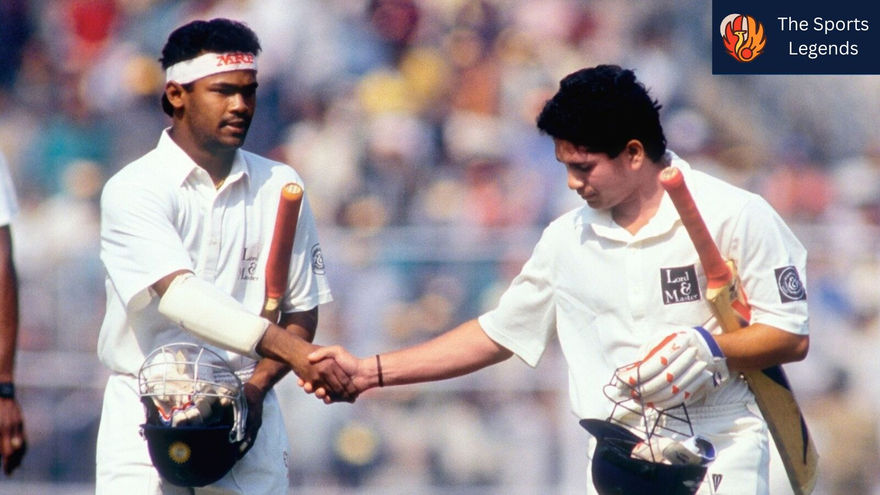
In the late 1980s, Mumbai school cricket witnessed one of the most iconic batting partnerships in history. Representing Shardashram Vidyamandir in the Harris Shield tournament, two teenage prodigies stitched together an unbeaten 664-run stand that stunned the cricketing world.
One was a disciplined and technically flawless right-hander named Sachin Tendulkar. The other was a flamboyant, naturally gifted left-hander named Vinod Kambli.
At the time, several Mumbai cricket experts believed Kambli possessed even greater raw talent than Tendulkar. Yet decades later, their careers tell completely different stories. Tendulkar retired as one of cricket’s greatest legends with 100 international centuries, while Kambli’s international career faded away before he turned 25.
So, why did Vinod Kambli fail to achieve the same greatness as Sachin Tendulkar? The answer lies in a mix of technical flaws, temperament issues, mental setbacks, and the unforgiving nature of international cricket.
Vinod Kambli’s Incredible Start to International Cricket
Few cricketers in history have started their Test careers as explosively as Vinod Kambli.
In just his first seven Test matches, Kambli scored:
Two double centuries
Two centuries
Over 1,000 Test runs at a staggering average above 100 at one stage
He became the first Indian batter to score consecutive Test double centuries:
224 vs England
227 vs Zimbabwe
For a brief period, Kambli looked destined to become India’s next batting superstar.
Player | Test Matches | Runs | Highest Score | Batting Average | Centuries |
Vinod Kambli | 17 | 1,084 | 227 | 54.20 | 4 |
Sachin Tendulkar | 200 | 15,921 | 248* | 53.78 |
Ironically, Kambli finished with a higher Test batting average than Tendulkar. However, greatness in cricket is defined not just by brilliance, but by consistency and longevity. Tendulkar sustained elite performance for 24 years, while Kambli’s Test career ended after only 17 matches.
Technical Weakness Against Fast Bowling
One of the biggest reasons behind Vinod Kambli’s downfall was his vulnerability against high-quality pace bowling, especially short-pitched deliveries.
Kambli dominated domestic cricket with his aggressive strokeplay and natural hand-eye coordination. However, international bowlers quickly identified weaknesses in his technique.
During India’s 1994-95 series against the West Indies, fast bowlers like Courtney Walsh consistently targeted Kambli with bouncers and rising deliveries. Unlike Tendulkar, Kambli struggled to:
Duck under short balls
Play controlled hook shots
Adjust quickly against express pace
His high backlift and limited footwork made him uncomfortable against genuine fast bowling.
Meanwhile, Tendulkar possessed:
Compact technique
Better balance
Strong back-foot game
Superior shot selection under pressure
Once opponents discovered Kambli’s weakness against the short ball, teams across the world repeatedly exploited it.
Temperament and Lifestyle Differences
Talent alone is never enough to survive at the highest level of sport. Mental discipline and professionalism often separate legends from gifted players.
Both Tendulkar and Kambli came from humble backgrounds, but they handled fame very differently.
Tendulkar remained deeply focused on cricket throughout his career. Guided by his brother Ajit Tendulkar and coach Ramakant Achrekar, he maintained exceptional discipline and constantly worked on improving his game.
Kambli, on the other hand, embraced celebrity life early:
Media attention
Glamorous lifestyle
Flashy public image
Off-field distractions
Over time, questions emerged about his consistency, preparation, and commitment.
While Tendulkar responded to failures with relentless practice sessions, Kambli struggled to maintain the same level of focus required to survive in elite international cricket.
The 1996 World Cup Semi-Final Changed Everything
A major turning point in Kambli’s career came during the 1996 Cricket World Cup semi-final between India and Sri Lanka at Eden Gardens.
India collapsed dramatically while chasing 252, falling from 120/1 to 120/8. The crowd erupted in chaos, forcing the match to be awarded to Sri Lanka.
Kambli remained unbeaten on 10 and famously walked off the field in tears.
That emotional moment became symbolic of his career trajectory. Many believe the psychological impact of that night permanently affected his confidence and mindset.
Although Kambli received several ODI comebacks afterward, he never looked like the fearless batter who once dominated Test cricket.
Poor Timing and Harsh Selection Policies
The era in which Kambli played also contributed heavily to his downfall.
During the 1990s, Indian cricket selection policies were extremely unforgiving. Players were often dropped after short periods of poor form, with little patience shown by selectors.
Tendulkar was recognized early as a once-in-a-generation talent and received long-term backing from team management even during difficult phases.
Kambli never received the same support.
After struggling against fast bowling during overseas tours and against the West Indies, he was dropped from the Test side permanently in 1995 — despite averaging 54.20 in Test cricket.
Shockingly:
Kambli played his final Test at just 23 years old
He never received another opportunity in Test cricket
He made multiple ODI comebacks but lacked stability and confidence
The constant pressure to perform immediately made it difficult for him to rebuild his career.
Sachin Tendulkar vs Vinod Kambli: Talent vs Discipline
The contrasting careers of Sachin Tendulkar and Vinod Kambli remain one of the greatest examples of how talent alone cannot guarantee sporting greatness.
Tendulkar combined:
Extraordinary skill
Technical perfection
Mental toughness
Incredible work ethic
Long-term consistency
Kambli possessed immense natural ability, but several factors held him back:
Technical flaws against pace
Difficulty handling pressure
Lifestyle distractions
Lack of institutional support
Declining confidence
Ultimately, Vinod Kambli’s story is not about lack of talent. It is about how difficult it is to sustain excellence at the highest level of cricket.
He remains one of Indian cricket’s greatest “what if” stories — a player blessed with extraordinary ability, whose career burned brightly but faded far too quickly.
More Stories on Sachin Tendulkar