
Death bowling is one of the toughest skills in limited-overs cricket. With batters attacking almost every delivery in the final overs, bowlers must combine accuracy, variations and composure to defend totals and restrict scoring.
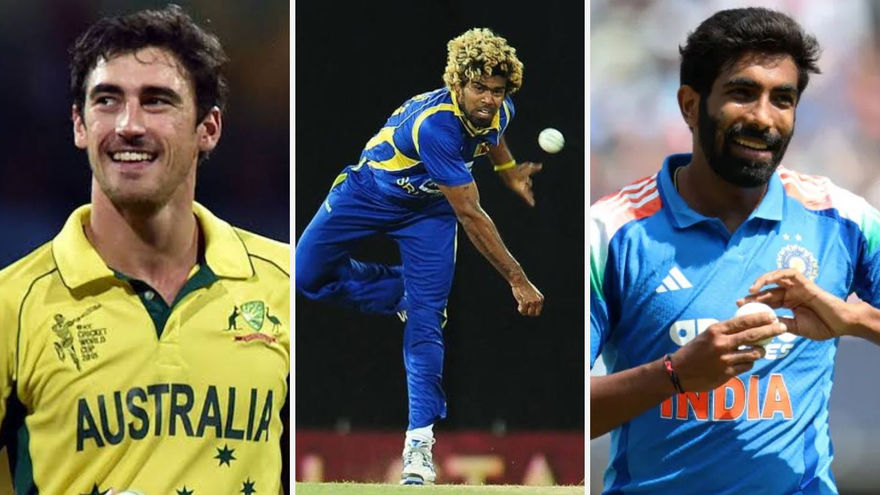
From Lasith Malinga's toe-crushing yorkers to Jasprit Bumrah's deceptive slower balls, the greatest death bowlers have developed different techniques to succeed under pressure.
Here are the 10 greatest death bowlers of all time, ranked by their skills, consistency, international achievements and performances in crucial matches.
What Is Death Bowling in Cricket?
Death bowling refers to the final phase of a limited-overs innings, when batters look to maximise their scoring.
ODI cricket: Generally the final 10 overs (41–50).
T20 cricket: Usually the final five overs (16–20).
The best death bowlers rely on three key skills:
Yorkers: Deliveries aimed at the batter's feet or the base of the stumps.
Variations: Slower balls, cutters, bouncers and wide yorkers that disrupt batting rhythm.
Tactical awareness: Using field placements and bowling angles to limit scoring opportunities.
Top 10 Greatest Death Bowlers of All Time
Rank | Bowler | Country | Signature Weapon |
1 | Lasith Malinga | Sri Lanka | Sling-arm yorkers |
2 | Jasprit Bumrah | India | Yorkers and slower balls |
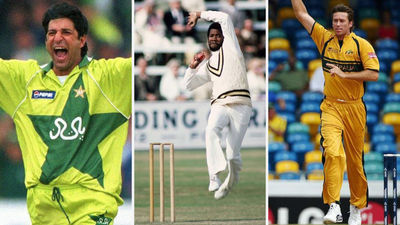
3 | Wasim Akram | Pakistan | Reverse-swinging yorkers |
4 | Waqar Younis | Pakistan | In-swinging toe-crushers |
5 | Mitchell Starc | Australia | Left-arm swinging yorkers |
6 | Dwayne Bravo | West Indies | Slower balls and cutters |
7 | Umar Gul | Pakistan | Reverse swing |
8 | Shaun Pollock | South Africa | Accuracy and cutters |
9 | Trent Boult | New Zealand | Angled yorkers |
10 | Mustafizur Rahman | Bangladesh | Deceptive off-cutters |
1. Lasith Malinga (Sri Lanka)
Lasith Malinga is widely regarded as one of the greatest death bowlers in cricket history. His distinctive sling-arm action and ability to execute yorkers consistently made him extremely difficult to attack.
His biggest weapon was the toe-crushing yorker, which he combined with deceptive slower balls.
One of his finest performances came in the 2019 IPL Final, when he defended nine runs in the final over for Mumbai Indians. His slower yorker dismissed Shardul Thakur LBW on the final delivery, securing a one-run victory.
Malinga also achieved the remarkable feat of taking four wickets in four balls twice in international cricket: against South Africa in the 2007 ODI World Cup and New Zealand in a 2019 T20I.
2. Jasprit Bumrah (India)
Jasprit Bumrah is one of the most effective modern death bowlers. His unusual bowling action, high release point and ability to disguise variations make him difficult to read.
He combines high-speed yorkers with slower balls, cutters and well-directed bouncers. His accuracy allows him to execute these deliveries even under extreme pressure.
Bumrah demonstrated his death-bowling ability in the 2024 T20 World Cup Final against South Africa. With South Africa needing 30 runs from the final 30 balls, he conceded just six runs across the 16th and 18th overs and dismissed Marco Jansen.
3. Wasim Akram (Pakistan)
Known as the Sultan of Swing, Wasim Akram was one of the pioneers of modern death bowling.
He used reverse swing with the older white ball to trouble batters, particularly through late-swinging yorkers that were difficult to anticipate.
His defining performance came in the 1992 World Cup Final against England, when he dismissed Allan Lamb and Chris Lewis with consecutive reverse-swinging deliveries.
Akram finished his ODI career with 502 wickets at an economy rate of 3.89, becoming the first bowler to cross 500 ODI wickets.
4. Waqar Younis (Pakistan)
Waqar Younis formed one of cricket's most feared fast-bowling partnerships with Wasim Akram.
While Akram relied heavily on swing and variations, Waqar became famous for his extreme pace and late in-swinging yorkers. His ability to target the base of the stumps made him particularly dangerous in the closing overs.
Waqar finished his ODI career with 416 wickets and 13 five-wicket hauls. His aggressive bowling and toe-crushing yorkers earned him the nickname Burewala Express.
5. Mitchell Starc (Australia)
Mitchell Starc is among the most dangerous left-arm fast bowlers in limited-overs cricket. His combination of pace, late swing and accurate yorkers makes him a major threat during the final overs.
His performances in the ODI World Cup highlight his ability to deliver in major tournaments. Starc took 22 wickets in the 2015 World Cup and 27 wickets in the 2019 edition, finishing as the leading wicket-taker in both tournaments.
His tall release point and ability to generate high pace make his yorkers particularly difficult to attack.
6. Dwayne Bravo (West Indies)
Dwayne Bravo proved that death bowling does not always require extreme pace. Instead, he built his reputation around slower balls, cutters and wide yorkers.
His dipping slower deliveries frequently forced batters to mistime their shots, making him particularly effective in T20 cricket.
Bravo became the first bowler to reach 500 and 600 wickets in T20 cricket, finishing with 631 career T20 wickets. He also won two T20 World Cups with West Indies in 2012 and 2016, alongside multiple IPL titles with Chennai Super Kings.
7. Umar Gul (Pakistan)
Umar Gul was one of the leading death bowlers during the early years of T20 International cricket.
His ability to generate reverse swing with the older white ball made him particularly effective in the closing overs.
His standout performance came against New Zealand at the 2009 ICC World T20, where he recorded extraordinary figures of 5/6 in three overs.
Gul also became the first bowler to claim multiple five-wicket hauls in T20 Internationals.
8. Shaun Pollock (South Africa)
Shaun Pollock relied on accuracy and discipline rather than express pace or extravagant variations.
His ability to consistently hit the right areas made it difficult for batters to score freely in the closing overs. He regularly targeted the off-stump channel and used cutters to disrupt batting rhythm.
Pollock finished his ODI career with 393 wickets at an economy rate of just 3.67 across 303 matches.
9. Trent Boult (New Zealand)
Trent Boult is best known for his new-ball swing, but his ability to contribute during the closing overs makes him a versatile limited-overs bowler.
His natural angle across right-handed batters allows him to attack the stumps with yorkers or use wider deliveries to challenge their outside edge.
His performances in international cricket and T20 leagues, including the IPL, have demonstrated his effectiveness across different phases of an innings.
10. Mustafizur Rahman (Bangladesh)
Mustafizur Rahman became an international sensation in 2015 through his deceptive cutters and variations.
His ability to take pace off the ball while maintaining a similar bowling action makes him particularly effective on slower pitches. His off-cutters grip the surface and move away from right-handed batters, making clean hitting difficult.
Mustafizur played an important role in Sunrisers Hyderabad's 2016 IPL title-winning campaign. He won the Emerging Player award after maintaining an economy rate of 6.90.
Frequently Asked Questions
1. Who is the greatest death bowler of all time?
Lasith Malinga is widely regarded as one of the greatest death bowlers because of his exceptional yorkers, consistency and success in international and franchise cricket. Jasprit Bumrah is among the strongest modern challengers.
2. Why are yorkers effective in death overs?
Yorkers land near the batter's feet, making it difficult to get underneath the ball and generate elevation. Accurate yorkers can restrict boundaries and create bowled or LBW opportunities.
3. How does dew affect death bowling?
Dew makes the ball slippery and reduces a bowler's grip. This makes slower balls and cutters harder to execute, increasing the importance of accurate yorkers.
4. Which spinner is best at death bowling?
Rashid Khan and Sunil Narine are among the most respected T20 spin specialists in the closing overs. Their variations, accuracy and ability to restrict scoring make them valuable options.
Also Read | Greatest Opening Batsmen of All Time in Cricket