
The 1982 FIFA World Cup in Spain arrived at a pivotal crossroads in international football. The game was moving away from the tactical romanticism of the 1970s—still echoing Dutch Total Football—toward an era defined by greater athleticism, tactical discipline, and relentless media scrutiny. The geopolitical backdrop only sharpened the tournament’s intensity: Argentina arrived carrying the shadow of the Falklands War, and a Europe divided by the Cold War watched every result through that prism.
But the dominant storyline of Spain 1982 centred on one man: Paolo Rossi. Fresh from a two-year ban linked to the 1980 Totonero match-fixing scandal, Rossi’s inclusion by Italy manager Enzo Bearzot was widely derided by the press. Critics described him as out of form and compromised. What followed was one of football’s most dramatic redemptions—an outcast transformed into a national icon.
Beyond Rossi’s personal arc, Spain 1982 offered a larger clash of footballing philosophies. Tele Santana’s Brazil produced arguably the most beautiful team of the modern era—fluid, inventive and audacious—yet they fell to a pragmatic, defensively rigorous Italy. The tournament became a turning point: the romance of attacking flair confronted the cold efficiency of structured defending, and for the moment, pragmatism prevailed.
Tournament snapshot
Host nation: Spain
Teams: 24 (expanded from 16 in 1978)
Format: Two group stages—six groups of four, then four groups of three. Winners of second-stage groups progressed to the semi-finals.
Champion: Italy (third title)
Runner-up: West Germany
Third place: Poland
Golden Ball: Paolo Rossi (Italy)
Golden Boot: Paolo Rossi (Italy) — 6 goals
Best Young Player: Manuel Amoros (France)
Road to the World Cup
The expansion to 24 teams broadened the tournament’s global reach and introduced several debutants: Algeria, Cameroon, Honduras, Kuwait, and New Zealand. The change enriched the World Cup’s diversity but also produced more uneven group dynamics. Traditional powers like the Netherlands failed to qualify, and England entered in transition, missing key veterans such as Kevin Keegan due to injury.
Brazil arrived as favorites. With a midfield of Zico, Sócrates, Falcão and Toninho Cerezo, they had enchanted the world with a South American brand of football that blended flair with technical mastery. Close contenders included Karl-Heinz Rummenigge’s West Germany and Diego Maradona’s Argentina. Italy, by contrast, arrived under a cloud—scraping through qualification and widely seen as a fractured, defensive-minded side unlikely to challenge for the trophy.
Group stage recap
The first group stage produced shock results and tactical imbalances.
Italy advanced from Group 1 without winning a game, drawing all three matches against Poland, Peru and Cameroon. They progressed only by scoring one more goal than Cameroon.
Algeria stunned West Germany 2–1 in Group 2, one of the tournament’s earliest upsets. But their elimination after the West Germany–Austria match in Gijón—the so-called "Disgrace of Gijón"—remains one of football’s darkest episodes. Both European sides needed only a slim West German win; after Horst Hrubesch’s 10th-minute goal they largely stopped competing and ensured mutual qualification, leaving Algeria eliminated on goal difference.
Northern Ireland topped Group 5 after a famous 1–0 win over hosts Spain, propelled by Billy Bingham’s organization and 17-year-old Norman Whiteside, who became the youngest World Cup player.
Hungary inflicted the tournament’s biggest rout, beating El Salvador 10–1, though neither side progressed from Group 3, which Argentina and Belgium won.
Second group stage: the crucible
The second group stage replaced traditional knockout rounds and produced the tournament’s most dramatic clashes.
Barcelona’s Group C—Italy, Brazil and Argentina—was football theatre at its finest. Italy opened by outworking Argentina, and Claudio Gentile’s relentless marking neutralised Maradona. Italy’s 2–1 win set up a winner-takes-all showdown with Brazil.
On July 5, 1982, at Estadi de Sarrià, Brazil needed only a draw; Italy needed victory. Paolo Rossi, largely anonymous earlier in the tournament, found his touch. He opened with a clinical header, Sócrates equalised, and Rossi scored again after capitalising on a defensive lapse by Cerezo. Falcão levelled with a spectacular long-range strike, a scoreline that would have sent Brazil through. But with 16 minutes remaining, Rossi finished from close range after a corner to complete a hat-trick. Dino Zoff’s late, match-saving stop from Oscar sealed a 3–2 win for Italy. The match remains one of the greatest World Cup encounters—brilliance and beauty meeting ruthless efficiency.
Semi-finals
Italy faced Poland in the semis and progressed comfortably with a 2–0 win; Rossi scored both goals, confirming his return to form.
The West Germany–France semi-final in Seville is remembered as an operatic classic. Tied 1–1 at full time, France surged to a 3–1 lead in extra time through Marius Trésor and Alain Giresse. West Germany, with Rummenigge entering despite injury, staged a miraculous comeback to make it 3–3. The match became the first World Cup game decided by a penalty shootout; West Germany prevailed 5–4. Off the field, the contest was marred by Harald Schumacher’s brutal, unpunished collision with Patrick Battiston, which left Battiston unconscious and controversially unprotected by the referee.
The final
On July 11 at the Santiago Bernabéu in Madrid, Italy met an exhausted West Germany. The first half was cagey—Antonio Cabrini missed an uncharacteristic penalty for Italy—but the match opened after halftime.
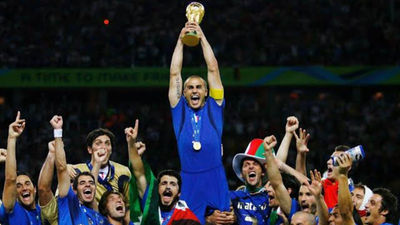
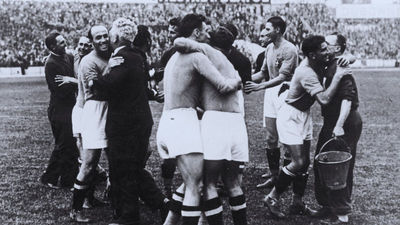
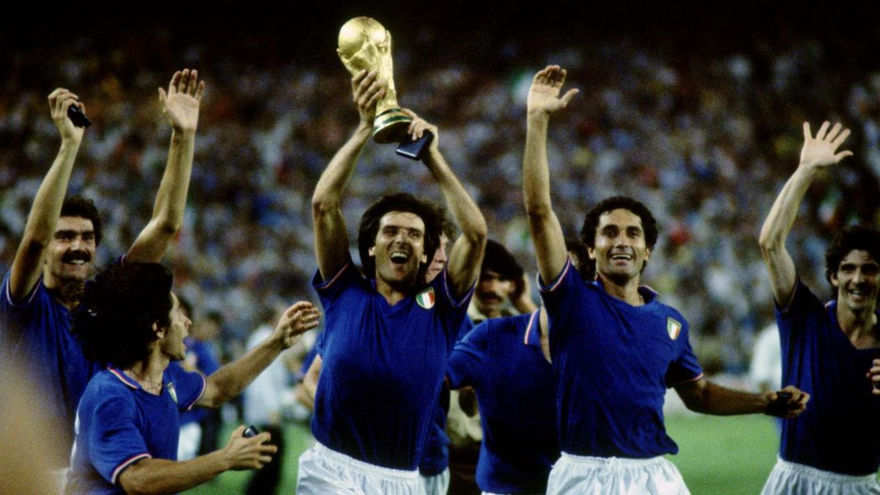
In the 57th minute Paolo Rossi darted in to head home from a Claudio Gentile cross. Marco Tardelli doubled the lead soon after with a ferocious strike that produced the tournament’s most enduring celebration: Tardelli’s raw scream and tears captured the emotional release of a nation. Alessandro Altobelli added a third on the counter, and Paul Breitner’s late goal for Germany was merely a consolation. Italy won 3–1, and 40-year-old captain Dino Zoff lifted the trophy.
Defining moments
Sarrià and Rossi’s hat-trick: That match reshaped perceptions of tactical balance—attacking beauty versus defensive discipline—and became the tournament’s defining moment.
Tardelli’s scream: A single image that has come to symbolise World Cup euphoria.
Schumacher–Battiston collision: A brutal incident that highlighted lapses in officiating and player safety.
Disgrace of Gijón: A match that forced FIFA to ensure final group games are played simultaneously to preserve competitive integrity.
Kuwait pitch invasion: During France vs Kuwait, Sheikh Fahad Al-Ahmed intervened on the pitch to protest a goal; the referee disallowed it after the confrontation, an extraordinary episode of off-field interference.
Standout players
Paolo Rossi (Italy)
Rossi’s arc is the template for tournament redemption. After a subdued start, he scored six goals in Italy’s final three matches against Brazil, Poland and West Germany. He operated as a classic poacher—terrific spatial awareness, sharp anticipation and a lethal first touch inside the box.
Falcão (Brazil)
Less celebrated in popular mythology than Zico, Falcão was Brazil’s tactical linchpin: elegant, expansive in passing and decisive in key moments, including his equaliser against Italy.
Dino Zoff (Italy)
At 40, Zoff’s calm leadership and vital saves—most notably the stoppage-time denial of Oscar at Sarrià—anchored Italy’s triumph.
Tactical legacy
Spain 1982 marked a shift in tactical thinking. The tournament signalled the waning influence of the attacking libero as a creative force and promoted more rigid, asymmetric defensive systems. Italy’s approach under Bearzot was a modernised Catenaccio: tight, localized man-marking (exemplified by Gentile) combined with quick vertical transitions and creative freedom for players like Bruno Conti to destabilise defences. Brazil showcased a flowing 4-2-2-2 with interchangeable forwards and overlapping full-backs (Junior, Leandro), but their lack of structural balance in transition left them exposed. The lesson for coaches was clear: aesthetic brilliance must be married to defensive solidity to win at the highest level.
Records and statistics
Top scorers: Paolo Rossi (6), Karl-Heinz Rummenigge (5), Zico (4), Zbigniew Boniek (4).
Youngest player: Norman Whiteside (Northern Ireland), 17 years 41 days.
Fastest goal: Bryan Robson (England) vs France, 27 seconds.
Highest-scoring match: Hungary 10–1 El Salvador.
Legacy
The 1982 World Cup endures as one of the sport’s most influential editions. For Italy it was more than a trophy; the triumph offered national catharsis after the turmoil of the "Years of Lead." Paolo Rossi’s transformation—from banned figure to national hero—remains one of sport’s most compelling redemption stories. Tactically, Spain 1982 nudged football towards a blend of pragmatism and flair, showing future generations that balance, not just beauty, wins championships. It forced FIFA to protect the competition’s integrity and initiated conversations about player safety and officiating standards that would echo for decades. Spain 1982 was a summer when football matured, and Paolo Rossi found his absolution.
Also Read |