
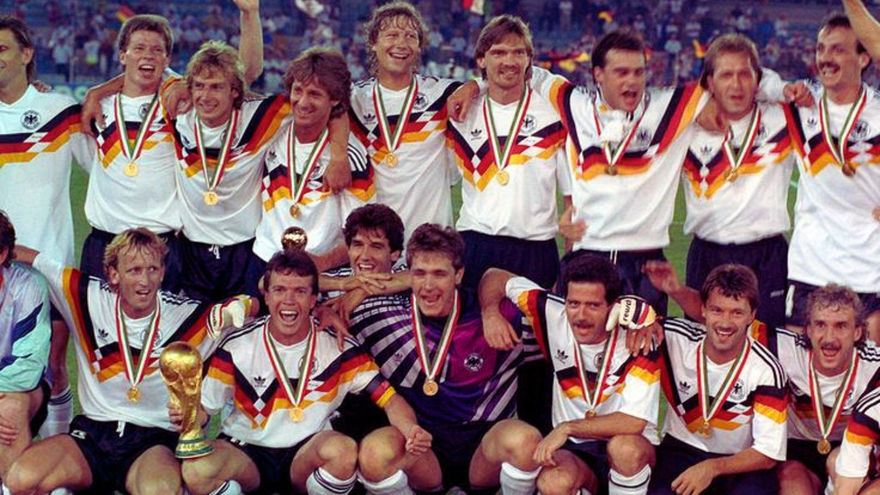
Italia ’90 occupies a conflicted place in World Cup history. Staged amid seismic geopolitical change—the fall of the Berlin Wall and the unraveling Soviet bloc—the tournament reflected a sport at a crossroads. It delivered memorable imagery, unexpected stories and the emergence of new footballing geographies. At the same time, it exposed the era’s tactical conservatism: defensive cynicism, time-wasting and physical obstruction dominated far too many matches. The end result was paradoxical: West Germany’s third World Cup title crowned a generation, but the tournament’s aesthetic failings forced FIFA to rewrite the rules and nudged football toward a faster, more open future.
Tournament snapshot
Host: Italy
Teams: 24
Format: Group stage (6 groups of 4), then a 16-team knockout bracket (four best third-placed teams advance)
Champion: West Germany (3rd title)
Runner-up: Argentina
Third place: Italy
Golden Ball / Golden Boot: Salvatore "Totò" Schillaci (Italy — 6 goals)
Best Young Player: Robert Prosinečki (Yugoslavia)
Road to the finals
Qualification for Italia ’90 rearranged the traditional hierarchy. France and Denmark failed to qualify; Scotland and Yugoslavia progressed; the Soviet Union qualified but would soon cease to exist in its previous form. Off-field scandal also intruded: Roberto Rojas’s deliberate feigning of injury in a Brazil–Chile qualifier led to Chile’s disqualification and lifetime sanctions for Rojas. The favourites arriving in Italy were clear: hosts Italy, with a world-class defensive spine; Franz Beckenbauer’s West Germany, led by Lothar Matthäus; and a still-dangerous Argentina anchored around Diego Maradona.
Group stage — shocks and storylines
The tournament opened with one of its most dramatic shocks: Cameroon stunned defending champions Argentina in Milan. François Omam‑Biyik’s towering header gave the Indomitable Lions a 1–0 lead; despite finishing with nine men, Cameroon held on for a seismic 1–0 victory that set the tone for an unpredictable tournament and announced African teams as genuine contenders.
Italy dominated their group defensively and produced the summer’s breakout star in Salvatore Schillaci, a late inclusion who scored a decisive winner against Austria and would become the competition’s unlikely hero. West Germany underlined their credentials with powerful wins, notably a 4–1 demolition of Yugoslavia, showcasing a dynamic 3-5-2 system that married defensive solidity with vertical thrust via Lothar Matthäus.
Not all giants impressed. The Netherlands—a team nominally rich with stars—struggled amid internal discord and left the group stage with three draws, while Argentina advanced precariously as a third‑placed qualifier after a bruising start.
Knockout stage — drama, controversy, and heroics
Round of 16
The knockouts intensified both drama and the tournament’s aesthetic problems. Brazil and Argentina produced a tense, tactical game in Turin: Brazil dominated possession but Argentina’s Maradona produced a decisive moment of magic, sliding a pass to Claudio Caniggia who finished to win 1–0. In another match, tensions boiled over in West Germany vs Netherlands when Frank Rijkaard spat at Rudi Völler; both were sent off, and Jürgen Klinsmann’s incisive play and Andreas Brehme’s finishing secured a 2–1 German victory.
Cameroon’s run continued to captivate. Roger Milla, the 38‑year‑old super‑sub, scored twice against Colombia—his opportunism and iconic goal celebrations helped propel Cameroon to the quarter-finals, the first African side to reach that stage.
Quarter-finals
The quarter-finals mixed high drama and dramatic comebacks. England’s meeting with Cameroon in Naples produced a frantic 3–2 extra-time win for the Three Lions after Gary Lineker converted late penalties to overturn a 2–1 deficit. West Germany edged technical Czechoslovakia while Italy’s defence remained relentless, progressing through narrow, hard-fought wins. Bulgaria upset reigning champions England’s old rival Germany in earlier knockout rounds, but it was Italy and West Germany who displayed the tournament’s prevailing emphasis on structure and discipline.
Semi-finals
The semis are indelibly etched into memory for their emotional extremes and penalty-clutch performances. Italy v Argentina in Naples became a cauldron. After a Schillaci opener, Claudio Caniggia equalised and Sergio Goycochea—Argentina’s reserve goalkeeper—emerged as the shootout hero, saving penalties to send Argentina through.
In Turin, West Germany and England contested a match that swung wildly. Andreas Brehme scored a late free-kick for Germany; Gary Lineker equalised, forcing extra time. England’s Paul Gascoigne received a booking that ruled him out of the final—his subsequent tears became the tournament’s defining emotional image. In the shootout, misses by Stuart Pearce and Chris Waddle handed West Germany the victory and a place in the final.
Third-place playoff
Italy beat England 2–1 in Bari, a more relaxed match that nevertheless confirmed Salvatore Schillaci as the tournament’s most surprising star and capped an impressive home tournament for the Azzurri.
The final — attrition, controversy, coronation
The Rome final on July 8, 1990, is often remembered as the tournament’s nadir for footballing aesthetics. Argentina set out explicitly to disrupt and delay; West Germany dominated territory but struggled to break down an ultra-low Argentinian block designed to force attrition and provoke expulsions. The match saw multiple dismissals—Pedro Monzón and Gustavo Dezotti were sent off—and produced little creative fluency.
The decisive moment arrived late. In the 85th minute, Edgardo Codesal awarded a penalty to West Germany after Rudi Völler went down under Roberto Sensini’s challenge. Despite some television replay debate over the contact, Andreas Brehme stepped up and converted with a calm, low finish. West Germany held on to win 1–0 and claim the tournament title—a deserved sporting achievement for a team built on tactical discipline and resilience, and the last World Cup won under the West German banner before reunification.
Defining moments
Cameroon’s opening upset (Cameroon 1–0 Argentina): A seismic shock that reoriented tournament expectations and spotlighted African football.
Roger Milla’s goals and celebrations: The 38‑year‑old’s impact popularized joyful celebration culture and challenged age assumptions.
Rijkaard–Völler confrontation: A notorious flashpoint symbolising the tournament’s rising tempers.
Gazza’s tears: Paul Gascoigne’s emotional reaction after a booking that cost him the final became an enduring human image.
Brehme’s penalty in Rome: The tournament’s decisive sporting moment, sealing West Germany’s coronation.
Best players
Lothar Matthäus (West Germany) — The archetypal box-to-box captain whose leadership, power and late runs propelled West Germany. His all‑round influence across midfield and defence made him the tournament’s central figure.
Salvatore Schillaci (Italy) — A true fairytale: a late call-up who became top scorer and the public face of Italia ’90, delivering crucial goals and captivating the home crowd.
Roger Milla (Cameroon) — A super‑sub who changed perceptions of African football and of veteran effectiveness at the highest level.
Tactical trends and consequences
Italia ’90 was a tactical inflection point. The tournament highlighted the limits of conservative defensive structures—time-wasting, tactical fouling and compact low blocks combined to produce an exceptionally low goals-per-game figure (2.21). The 3-5-2 with a sweeper (libero) and extreme central congestion were common; creative number‑tens were frequently starved of space.
The tournament’s perceived negativity directly prompted rule changes: FIFA’s back-pass rule (introduced in 1992) banned goalkeepers from handling deliberate passes from teammates, while stricter enforcement against cynical fouls followed. These interventions helped restore tempo and attacking intent, reshaping how teams built play from the back and reducing time-wasting strategies.
Records and statistics
Total goals: 115 (52 matches), average 2.21 goals per match (the lowest in World Cup history).
Red cards: 16 dismissals, including the first-ever World Cup final sendings (Monzón, Dezotti).
Clean-sheet record: Walter Zenga (Italy) went 517 consecutive minutes without conceding.
Penalty shootouts: Italia ’90 featured four shootouts, underscoring the tournament’s defensive deadlocks.
Legacy
On the face of it, Italia ’90 was a corrective: its tactical conservatism forced football’s governing bodies to modernize the laws to favour attacking football. It also broadened the sport’s global narrative—Cameroon’s run reshaped perceptions of African football, Gazza incarnated English emotion, and the tournament supplied memorable characters and imagery that would define the early 1990s football culture.
For West Germany, the title was a final coronation of a footballing powerhouse. The win carried symbolic weight as reunification loomed and Beckenbauer, the architect of German football, watched his nation move into an uncertain new era. More broadly, the tournament accelerated changes—both in rules and in mentality—that nudged football away from the stasis Italia ’90 exposed.
Italia ’90 is football’s great paradox: a tournament that was often tactically stifling and yet culturally electrifying. It stands as a turning point that exposed the sport’s vulnerabilities and, in doing so, triggered measures that helped restore the game’s tempo and inventive impulse. West Germany’s victory closed an era; the tournament’s real legacy was the structural rebirth of international football that followed.
Also Read |