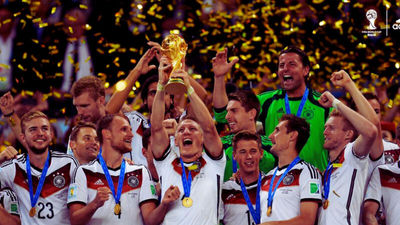

The FIFA World Cup has always been more than sport: it is a cultural mirror, a tactical laboratory, and a theatre of raw human emotion. Few editions have carried the weight of 2014 in Brazil. Returning to the spiritual home of jogo bonito for the first time since 1950, the tournament intended to exorcise old ghosts — but instead birthed new ones. Brazil 2014 became a study in extremes: the coldly engineered coronation of Germany and the most public sporting catastrophe of the 21st century.
Before the opening whistle in June 2014, world football was at a tactical crossroads. Spain’s tiki-taka — which had delivered two European Championships and the 2010 World Cup — showed signs of terminal fatigue, exposed by the physical, transition-focused models flourishing in club football. A new paradigm was emerging that blended technical possession with elite athletic intensity.
The storylines were cinematic. Could Brazil, buoyed by a patriotic nation and the flair of Neymar, finally erase the trauma of the 1950 Maracanazo? Could Lionel Messi, at the height of his powers, conjure another Maradona-esque campaign? Or would Germany’s decade-long structural rebuild finally produce a global title? The month that followed was relentless, high-scoring, and transformative.
Tournament snapshot
Host nation: Brazil
Teams: 32
Format: Group stage (8 groups of 4) then single-elimination knockout
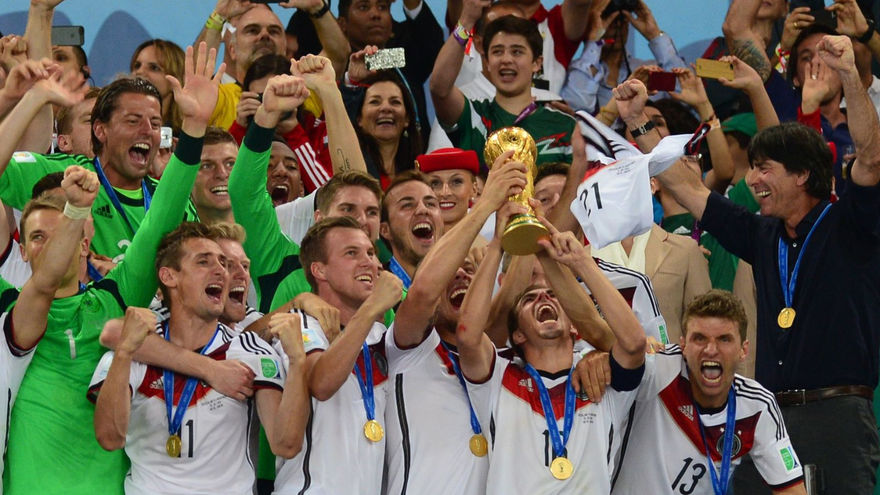
Champion: Germany (4th title)
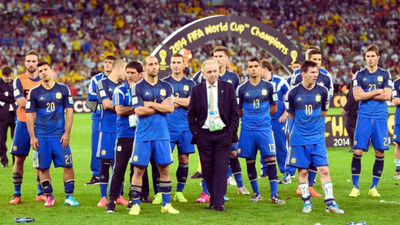
Runner-up: Argentina
Third place: Netherlands
Golden Ball: Lionel Messi (Argentina)
Golden Boot: James Rodríguez (Colombia, 6 goals)
Golden Glove: Manuel Neuer (Germany)
Best Young Player: Paul Pogba (France)
Road to the World Cup
Qualification underscored international football’s ruthlessness. France needed a dramatic 3–0 second-leg playoff comeback against Ukraine. Sweden fell to Portugal in a memorable playoff, denying Zlatan Ibrahimović a return. Traditional powers like Egypt and Nigeria struggled, while Bosnia and Herzegovina qualified for the first time as an independent nation. These paths foreshadowed a tournament where history and current form often diverged.
Pre-tournament favourites were divided between geography and momentum. No European side had won a World Cup in South America, so Brazil and Argentina carried extra weight. Brazil’s 3–0 win over Spain in the 2013 Confederations Cup convinced many they were ready. Germany, labelled “nearly men” after several deep runs without silverware, arrived with pressure on Joachim Löw to validate a patient, attractive system. Belgium’s emerging generation and Chile’s high-intensity style were seen as dark-horse threats.
Group stage
The group phase was an attacking festival — 136 goals in the opening fortnight. The Netherlands’ 5–1 dismantling of Spain in Salvador announced a definitive end to Spain’s dominance; Robin van Persie’s flying header became one of the tournament’s iconic images. Spain’s subsequent defeat by Chile confirmed tactical obsolescence at the highest level.
Group D final standings — the so-called "Group of Death"
Costa Rica | 7 pts | GD +3 (Qualified)
Uruguay | 6 pts | GD 0 (Qualified)
Italy | 3 pts | GD -1 (Eliminated)
England | 1 pt | GD -2 (Eliminated)
Costa Rica’s emergence was one of the tournament’s great surprises. Jorge Luis Pinto’s side executed a disciplined 5-4-1 defensive block and sharp counter-transitions, toppling Uruguay and Italy and sending two European heavyweights home. Portugal’s over-reliance on an unfit Cristiano Ronaldo led to a humbling 4–0 loss to Germany and early elimination. Colombia’s James Rodríguez filled Radamel Falcao’s absence with breathtaking playmaking, announcing himself as a genuine superstar.
Knockout stage - FIFA World Cup 2014
Round of 16
Knockout football tempered the freewheeling scoring but produced intense tactical duels and remarkable goalkeeping. Brazil scraped past Chile on penalties after a 120th-minute miss rattled the crossbar. Colombia dispatched Uruguay with James Rodríguez again at the centre of the action. Germany faced a tricky test from Algeria, whose direct balls repeatedly exposed Germany’s high line and forced Manuel Neuer to adopt a sweeping role outside his box. Germany survived 2–1 after extra time. Costa Rica continued their story by eliminating Greece on penalties, and Argentina edged past Switzerland thanks to Ángel Di María’s 118th-minute strike.
Quarter-finals
Quarter-final matches were decided by fine margins. Germany beat France 1–0 at the Maracanã through a Mats Hummels set-piece, while Argentina’s pragmatic 1–0 win over Belgium rested on Javier Mascherano’s defensive nous and an early Gonzalo Higuaín finish. Brazil’s 2–1 victory over Colombia came at enormous cost: Neymar suffered a fractured vertebra from a challenge by Juan Camilo Zúñiga, ruling him out of the remainder of the tournament, and Thiago Silva’s suspension removed Brazil’s defensive captain. The team’s emotional and structural spine had been broken.
Semi-finals — the Mineirazo
What occurred on July 8, 2014, at the Estádio Mineirão in Belo Horizonte remains unparalleled. Overwhelmed by the absence of Neymar and Thiago Silva, Brazil imploded against a merciless German machine.
Brazil 1–7 Germany — match timeline (selected)
11' Thomas Müller (0–1)
23' Miroslav Klose (0–2) — became World Cup all-time top scorer
24' Toni Kroos (0–3)
26' Toni Kroos (0–4)
29' Sami Khedira (0–5)
Germany scored five goals in an 18-minute span, exploiting disordered Brazilian defending and a shattered midfield. Toni Kroos’ quick double and Klose’s record-breaking strike compounded the rout. André Schürrle added two second-half goals to seal a result that stunned the football world and left many Brazilian fans openly distraught in the stands.
The second semi could not have been more different: Argentina and the Netherlands played a tense, tactical stalemate that extended to penalties. Sergio Romero’s two shootout saves sent Argentina to the final.
Third-place playoff
A devastated Brazil failed to recover in the third-place match, losing 3–0 to the Netherlands. Van Gaal’s side finished unbeaten in open play; Robin van Persie’s composed penalty and goals by Daley Blind and Georginio Wijnaldum compounded Brazil’s national mourning.
The final — Götze’s defining touch
On July 13, 2014, the Maracanã staged a classic final. Germany controlled possession without converting until extra time. With the match seemingly bound for penalties, André Schürrle’s left-flank surge produced a cross that Mario Götze chest-controlled and volleyed with sublime technique in the 113th minute. The 1–0 scoreline held, and Germany became the first European nation to win a World Cup in the Americas.
Defining moments
Spain 1–5 Netherlands: Robin van Persie’s flying header and the tactical dismantling of Spain signalled an end to a dynasty.
Brazil 1–7 Germany: Miroslav Klose’s record-breaking goal and Germany’s devastating five-goal blitz became the tournament’s defining, tragic moment.
Neuer vs Algeria: Manuel Neuer’s sweeper-keeper role redefined modern goalkeeping and allowed Germany to sustain a high defensive line.
James Rodríguez’s volley vs Uruguay: A candidate for the Puskás Award and the signature moment of Colombia’s campaign.
Mascherano’s tackle: A defining defensive sacrifice in Argentina’s shootout win over the Netherlands.
Best players
Manuel Neuer (Germany)
Role: Sweeper-keeper and defensive organiser.
Key stats: Exceptional passing (244 completed passes), multiple clean sheets and decisive interventions that extended beyond traditional goalkeeping. Neuer’s Golden Glove campaign shifted coaching perspectives on goalkeeper positioning and build-up play.
Lionel Messi (Argentina)
Role: Playmaker and talisman.
Key stats: 4 goals, 1 assist, tournament-high chances created and four consecutive Man of the Match awards. Messi carried Argentina through narrow escapes and was deservedly named Golden Ball winner despite the final defeat.
Arjen Robben (Netherlands)
Role: Inverted transitional winger.
Key stats: 3 goals, 1 assist; one of the tournament’s fastest players. Robben’s direct runs and counter-attacking threat powered the Dutch to third place.
Tactical trends
Brazil 2014 marked the triumph of tactical pragmatism and flexibility. The tournament exposed the pitfalls of possession without penetration and saw the resurgence of the three-man defence, championed by Louis van Gaal’s Netherlands and effective for Costa Rica and Chile. Joachim Löw’s Germany exemplified a flexible collective that could alternate between 4–3–3 possession phases and direct vertical transitions. The competition also cemented the sweeper-keeper as a modern tactical asset.
Records and statistics
Total goals: 171 (tied with France 1998)
Average goals per match: 2.67
Most team goals: Germany (18)
Miroslav Klose became the World Cup’s all-time top scorer with 16 goals.
Golden Boot: James Rodríguez — 6 goals in 5 matches.
Legacy
The legacy of Brazil 2014 is complex and enduring. For Brazil, the Mineirazo forced a national reckoning: a move away from romanticised attacking doctrine towards a more pragmatic, European-informed model. For Germany, the title validated long-term reforms in youth development and tactical planning. Historically, Brazil 2014 ranks among the modern era’s great World Cups — memorable for its attacking spectacle, tactical innovation, and the Mineirazo, an event that reshaped football conversation worldwide.
The 2014 World Cup was a dramatic fulcrum in modern football. It ended one empire and elevated another; it revealed the limits of style without substance and showcased the enduring power of collective preparation. Long after the tears in Belo Horizonte and Mario Götze’s winning volley have become part of footballing lore, Brazil 2014 will be remembered as the tournament that shocked, thrilled, and rewrote expectations on a global scale.
Also Read |