
The 2010 FIFA World Cup in South Africa is remembered not just for being the first finals on African soil, but for one defining outcome: the global coronation of tiki-taka. Against a backdrop of vuvuzela noise and vibrant host cities, Spain’s possession-first philosophy—rooted in La Masia and refined under Vicente del Bosque—was stress-tested on the world stage and emerged triumphant. The tournament reshaped tactical priorities worldwide, proving that patient positional control could survive the attrition of seven knockout matches.
Before June 2010, world football was in an identity tussle. The mid-2000s favoured defensive rigidity and deadly counters—Italy’s 2006 triumph and pragmatic club templates were recent proof. Meanwhile, Barcelona’s possession mastery and Spain’s Euro 2008 success signalled a possible tectonic shift. South Africa posed the question: could Spain’s aesthetic, possession-centric model endure and win a World Cup? The answer unfolded in matches of tactical discipline, rare drama, and subtle genius.
Tournament snapshot
Host nation: South Africa
Teams: 32
Format: Group stage (8 groups of 4), then single-elimination knockout
Champion: Spain (1st title)
Runner-up: Netherlands
Third place: Germany
Golden Ball: Diego Forlán (Uruguay)
Golden Boot: Thomas Müller (Germany — 5 goals, 3 assists)
Golden Glove: Iker Casillas (Spain)
Best Young Player: Thomas Müller (Germany)
Road to the World Cup
Qualification was dramatic. Thierry Henry’s handball that led to France’s playoff win over Ireland in Paris provoked worldwide outrage, while nations like Croatia, Sweden and the Czech Republic failed to qualify. New or rare entrants—Slovakia, New Zealand, North Korea—added to the tournament’s unpredictability. Spain arrived as favourites after a perfect qualification record; Brazil, hardened under Dunga and Confederations Cup success, and a dangerous Argentina were the obvious challengers. Dark horses included Marcelo Bielsa’s pressing Chile and a well-drilled Ivory Coast.
Group stage
South Africa’s opening phase felt controlled and tactical. The Jabulani ball troubled many attackers and goalkeepers; Switzerland shocked Spain 1–0 in Durban, immediately putting La Roja under pressure and forcing Del Bosque to treat each group match as critical.
Group A final standings
Uruguay | 7 pts | GD +4 (Qualified)
Mexico | 4 pts | GD +1 (Qualified)
South Africa | 4 pts | GD -2 (Eliminated)
France | 1 pt | GD -3 (Eliminated)
France’s campaign imploded amid backstage mutiny and a public training strike—one of the tournament’s ugliest off-field sagas. Italy, too, disappointed and bowed out early. Germany provided the most eye-catching football in the group stage, announcing a confident young side led by Thomas Müller and Mesut Özil. Diego Forlán, adapting superbly to the Jabulani, emerged as Uruguay’s inspirational figure.
Knockout stage
Round of 16
The knockouts revived old rivalries and exposed officiating weaknesses. Germany beat England 4–1 in Bloemfontein in a match overshadowed by Frank Lampard’s clear (unawarded) goal—a moment that accelerated FIFA’s acceptance of goal-line technology. Argentina overcame Mexico while Spain ground down Portugal; Del Bosque’s tactical tweak—bringing on Fernando Llorente to unsettle a low block—created space for David Villa’s winner. Ghana pushed through to the quarters with a dramatic extra-time win over the USA, carrying the hopes of the continent.
Quarter-finals
The last eight delivered raw drama. Uruguay’s emotional tie with Ghana ended in controversy: Luis Suárez handled on the line in the dying seconds and was sent off; Asamoah Gyan’s resultant penalty struck the bar and Uruguay won the shootout after Sebastián Abreu’s audacious Panenka. The Netherlands stunned Brazil with a second-half comeback, Wesley Sneijder exploiting a Brazil side that had collapsed mentally. Germany dismantled Argentina 4–0, exposing tactical naivety. Spain scraped past Paraguay in a match of missed chances before Villa’s late, scruffy winner.
Semi-finals
The semis offered contrasting narratives. The Netherlands edged a thrilling 3–2 win over Uruguay, highlighted by Giovanni van Bronckhorst’s thunderbolt from distance. Spain faced Germany in a tactical rematch of Euro 2008; Spain’s counter-press and midfield control suffocated German transitions. Carles Puyol’s late header from a Xavi corner broke the deadlock and carried Spain into the final.
Third-place playoff
Germany beat Uruguay 3–2 in an open, entertaining match—an occasion to showcase Thomas Müller and Forlán’s quality while confirming Germany’s depth and Spain’s ascendancy.
The final — ideology vs intimidation
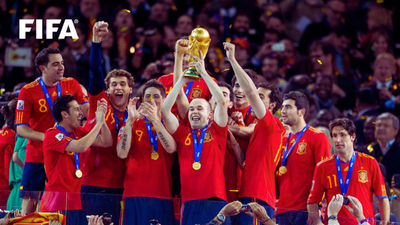
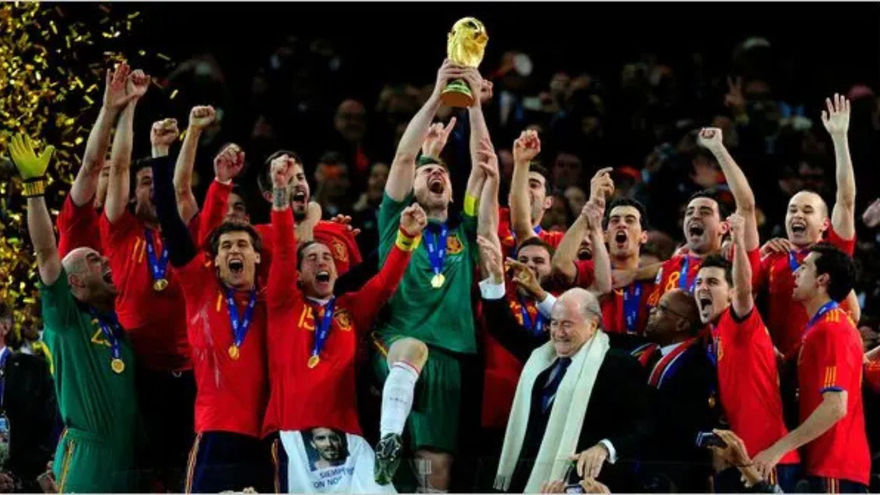
Soccer City, July 11, 2010, hosted a final that was as much a clash of footballing philosophies as a match. The Netherlands adopted a physical, aggressive template to disrupt Spain’s rhythm. Referee Howard Webb issued a record haul of cautions as the game turned ugly; Nigel de Jong’s chest-high kick on Xabi Alonso epitomised that brutality. Spain weathered the storm, and in the 116th minute Andrés Iniesta’s composed volley—set up by Cesc Fàbregas—found the net. Iniesta’s emotional celebration, revealing a shirt dedicated to the late Dani Jarque, sealed Spain’s first World Cup and validated the tiki-taka doctrine at the highest level.
Defining moments
Tshabalala’s opener (South Africa 1–1 Mexico): A tournament-opening scream of a goal that captured continental pride.
Lampard’s “ghost” goal (Germany 4–1 England): A pivotal missed call that hastened goal-line technology adoption.
Suárez’s handball (Uruguay 1–1 Ghana): One of football’s most polarising moments—villainy for many, sacrificial heroism for others.
Casillas’s boot (Spain 1–0 Netherlands): Iker’s vital 1v1 save on Arjen Robben that kept Spain in the game.
Iniesta’s winner (Spain 1–0 Netherlands): A moment of technique and emotion that completed Spain’s historic treble.
Best players
Xavi Hernández (Spain)
Role: Metronomic conductor. Key stat: Tournament-high passing volume and a phenomenal 91% accuracy. Xavi dictated tempo and turned possession into a defensive instrument.
Diego Forlán (Uruguay)
Role: Complete forward and dead-ball specialist. Key stat: 5 goals and the Golden Ball. Forlán mastered the Jabulani and single-handedly elevated Uruguay.
Wesley Sneijder (Netherlands)
Role: Transitional playmaker. Key stat: 5 goals and decisive knockout contributions. Sneijder’s vertical passing unlocked defenses at crucial moments.
Also Read | Greatest Spanish Footballers of all time
Tactical trends
South Africa 2010 crystallised possession as a defensive strategy. Spain’s model—overloading the midfield, patient recirculation and immediate counter-press on loss of possession—proved effective against physical opposition. The tournament accelerated the global embrace of positional play (Juego de Posición), forcing defenders and keepers to become better on the ball. It also highlighted the limitations of rigid, purely athletic systems when faced with technically superior, well-drilled positional teams.
Records and statistics
Total goals: 145 (lowest average per game since 1990)
Average goals per match: 2.27
Spain conceded only 2 goals in 7 matches; first nation to win the World Cup after losing their opening group match.
Joint top scorers: Thomas Müller, David Villa, Wesley Sneijder, Diego Forlán — 5 goals each; Müller won the Golden Boot on assists.
The Lampard incident directly influenced the adoption of goal-line technology.
Legacy and place in history
The 2010 World Cup’s legacy is tactical and cultural. Spain’s win validated a decade-long emphasis on academy development and ball mastery, prompting coaches worldwide to prioritise technical training and positional nuance. The tournament elevated the role of the deep-lying pivot and the importance of coordinated counter-pressing. It also accelerated technological adoption in football officiating. While South Africa lacked the high-scoring spectacle of later tournaments, its influence on how football is taught, coached and analyzed is arguably unmatched in the 21st century.
South Africa 2010 was both a celebration and an ideological statement. It brought the World Cup to Africa with colour and noise while confirming that meticulous collective structure and possession-based discipline could triumph over brute force and raw athleticism. Long after the vuvuzelas fell silent, Spain’s tiki-taka has endured in coaching syllabuses and tactical discourse—an enduring testament to a World Cup that changed football’s trajectory.
Also Read |