
The 1970 FIFA World Cup in Mexico represents the high-water mark of football’s romantic era. Played in high-altitude sunshine and broadcast worldwide in colour for the first time, the tournament marked football’s transition into a global spectacle. After a bruising 1966 World Cup that threatened to suffocate creativity, Mexico 1970 offered a joyous corrective: attacking invention, technical brilliance and some of the sport’s most enduring images.
At the centre was Brazil — a team that not only won but redefined what attacking football could be. Under Mário Zagallo, a constellation of creative stars found harmony and produced a sequence of performances that remain the sport’s gold standard for collective artistry: o Jogo Bonito, the Beautiful Game.
Tournament snapshot
Host nation: Mexico
Teams: 16
Format: Four groups of four; top two advanced to a single-elimination eight-team knockout bracket (quarter-finals, semi-finals, final).
Champion: Brazil (third title)
Runner-up: Italy
Third place: West Germany
Golden Ball: Pelé (Brazil)
Golden Boot: Gerd Müller (West Germany) — 10 goals
Best Young Player: Teófilo Cubillas (Peru)
Road to the World Cup
Qualification to Mexico 1970 was turbulent and at times tragic. Argentina failed to qualify, while matches between El Salvador and Honduras helped spark the brief 1969 "Football War." England and the defending champions entered with strong reputations, but all eyes were on Brazil, who reached the finals with a perfect qualification record. Zagallo’s late appointment after João Saldanha’s removal only added intrigue to a side expected to blend flair with ruthless effectiveness.
Group stage recap
The group stage delivered immediate drama and clarification of the pecking order.
Brazil beat England 1–0 in Guadalajara, a tactical chess match won by Jairzinho’s decisive strike. Both teams advanced and justified their pre-tournament reputations.
Mexico impressed at home, pushing through Group 1 and winning widespread affection.
Italy advanced in pragmatic style from Group 2, while Peru emerged as the tournament’s attacking surprise in Group 4, buoyed by Teófilo Cubillas.
West Germany, led by Gerd Müller, moved through Group 3 and set the tone for a strong knockout run.
Knockout stage recap
The knockout phase produced a series of matches that read like opera — full of rhythm, tension and dramatic reversals.
Quarter-finals
West Germany staged a memorable comeback against England, overturning a 2–0 deficit to win 3–2 in extra time; Gerd Müller’s late volley sealed the victory. Brazil eliminated Peru in a 4–2 classic, while Italy overcame Mexico 4–1. Uruguay edged the Soviet Union.
Semi-finals — the Match of the Century
The semi-finals offered two contrasting narratives. Brazil overcame Uruguay 3–1 in Guadalajara, with Jairzinho and Rivelino instrumental in a performance that exorcised historical demons. The other semi-final — Italy vs West Germany at the Estadio Azteca — became the "Match of the Century." After a late equaliser by Karl-Heinz Schnellinger, extra time produced five goals in a frantic 4–3 win for Italy, Gianni Rivera’s decisive strike sealing an exhausted but historic triumph.
Third-place playoff
West Germany recovered to beat Uruguay 1–0 and claim third place, Wolfgang Overath scoring a fine winner in a spirited match.
The final — Brazil’s coronation
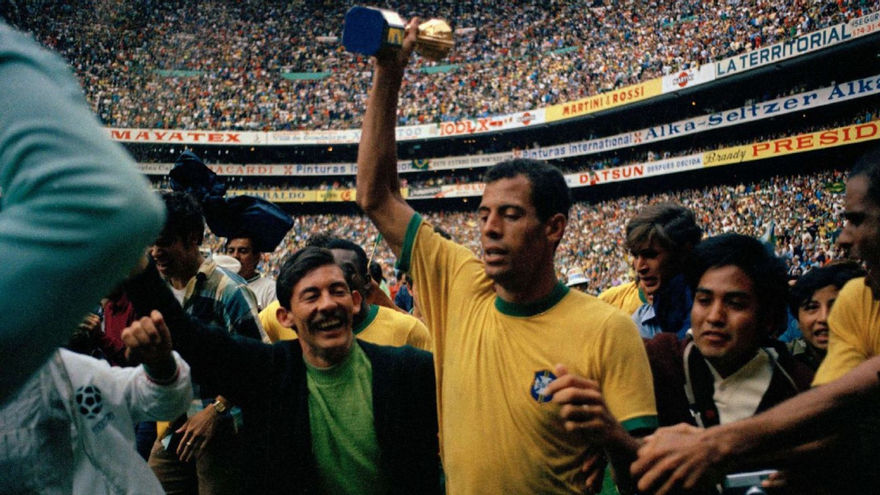
On June 21, 1970, more than 107,000 spectators saw Brazil and Italy contest a final that would define the modern game. Brazil opened the scoring when Pelé rose to head past Enrico Albertosi. Italy levelled before half-time, but the second half belonged to Brazil. Gérson’s long-range strike restored the lead, and a sweeping team move culminated in Jairzinho’s finish, making him the only player to score in every match of a World Cup. The match’s crowning moment came from a nine-pass, collective masterpiece finished by Carlos Alberto — a first-time thunderbolt that remains widely regarded as the greatest team goal in World Cup history. Brazil won 4–1 and kept the Jules Rimet Trophy permanently.
Defining moments
Gordon Banks’ save: The keeper’s incredible twist-and-dive to deny Pelé’s header remains the benchmark of extraordinary goalkeeping.
Pelé’s audacity: A near-goal from inside his own half early in the tournament captured Brazil’s fearless imagination.
The semi-final spectacle: Italy 4–3 West Germany in extra time is football drama distilled to its essence.
Jairzinho’s consistency: Scoring in all seven of Brazil’s matches, a feat unmatched to date.
Carlos Alberto’s goal: A collective, flowing move finished with ferocious power; an image of footballing perfection.
Best players of the tournament
Pelé (Brazil) — The tournament crowned Pelé’s evolution: a leader, creator and clinical finisher, contributing goals and assists across the run.
Gerd Müller (West Germany) — A lethal number nine who finished the tournament with ten goals and decisive match-winners.
Jairzinho (Brazil) — An explosive winger who scored in every game, combining pace and finishing to devastating effect.
Tactical trends
Mexico 1970 blurred positional labels and emphasised fluid attacking systems. Zagallo’s Brazil nominally used a 4-3-3 but functioned like a fluid 4-2-3-1, with Tostão acting as a "false nine," Pelé free to roam, and Carlos Alberto pioneering the marauding attacking full-back role. Gérson’s deep-lying playmaking and Clodoaldo’s covering runs enabled sustained creativity. The tournament demonstrated that possession, intelligent movement and collective pressing could dismantle static defensive systems like Catenaccio.
Records and statistics
Top scorers: Gerd Müller (10), Jairzinho (7), Teófilo Cubillas (5), Pelé (4).
Clean sweep: Brazil won every qualification and finals match en route to the title — an unbeaten perfection.
Substitutions and cards: Mexico 1970 featured the early use of tactical substitutions and introduced yellow/red cards to curb violent play.
Legacy
Mexico 1970 reshaped football’s global image. Brazil’s team became the template for how to marry flair with structure. Media coverage in vibrant colour elevated the players to international celebrity and accelerated football’s commercialisation. The tournament also demonstrated host-country capability in extreme conditions, proving Mexico could stage world-class events.
Why 1970 is remembered
Mexico 1970 is remembered for its synthesis of beauty and effectiveness: the world saw how attacking invention could translate into trophies. The tournament produced iconic moments, revolutionary tactical ideas and an enduring image of football as collective art.
Conclusion
The 1970 World Cup stands as football’s artistic summit. Brazil’s domination, Pelé’s leadership and the tournament’s sequence of masterful matches created a blueprint for generations. From Gordon Banks’ miraculous save to Carlos Alberto’s thunderbolt, Mexico 1970 remains the sport’s finest hour — a tournament where football transcended sport and entered the realm of cultural myth.
FAQs
Why is the 1970 World Cup considered Brazil’s greatest?
Brazil combined technical brilliance, tactical innovation and consistent results — winning every finals match with a fluid attack led by Pelé, Jairzinho and Carlos Alberto.
Who scored the famous Carlos Alberto goal in 1970?
Carlos Alberto finished a nine-pass team move in the final against Italy, a goal widely regarded as the greatest World Cup team goal.
What was the "Match of the Century" in 1970?
The Italy vs West Germany semi-final, a 4–3 extra-time classic at the Estadio Azteca, celebrated for its dramatic momentum swings and high drama.
Which player scored in every match for Brazil in 1970?
Jairzinho scored in all seven of Brazil’s matches — a unique World Cup record.
What tactical lessons came from Mexico 1970?
The tournament validated fluid attacking systems, the false-nine role, deep-lying playmakers and attacking full-backs — ideas that shaped modern football.
Also Read |