
The 1966 FIFA World Cup in England was more than a sporting tournament; it was a cultural and tactical watershed that reshaped the global game. Staged in the heart of the "Swinging Sixties," the event married pop culture spectacle with old-fashioned English pragmatism. England, the birthplace of organised football, seized the chance to validate its claim to the sport amid rising continental competition.
The competition arrived at a tactical inflection point: South American flair clashed with increasingly organised European defence and physicality. The tournament delivered dramatic narratives—from the theft and recovery of the Jules Rimet Trophy by a dog named Pickles, to the heavy burden on Pelé and Brazil—and produced a final whose defining moment is still debated to this day.
Tournament snapshot
Host nation: England
Teams: 16
Format: Four groups of four; top two advanced to a traditional single-elimination eight-team knockout (quarter-finals, semi-finals, third-place play-off, final).
Champion: England (first title)
Runner-up: West Germany
Third place: Portugal
Golden Ball: Bobby Charlton (England)
Golden Boot: Eusébio (Portugal) — 9 goals
Best Young Player: Franz Beckenbauer (West Germany)
Road to the World Cup
Qualification to 1966 was politically charged. African nations withdrew in protest of FIFA’s allocation process, and South Africa remained excluded over apartheid. That vacuum helped North Korea qualify via an abbreviated Asian route.
Several established nations advanced without drama; others surprised. Portugal qualified emphatically and emerged as a dark horse led by Eusébio. West Germany and England navigated their paths with expectation and tactical clarity. Brazil arrived as holders but carried the burden of aging stars and growing European physicality.
Group stage recap
The group stage produced shocks and tactical theatre.
England progressed efficiently, opening with a 0–0 draw against Uruguay before recording 2–0 wins over Mexico and France while conceding no goals.
Brazil’s campaign collapsed amid aggressive marking and rugged tackling. After a 2–0 win over Bulgaria, Pelé sat out a 3–1 loss to Hungary. In the decider against Portugal, Pelé was repeatedly fouled and Brazil were beaten 3–1, exiting at the group stage for the first time since 1934.
North Korea stunned Italy 1–0 at Ayresome Park, eliminating the Azzurri and producing one of the tournament’s biggest upsets. Pak Do‑Ik’s low strike and his team’s disciplined defending carried the debutants into the quarter-finals.
West Germany qualified comfortably, with a young Franz Beckenbauer beginning to make his mark.
Knockout stage recap
The knockout rounds combined geopolitical drama, individual brilliance and tactical battles.
Quarter-finals
Two matches became instant classics. North Korea raced to a 3–0 lead against Portugal, only for Eusébio to produce a historic comeback—four goals, including two penalties—steering Portugal to a 5–3 victory. Meanwhile, England faced Argentina in a heated tie that ended 1–0; the match was remembered for Antonio Rattín’s controversial dismissal and the fierce atmosphere that followed.
Semi-finals
England beat Portugal 2–1 at Wembley. Bobby Charlton produced a defining performance—his long-range strike and late second goal exemplified his influence. In the other semi, West Germany edged the Soviet Union 2–1; Beckenbauer scored a trademark run-and-finish to seal victory.
Third-place play-off
Portugal beat the Soviet Union 2–1, with a dramatic late goal from José Torres capping a memorable debut tournament for the Portuguese.
The final — Wembley, destiny and debate
On July 30, 1966, Wembley staged a final that remains one of football’s most enduring spectacles. West Germany opened through Helmut Haller, but Geoff Hurst equalised before England took the lead via Martin Peters. A late Wolfgang Weber equaliser forced extra time.
The most controversial moment arrived in the 101st minute. Geoff Hurst struck a shot that hit the underside of the crossbar and bounced down. After hesitation from referee Gottfried Dienst, linesman Tofiq Bahramov signalled goal; Dienst awarded it, putting England 3–2 ahead. Decades of analysis and simulation still divide opinion on whether the ball fully crossed the line, but the referee’s decision stood.
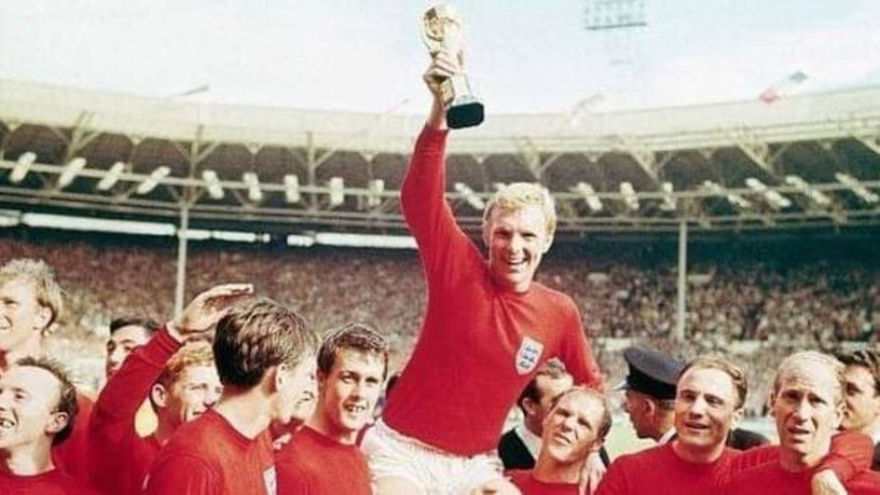
England added a fourth through Hurst to complete the only hat-trick ever scored in a World Cup final (until 2022). The match ended 4–2; Queen Elizabeth II presented the Jules Rimet Trophy to captain Bobby Moore.
Defining moments
Rattín’s dismissal: Antonio Rattín’s send-off against England sparked protests and remains symbolic of volatile referee–player relations of the era.
Bahramov’s call: The Azerbaijani linesman’s signal for Hurst’s extra-time goal decided a final and sparked lifelong debate.
Pak Do‑Ik’s strike: North Korea’s low finish against Italy produced one of the competition’s great shocks.
Eusébio’s revival: Four goals in the quarter-final comeback against North Korea cemented his status as the tournament’s outstanding striker.
Bobby Moore’s composure: Moore’s calm leadership—most famously wiping his hands before receiving the trophy—became an enduring image of sportsmanship.
Standout players
Bobby Charlton (England) — The tournament’s best player: power, range and finishing that controlled England’s rhythm.
Eusébio (Portugal) — A nine-goal eruption that carried Portugal to a memorable third place.
Franz Beckenbauer (West Germany) — A 20-year-old showcased the technique and intelligence that would redefine the libero role.
Tactical trends
1966 marked the move away from the 4-2-4 spectacle toward compact midfield structures. Sir Alf Ramsey’s “Wingless Wonders” — a narrow 4-1-3-2 shape — removed traditional wingers in favour of central control and defensive solidity. Nobby Stiles’ screening role, Bobby Moore’s reading of the game, and the use of industrious central midfielders set a template for modern international tactics.
Records and statistics
Top scorers: Eusébio (9), Helmut Haller (6), Geoff Hurst (4), Franz Beckenbauer (4).
Hurst’s hat-trick: The only hat-trick in a World Cup final for 56 years.
Defensive milestone: England conceded no goals in the group stage.
Asian breakthrough: North Korea became the first team from outside Europe or the Americas to progress beyond the first round.
Legacy
The 1966 World Cup left a complex legacy. For England, the victory remains a defining national moment—an enduring reference point of sporting identity. Tactically, Ramsey’s innovations encouraged a broader shift toward compactness, organisation and midfield control across Europe and South America. The tournament’s controversies—most notably the Rattín sending-off and the “Wembley Goal”—accelerated reforms in refereeing and match control that would culminate in later innovations like cards and, eventually, technological aids.
Why 1966 is remembered
1966 is remembered not only for England’s triumph but for how it broadcast football to a global audience and forced tactical evolution. It combined drama, controversy and technical shifts, marking a moment when the sport matured into a modern, widely consumed spectacle.
Conclusion
The 1966 World Cup was a turning point that fused national pride, tactical rethinking and global attention. It was a tournament of giants: Bobby Charlton’s artistry, Eusébio’s power, Beckenbauer’s precocity—and a final whose decisive moments continue to be dissected and debated. It was the summer football came home, forever changing the game’s narrative and infrastructure.
FAQs
What was the Wembley Goal in 1966?
Geoff Hurst’s extra-time shot hit the underside of the crossbar and bounced down. Linesman Tofiq Bahramov signalled goal; referees awarded it. Whether it fully crossed the line remains debated.
Who was the top scorer at the 1966 World Cup?
Eusébio (Portugal) scored nine goals, including four in the quarter-final comeback against North Korea.
What tactical system did England use in 1966?
Alf Ramsey used a narrow, "wingless" 4-1-3-2 system focused on central compactness, defensive screening and midfield control.
Why was North Korea’s victory over Italy significant?
North Korea’s 1–0 win eliminated Italy and marked the first time an Asian nation progressed to the World Cup quarter-finals, producing one of the competition’s great shocks.
What lasting changes followed the controversies of 1966?
Incidents like Rattín’s sending-off exposed communication failures and contributed to later refereeing reforms—eventually leading to the introduction of yellow/red cards and, much later, technological aids.
Also Read |