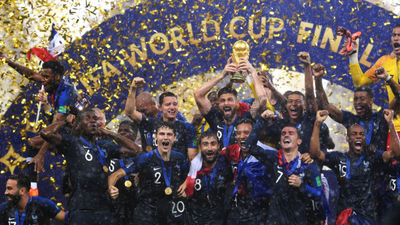

The 1998 FIFA World Cup in France arrived as a moment both sporting and civic: the first 32-team finals, staged at the end of a turbulent century, and an event that allowed the host nation to project a modern, multi‑cultural identity. What followed was football at full theatrical scale — high drama, tactical evolution and generational talent — culminating in a Parisian coronation that elevated Zinedine Zidane from national figure to global icon.
Context and storylines
Pre-tournament expectations were simple on paper: Brazil, led by a young Ronaldo and a forward line of dizzying talent, were the favourites. England hoped a youthful crop including Michael Owen could finally end a long wait. Emerging nations — notably Croatia and Nigeria — arrived with the potential to disturb the established order. For France, manager Aimé Jacquet faced intense scrutiny for a conservative squad selection that many critics doubted could win at home. Those doubts evaporated during a summer that married tactical discipline with moments of singular brilliance.
Tournament snapshot
Host: France
Teams: 32
Format: Group stage (8 groups of 4), then single-elimination knockouts
Champion: France (1st title)
Runner-up: Brazil
Third place: Croatia
Golden Ball: Ronaldo (Brazil)
Golden Boot: Davor Šuker (Croatia — 6 goals)
Golden Glove: Fabien Barthez (France)
Best Young Player: Michael Owen (England)
Group stage — unpredictability and breakout stars
The expanded format delivered immediate variety. Nigeria stunned Spain 3–2 in a lively opener; Senegal, in 2002, earlier would play a similar role of giant-killer, but in 1998 it was Nigeria’s athletic exuberance and Sunday Oliseh’s thunderbolt that set the tone. England’s Michael Owen announced himself with a superb individual goal against Argentina — a defining prodigy moment.
France survived early turbulence: Zidane was sent off against Saudi Arabia and suspended for two games, but Les Bleus still advanced smoothly, scoring freely in Group C. Croatia, competing in their first World Cup as an independent nation, combined tactical steel with clinical finishing to emerge as genuine contenders. Meanwhile, Spain’s elimination in the group stage was a reminder that pedigree alone no longer guaranteed progression.
Knockout phase — drama and artistry
Round of 16
The knockout rounds sharpened tension. England and Argentina met in a classic in Saint-Étienne: after Michael Owen’s wondergoal, David Beckham was sent off, and England bowed out on penalties following Carlos Roa’s penalty heroics. France overcame Paraguay when substitute Laurent Blanc scored Europe’s first-ever Golden Goal, a historic moment that underlined the tournament’s capacity for invention.
Quarter-finals
The quarters produced some of the tournament’s most memorable sequences. Croatia stunned Germany 3–0 after Christian Wörns’ sending-off, announcing themselves on the biggest stage. In Marseille, Dennis Bergkamp produced one of the competition’s enduring individual moments, controlling a long pass with sublime technique and finishing in the 89th minute to send the Netherlands through. France edged Italy on penalties at the Stade de France in a tactical, cagey affair.
Semi-finals — Thuram’s unlikely heroics and Brazil’s nerve
Brazil and the Netherlands delivered a tense, technically rich semi that only Taffarel’s penalty saves and marginal margins decided. Croatia bowed out to France in Paris — but not before Davor Šuker’s clinical finishing had earned him the Golden Boot. The semi that defined the tournament emotionally was France v Croatia: after Šuker’s opener, Lilian Thuram, a player who had never scored for his country, produced a miraculous double to send the hosts into the final. Thuram’s late intervention remains one of international football’s great individual recoveries.
Third-place match
Croatia finished strongly, beating the Netherlands 2–1 in a spirited third-place game. Davor Šuker’s tournament haul of six goals underlined his status as one of the competition’s top finishers.
The final — tension, mystery and mastery
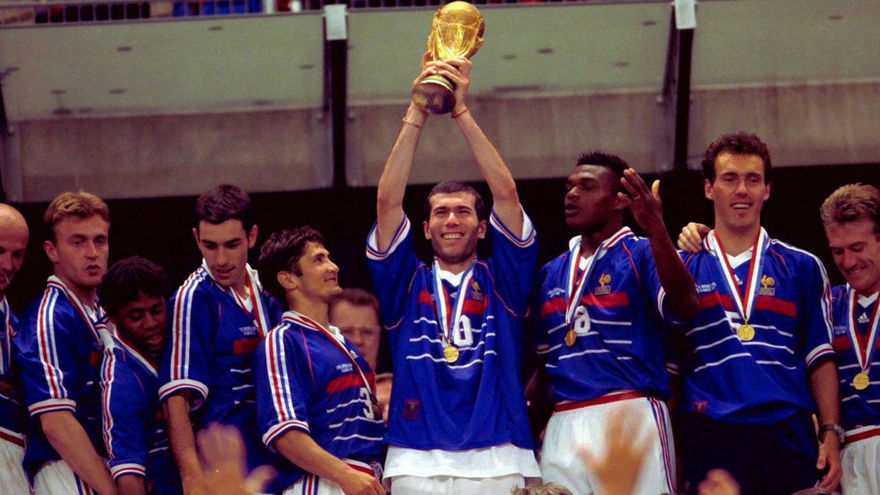
The final in Saint-Denis is one of World Cup folklore’s most discussed matches. With sensational pre-match scenes surrounding Ronaldo’s health, the game took on an almost mythic quality. France executed a game plan built to exploit Brazil’s zonal weaknesses at set pieces. Zinedine Zidane rose to head two first-half goals from corners; his movement and timing were clinical. As the second half unfolded, France’s compact structure held firm, and Emmanuel Petit’s late third after a counter sealed a historic 3–0 victory.
The result — a hosts’ triumph achieved through defensive organisation, set-piece ruthlessness and big-game poise from Zidane — inaugurated a new national mythos and reoriented football’s cultural conversation.
Defining moments
Oliseh’s rocket (Nigeria 3–2 Spain): A long-range strike that became emblematic of the tournament’s unpredictability.
Owen’s breakthrough (England 2–2 Argentina): The emergence of a global star in a single, electrifying moment.
Bergkamp’s finish (Netherlands 2–1 Argentina): A late, virtuoso goal that epitomised technique under pressure.
Thuram’s double (France 2–1 Croatia): Two improbable, match-defining strikes from a defensive player.
Zidane’s twin headers (France 3–0 Brazil): The final’s decisive acts; two set-piece headers that crowned a homegrown genius.
Best players
Zinedine Zidane (France) — His two headed goals in the final elevated a fine tournament into legendary status; his influence on France’s tempo and control was decisive.
Davor Šuker (Croatia) — Golden Boot winner whose finishing carried a debutant nation deep into the competition.
Lilian Thuram (France) — Defensive cornerstone whose two semi-final goals remain among the tournament’s most dramatic contributions.
Tactical trends
France 1998 illustrated the growing importance of structured midfield shields and disciplined defensive compactness. Aimé Jacquet’s design privileged a hardworking central block — Didier Deschamps and Emmanuel Petit — that protected the backline and freed Zidane to operate in higher, more decisive spaces. The tournament also demonstrated that set pieces and transitional counters were essential weapons in a congested tactical landscape.
Records and statistics
Total goals: 171 (a tournament high at the time)
Average goals per match: 2.67
Golden Boot: Davor Šuker — 6 goals
France conceded only two goals across seven matches, a hallmark of their defensive efficiency.
Legacy
France 1998’s legacy is both sporting and social. On the pitch, it launched a generation — Zidane, Henry, Vieira, Thuram — that would dominate club and international football in the following decade. Off the pitch, the victory became a symbol of France’s modern, multicultural identity — “Black-Blanc-Beur” — and provided a unifying national narrative. Tactically, the tournament underlined the value of midfield balance, set-piece planning and compact defensive architecture in elite international football.
The 1998 World Cup combined spectacle with structural clarity. It introduced a wider field, produced breakout stars, and delivered one of football’s great moments in Zidane’s masterclass on the game’s biggest stage. Decades on, France ’98 remains a landmark: the tournament that formalised the modern World Cup era and gave the game one of its most enduring images — a home nation lifted by a son of immigrants into global immortality.
Also Read |