
The 1938 FIFA World Cup in France remains one of the most politically charged and technically accomplished tournaments in football history. Played across ten French cities in June 1938, the third edition unfolded as Europe slipped toward catastrophe. The competition reflected the tense geopolitics of the era—Spanish Civil War, Anschluss, the rise of totalitarian regimes—and football fields became a stage for national narratives and propaganda. Yet amid the foreboding atmosphere the tournament also produced dazzling individual brilliance, inventive tactics and a final that crowned Italy’s last pre‑war triumph.
Tournament snapshot
Host nation: France
Teams: 15 (Austria withdrew after annexation)
Format: Straight knockout from the first round; drawn matches went to replays.
Champion: Italy (second consecutive title)
Runner‑up: Hungary
Third place: Brazil
Golden Ball: Leônidas da Silva (Brazil)
Golden Boot: Leônidas da Silva (Brazil) — 7 goals
Road to the World Cup
Qualification for 1938 was disrupted by politics. Argentina and Uruguay withdrew in protest at Europe hosting consecutive tournaments; Austria qualified but was then annexed by Nazi Germany, its players forcibly folded into the German setup. Brazil emerged as South America’s sole representative. Vittorio Pozzo’s Italy arrived as the favourite, a team hardened by continuity and preparation that many saw—rightly or wrongly—as a tool of fascist prestige. Hungary and Brazil arrived as the primary sporting threats.
Round of 16 — instant high stakes
With no group stage, every match was sudden‑death, producing dramatic early shocks.
Germany (now including Austrian players) were stunned by Switzerland after a replay; Swiss tactical discipline under Karl Rappan’s verrou system upset the favourites.
Italy survived a scare against Norway when Silvio Piola struck in extra time.
Brazil produced one of the tournament’s wildest matches, beating Poland 6–5 after extra time in torrential rain; Leônidas briefly played barefoot and scored a hat‑trick, while Ernst Wilimowski notched four for Poland.
Cuba's surprise progression—defeating Romania in a replay—added to the tournament’s unpredictability.
Quarter‑finals — politics and violence
The quarter‑finals reflected both on‑field intensity and off‑field tensions.
France vs Italy in Paris carried political heat; Italy wore a black change strip and produced a controlled, tactical performance. Silvio Piola’s brace secured a 3–1 win for Pozzo’s side.
Brazil’s replay win over Czechoslovakia in Bordeaux followed a rough first encounter known as the "Battle of Bordeaux."
Hungary’s neat 2–0 victory over Switzerland and Sweden’s 8–0 demolition of a weary Cuba completed the last eight.
Semi‑finals — Pozzo’s triumph over confidence
The semis were a study in tactical control versus overreach.
Italy outplayed Brazil in Marseille. Brazilian manager Adhemar Pimenta’s decision to rest Leônidas backfired; Pozzo’s unit exploited gaps and Meazza dictated the midfield. Italy advanced 2–1.
Hungary overran Sweden 5–1 in Paris, setting up a final between two contrasting football philosophies.
Third place
Brazil recovered to win bronze, beating Sweden 4–2 in Bordeaux. Leônidas returned to the starting XI and underlined his tournament claim as its best player.
The final — Pozzo’s tactical coronation
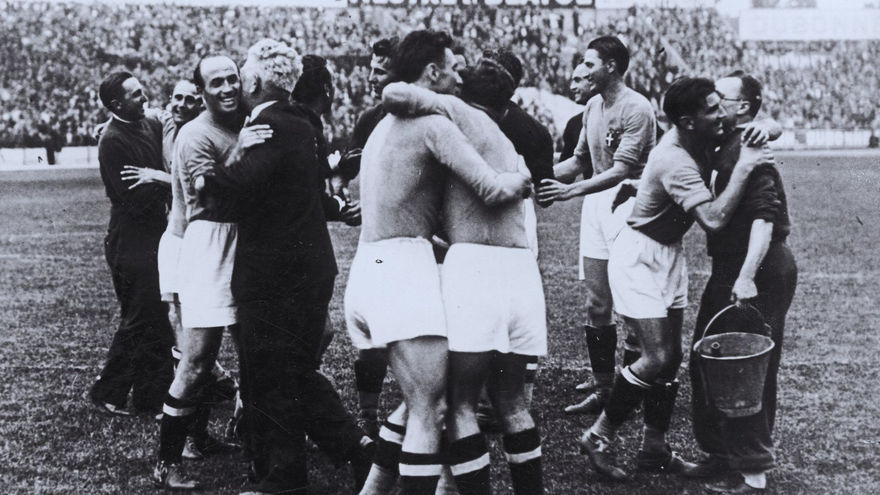
On 19 June 1938 at Stade de Colombes, Italy met Hungary in a match that pitted Pozzo’s Metodo against the Danubian passing school. Italy struck early; Gino Colaussi’s volley put the Azzurri ahead. Hungary replied, but Italy’s movement and Meazza’s playmaking forced openings. Piola converted a combination move to restore the lead, and a second Colaussi goal before halftime left Italy in command. Hungary fought back late, but Piola’s 82nd‑minute strike sealed a 4–2 victory. Italy became the first nation to retain the World Cup, cementing Pozzo’s reputation as the era’s greatest international coach.
Defining moments
The Swiss replay over Germany: A political and sporting upset that undermined the narrative of invincibility surrounding the Reich’s team.
Brazil 6–5 Poland: A torrential, chaotic classic where Leônidas and Wilimowski traded extraordinary strikes.
Meazza’s cool leadership and Piola’s finishing: Italy’s tactical discipline and match‑winning ruthlessness.
The black shirts and political overtones: Italy’s choice of kit and the tournament’s associations with fascist pageantry remain troubling historical context.
Sindelar’s absence: The mysteriously defiant withdrawal of Austria’s greatest player loomed as a tragic political footnote.
Standout players
Leônidas da Silva (Brazil)
The tournament’s most electrifying individual: inventive, explosive and the author of the bicycle‑kick legend; top scorer with seven goals.
Silvio Piola (Italy)
A clinical, big‑game striker whose goals proved decisive in Italy’s run.
György Sárosi (Hungary)
The intelligent, versatile figure who epitomised the Danubian school’s elegance.
Tactical trends
1938 showcased a clash of systems. Pozzo’s Metodo (an adaptive 2‑3‑2‑3) emphasised inside‑forwards dropping into midfield to link play and allow swift, vertical counters. This shape offered defensive solidity and direct transition football—ancestral to later Italian counter‑attacking models. Opposing teams, particularly Hungary, demonstrated the potency of short‑passing, positional rotation and technical fluidity that would influence post‑war tactics.
Records and statistics
Top scorer: Leônidas da Silva — 7 goals.
Notable match: Brazil 6–5 Poland—one of the highest‑scoring and most frenetic fixtures in early World Cup history.
Coaching milestone: Vittorio Pozzo remains the only manager to win two pre‑war World Cups.
Legacy
The 1938 World Cup is a tableau of pre‑war football culture halted by global conflict. It gave the world Leônidas’s flair and Piola’s finishing, and showcased both political manipulation and genuine tactical evolution. With World War II soon to shatter international sport, France 1938 stands as the last major theatre where inter‑war football’s innovations and contradictions were displayed in full. Pozzo’s Italy won not only on the pitch but—more sombrely—entered history as a symbol of sporting achievement entwined with political power.
Conclusion
France 1938 is remembered for its mixture of artistry and alarm. It preserved some of football’s finest pre‑war talents and tactical ideas while underscoring how sport can be swept into the currents of history. The tournament’s matches—wild, brilliant and at times ugly—remain essential viewing for anyone seeking the roots of modern international football.
FAQs
Who won the 1938 FIFA World Cup?
Italy won the 1938 World Cup, beating Hungary 4–2 in the final to retain the trophy.
Who was the top scorer at France 1938?
Leônidas da Silva of Brazil finished as top scorer with seven goals.
Why did Austria not play in 1938?
Austria withdrew after the March 1938 Anschluss when the country was annexed by Nazi Germany and its federation dissolved.
What was notable about Brazil vs Poland in 1938?
Brazil beat Poland 6–5 after extra time in torrential conditions; Ernst Wilimowski scored four while Leônidas scored a hat‑trick.
What tactical system did Italy use in 1938?
Vittorio Pozzo’s Metodo (a flexible 2‑3‑2‑3) emphasised inside‑forwards dropping into midfield and rapid vertical transitions—an early ancestor of structured counter‑attacking play.
Also Read |