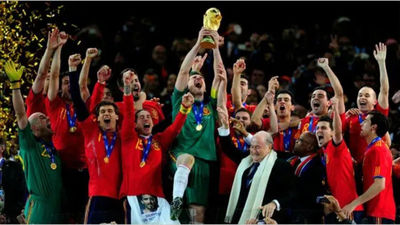

International football moves in cycles: tactical revolutions and generational talent periodically reshape the global order. If Spain’s tiki-taka reached its peak in 2010 and the defensive fragilities exposed in 2014 signalled the end of certain orthodoxies, the 2018 FIFA World Cup in Russia announced the next phase — an era of hyper-athletic verticality, structural flexibility, and the arrival of a terrifying new generation of superstars.
Before the first whistle in June 2018, the international landscape looked fragmented. Europe retained its hegemony, but many elite sides showed clear signs of systemic fatigue. Germany arrived as defending champions but carried the rust of a team that had not refreshed its core. Argentina and Portugal remained overly dependent on ageing icons — Lionel Messi and Cristiano Ronaldo — supported by inconsistent squads. The central question of Russia 2018 was whether pragmatic structure could overcome individual brilliance. What followed was a tournament defined by breathless drama, the decline of static possession football, and the explosive emergence of a 19-year-old French prodigy.
Tournament snapshot
Host nation: Russia
Teams: 32
Format: Group stage (8 groups of 4) then single-elimination knockout
Champion: France (2nd title)
Runner-up: Croatia
Third place: Belgium
Golden Ball: Luka Modrić (Croatia)
Golden Boot: Harry Kane (England, 6 goals)
Golden Glove: Thibaut Courtois (Belgium)
Best Young Player: Kylian Mbappé (France)
Road to the World Cup
Qualification for Russia produced seismic shocks. Four-time champions Italy failed to reach the finals for the first time since 1958 after a brutal playoff loss to Sweden. The Netherlands missed a second straight major tournament, underscoring a structural decline. In CONCACAF, the United States suffered a final-day defeat to Trinidad and Tobago and ended a streak of seven consecutive World Cup appearances. Chile — reigning back-to-back Copa América winners — missed out on goal difference.
Pre-tournament favourites included Brazil, retooled and confident after rebuilding under Tite; a still-dangerous Germany; and France, whose depth was unrivalled though Didier Deschamps’ cautious tactics drew scepticism. Belgium’s “Golden Generation” was under pressure to deliver, while Croatia looked dangerous in knockout football if their experienced midfield could hold up physically.
Group stage
The opening phase dismantled several expectations. Group F produced the tournament’s signature shock: Germany’s collapse. After Toni Kroos’ stoppage-time free-kick salvaged a win over Sweden, the holders collapsed in the final match against South Korea, conceding twice in stoppage time to finish bottom — their earliest group exit since 1938.
Group F final standings
Sweden | 6 pts | GD +3 (Qualified)
Mexico | 6 pts | GD -1 (Qualified)
South Korea | 3 pts | GD 0
Germany | 3 pts | GD -2 (Eliminated)
Group D underlined Croatia’s midfield mastery with a clinical 3-0 dismantling of Argentina. Russia, the hosts, exceeded expectations with confident wins over Saudi Arabia and Egypt, boosted by Artem Dzyuba’s aerial presence and Aleksandr Golovin’s creative spark. The group stage also introduced several breakout stars: Hirving “Chucky” Lozano’s winner against Germany made him a national hero, and France’s attacking combination of Paul Pogba, N’Golo Kanté and youthful pace hinted at a devastating transitional side.
Knockout stage
Round of 16
The knockouts opened with one of the tournament’s classics: France 4–3 Argentina. That match felt like a passing of the torch — Kylian Mbappé, with terrifying acceleration and composure, tore apart Argentina’s defence and announced himself on the biggest stage. Uruguay eliminated Portugal 2–1 as Edinson Cavani scored twice, and meanwhile Spain were stunned by Russia’s compact low block, losing on penalties. Croatia edged Denmark on penalties, thanks to Danijel Subašić’s heroics. Belgium staged a late, dramatic comeback to beat Japan 3–2 after trailing 2–0, a sequence finished by Nacer Chadli’s stoppage-time winner.
Quarter-finals
France eased past Uruguay 2–0, with Raphael Varane and Antoine Griezmann on target. The most tactically fascinating tie saw Belgium knock out Brazil 2–1. Roberto Martínez’s decision to use Kevin De Bruyne as a false nine and drift Romelu Lukaku wide created decisive overloads, exploiting space left by Brazil’s adventurous full-backs; Thibaut Courtois’ saves preserved the win. England beat Sweden 2–0, and Croatia knocked out Russia on penalties after a 2–2 draw.
Semi-finals
The semis were chess matches. France defeated Belgium 1–0 courtesy of Samuel Umtiti’s smart header from a corner; Deschamps’ side then sat deep to stifle Eden Hazard and Kevin De Bruyne. Croatia upset England in extra time after an early Kieran Trippier free-kick, with Luka Modrić and Ivan Rakitić gradually wresting control. Ivan Perišić equalised and Mario Mandžukić completed the comeback in the 109th minute.
Third-place playoff
Belgium recorded their best-ever World Cup finish, beating England 2–0. Thomas Meunier opened the scoring and Eden Hazard added a late second, capping a tournament in which Hazard produced some of the most aesthetically brilliant attacking play on show.
The final
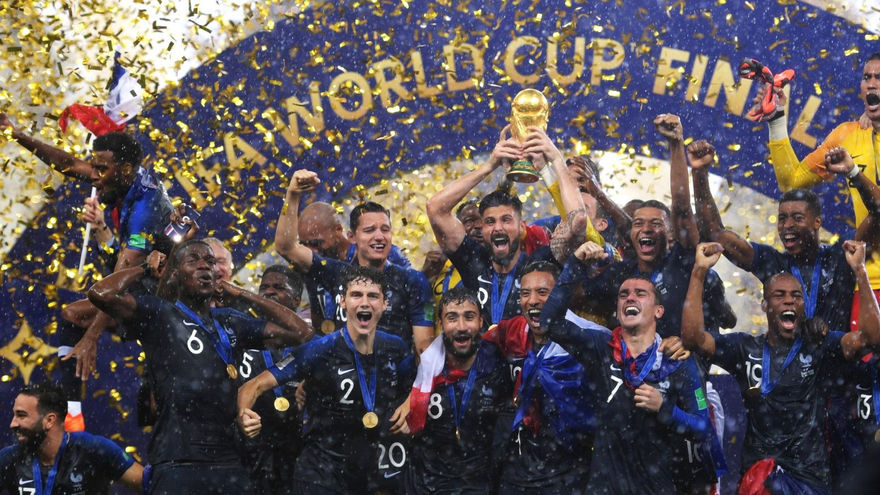
On July 15, 2018, a rain-swept Luzhniki Stadium staged a chaotic, high-scoring final. Croatia began strongly, but France’s clinical efficiency proved decisive. An early own goal by Mario Mandžukić and an Ivan Perišić equaliser set a frenetic tone. A VAR-awarded penalty — coolly taken by Antoine Griezmann — shifted momentum. Paul Pogba scored a superb long-range strike before Kylian Mbappé, just 19, became the first teenager since Pelé to score in a World Cup final. A late Mandžukić goal off a Hugo Lloris error made it 4–2, but France held on as Lloris lifted the trophy amid a thunderstorm, cementing France’s status at the summit of modern football.
Defining moments
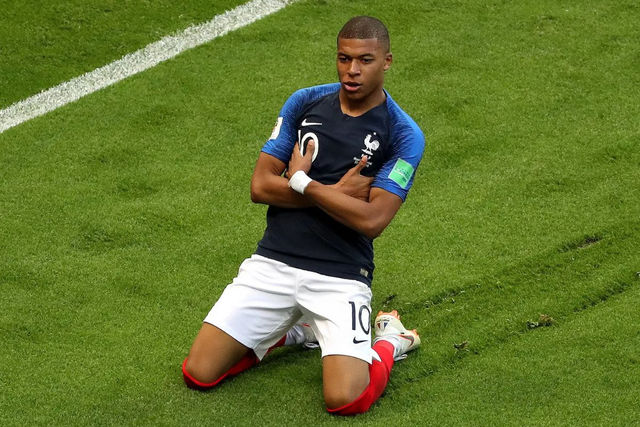
Mbappé vs Argentina: Mbappé reached a recorded top speed of 38 km/h in that 4–3 game, slicing through Argentina with frightening acceleration before winning a penalty.
Kroos’ free-kick vs Sweden: Trailing with ten men, Toni Kroos curled a stoppage-time free-kick into the corner to briefly resurrect Germany’s hopes.
Belgium vs Japan counter: In the final seconds, Thibaut Courtois started a 9-second transition that led to Nacer Chadli’s winner — a textbook counter-attack.
Pavard volley: Benjamin Pavard’s outside-of-the-boot volley from 25 yards against Argentina was later voted Goal of the Tournament.
VAR in the final: Néstor Pitana’s pitchside review to award a penalty for handball marked the technology’s decisive influence on a World Cup Final.
FIFA World Cup 2018 Best players
Luka Modrić (Croatia) — Golden Ball
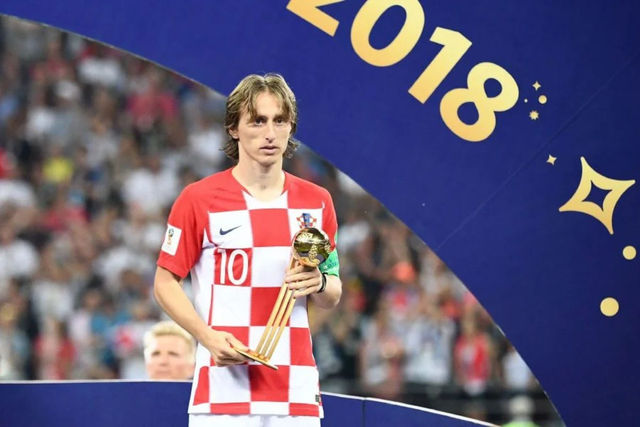
Role: Metronomic playmaker and captain who controlled tempo across three consecutive extra-time matches.
Key stats: 2 goals, 1 assist, tournament-high distance covered. Modrić’s performance crowned him the standout midfielder of the month and helped break the Messi–Ronaldo stranglehold on individual awards later that year.
Antoine Griezmann (France)
Role: Tactical fulcrum and set-piece specialist.
Key stats: 4 goals, 2 assists, heavily involved in France’s offensive output. Griezmann combined intelligence, pressing work, and clinical execution to anchor Deschamps’ system.
Eden Hazard (Belgium)
Role: Left-sided creator and dribbler.
Key stats: 3 goals, 2 assists, tournament-leading dribbles. Hazard delivered one of the tournament’s most beautiful individual performances, notably tormenting Brazil in the quarter-finals.
Tactical trends
Russia 2018 marked a clear shift away from static possession football. Teams that relied on keeping the ball without vertical intent were repeatedly punished by disciplined mid-blocks and lightning transitions. Set-pieces also rose in importance — an unusually high share of goals came from dead-ball situations as teams tightened open-play defending.
Tactical paradigm (broad stroke)
Old model (2010–2014): High pressing → prolonged possession → slow build
New model (2018): Mid-block → explosive transitions → set-piece reliance
Deschamps’ asymmetric 4-2-3-1 became the tournament template. Blaise Matuidi was often used on the left to tuck inside and protect space, enabling Paul Pogba to launch vertical passes while Kylian Mbappé exploited one-on-one situations on the opposite wing. The system combined physical power, spatial compaction, and ruthless efficiency.
Statistics and records
Total goals: 169
Goalless matches: 1 (Denmark vs France in the group stage)
Total penalties: 29 (a World Cup record, heavily influenced by VAR involvement)
Golden Boot: Harry Kane (6 goals)
Most assists: Eden Hazard, Kevin De Bruyne, Antoine Griezmann, Lionel Messi (3 assists each)
Most saves: Thibaut Courtois (27 saves)
Notable milestones included Cristiano Ronaldo becoming the oldest player to score a World Cup hat-trick and Didier Deschamps joining Mário Zagallo and Franz Beckenbauer as individuals who have won the World Cup both as player and manager.
Legacy
Russia 2018 reorganised European and global hierarchies. France’s triumph validated a national development model that produced a multi-faceted, multicultural squad primed to dominate for years. Croatia’s silver run confirmed that compact talent networks and collective resilience can overcome demographic and financial disadvantages. For neutral observers, the tournament is remembered for entertainment value, unpredictability, and tactical balance. It may lack the mythic romance of some past tournaments, but Russia 2018 stands out as a turning point: it signalled the decline of possession orthodoxy and the rise of athletic, vertical football — and introduced Kylian Mbappé as the heir apparent to world football’s next era.
FAQs Related to 2018 FIFA World Cup
Who won the 2018 FIFA World Cup?
France won the 2018 World Cup, beating Croatia 4–2 in the final.
Who was the tournament’s best player in 2018?
Luka Modrić won the Golden Ball as the tournament’s best player.
Which young player broke through at Russia 2018?
Kylian Mbappé emerged as the standout young talent and won the Best Young Player award.
How did VAR affect the 2018 World Cup?
VAR influenced multiple decisions, including a pivotal penalty in the final; it increased penalties awarded and changed high-profile match outcomes.
What tactical trends defined the 2018 World Cup?
The tournament favoured mid-block defence, explosive transitions, and greater reliance on set-pieces over slow, horizontal possession.
Also Read | FIFA World Cup 2022 Recap