
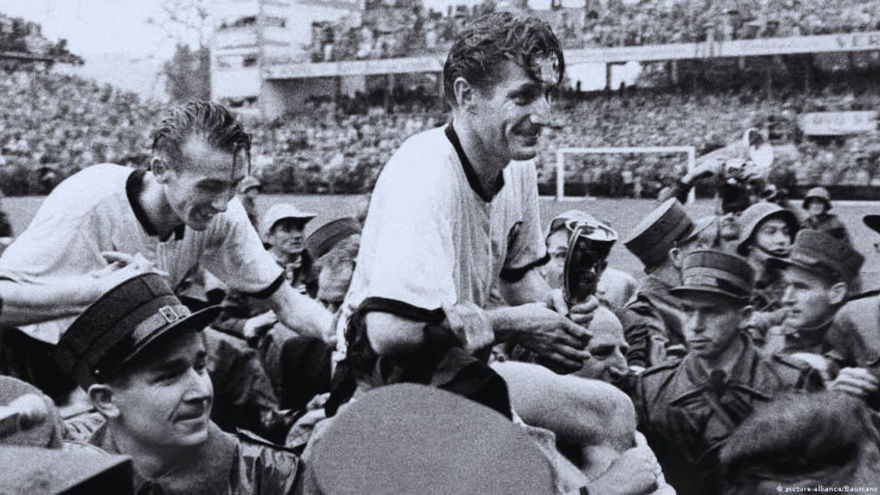
The 1954 FIFA World Cup in Switzerland is a cornerstone of sporting myth: a tournament where tactical revolution, political symbolism and pure drama met on the pitch. Staged during FIFA’s golden jubilee, the fifth World Cup took place in a Europe still recovering from World War II. Hungary’s Aranycsapat—the Golden Team—arrived as the tournament’s overwhelming favourite. What followed, however, culminated in the Miracle of Bern: an upset that reshaped football’s technical and cultural landscape and remains one of sport’s most potent narratives.
Tournament snapshot
Host nation: Switzerland
Teams: 16
Format: Four groups of four, with each team playing two group matches (seeded vs unseeded). Ties for second place were decided by a playoff; winners moved to an eight-team knockout phase (quarter-finals, semi-finals, third-place play-off, final).
Champion: West Germany (first title)
Runner-up: Hungary
Third place: Austria
Golden Ball: Ferenc Puskás (Hungary)
Golden Boot: Sándor Kocsis (Hungary) — 11 goals
Road to the World Cup
Post‑war politics shaped qualification. West Germany returned to the finals for the first time since the war; Spain missed out after a lottery-style tiebreaker handed the place to Turkey. Hungary entered as an unbeaten superpower—Puskás, Kocsis and Hidegkuti had rewritten attacking football and carried a four‑year, 31‑match run without defeat. West Germany, by contrast, were viewed as underdogs—semi‑professionals with little expectation beyond participation.
Group stage recap
The 1954 format encouraged tactical calculation and, sometimes, gamesmanship.
Hungary began with destructive form, beating South Korea 9–0 and then humiliating West Germany 8–3 in a match where Werner Liebrich’s tackle fractured Puskás’s ankle—an injury that would hamper Hungary in the knockout rounds.
West Germany managed to progress via a playoff win over Turkey and conserved key players in the group stage deliberately to avoid an early clash with Hungary.
Brazil and Yugoslavia also progressed from Group 1; Uruguay and Austria advanced from Group 3 without conceding in initial matches.
Host Switzerland produced a surprise, eliminating Italy in a playoff and energising a passionate local following.
Knockout stage recap
The elimination rounds produced some of the highest-scoring and most violent matches in World Cup history.
Quarter‑finals
Austria 7–5 Switzerland in Lausanne: a match played in stifling heat and remembered as the highest‑scoring World Cup fixture ever. Austria overturned a 3–0 deficit to win 7–5 in a frantic ten‑minute burst.
Hungary’s 4–2 victory over Brazil in Bern became known as the "Battle of Bern"—a chaotic, ill‑tempered affair marked by mass violence and loss of control by officials.
West Germany beat Yugoslavia 2–0; Uruguay defeated England 4–2.
Semi‑finals
Hungary overcame Uruguay 4–2 in extra time; Sándor Kocsis’s aerial dominance (two extra‑time headers) ended Uruguay’s unbeaten World Cup record.
West Germany dismantled Austria 6–1 in Basel, a comprehensive win that demonstrated Sepp Herberger’s tactical discipline and his team’s superior fitness.
Third‑place play‑off
Austria beat Uruguay 3–1 to secure the tournament’s bronze medal, capping an impressive and high‑scoring campaign.
The final — The Miracle of Bern
On 4 July 1954, in driving rain at Bern’s Wankdorf Stadium, Hungary looked set to confirm their supremacy. Within eight minutes they led 2–0—Puskás and Czibor had struck early. Instead, West Germany rallied: Max Morlock pulled one back and Helmut Rahn equalised with a composed volley. The second half became a dogged siege. Hungary bombarded the German goal but were repeatedly denied, while German goalkeeper Toni Turek produced outstanding saves.
A decisive moment came late when Rahn scored again, a low, left‑footed strike that proved the match‑winner despite a Puskás effort ruled out for a marginal offside. The final whistle confirmed a 3–2 West German victory: the Miracle of Bern. The win was equal parts tactical adaptation, physical preparation and, some argue, technological advantage—Germany’s screw‑in studs retained traction on the sodden pitch.
Defining moments
The screw‑in stud innovation: With the pitch turning to mud, adjustable studs gave the Germans superior grip—an equipment edge that sparked a manufacturing revolution.
The Battle of Bern: Hungary’s quarter‑final against Brazil became infamous for its violence and loss of control.
Lausanne’s 7–5 thriller: Austria’s comeback against Switzerland remains the World Cup’s highest‑scoring match.
Puskás’s injury: The group‑stage tackle that fractured his ankle dented Hungary’s potency in the knockout rounds.
Zimmermann’s commentary: Herbert Zimmermann’s breathless radio call became the emotional anthem of post‑war German renewal.
Standout players
Fritz Walter (West Germany)
Captain and on‑pitch leader, whose intelligence and calm shaped Germany’s play and identity.
Sándor Kocsis (Hungary)
Aerially unstoppable, Kocsis scored 11 goals and dominated the tournament’s scoring charts.
Helmut Rahn (West Germany)
The big‑game player whose two final goals secured national legend.
Tactical trends
1954 showcased Hungary’s revolutionary use of the "false nine" (Hidegkuti) within a WW/2‑3‑5 variation, creating overloads and positional confusion for defenders. Hungary’s system emphasized fluid inside‑forwards and positional interchanges. West Germany countered with physical preparation, man‑marking discipline and tactical pragmatism—Herberger’s calculated rotation in the group stage and fitness regimen allowed his team to exploit late‑game conditions.
Records and statistics
Top scorer: Sándor Kocsis (Hungary) — 11 goals.
Highest scoring match: Austria 7–5 Switzerland.
Tournament scoring average: 5.38 goals per match—an all‑time high.
Hungary’s goals: 27 in five matches—a single‑tournament team record.
Legacy
The 1954 World Cup’s impact transcends sport. For West Germany, Bern was a symbolic rebirth—its victory contributed to a renewed national confidence in the post‑war era. For international football, the tournament highlighted how preparation, tactics, equipment and psychology could overturn technical superiority. Hungary’s decline after 1954 and the later political upheavals (the 1956 revolution) meant the Aranycsapat’s golden era never returned, augmenting the match’s tragic grandeur.
Why this World Cup is remembered
Switzerland 1954 is remembered for its contradictions: dazzling attacking play and brutal violence; technical genius and tactical pragmatism; individual myths and collective reinvention. It stands as proof that the World Cup can alter national narratives—a rainy afternoon in Bern rewrote history and created a template for upsets to come.
Conclusion
The Miracle of Bern remains one of football’s defining stories: a tactical and cultural turning point where underdogs prevailed and the modern factors that shape elite football—preparation, equipment, psychology—were thrown into sharp relief. The 1954 World Cup gave the world Sándor Kocsis’s goals, Fritz Walter’s leadership and Helmut Rahn’s heroics; more than that, it confirmed that football’s drama can carry weight far beyond ninety minutes.
FAQs
What was the Miracle of Bern?
The Miracle of Bern refers to West Germany’s 3–2 victory over Hungary in the 1954 World Cup final—a historic upset that shocked the football world.
Who was the top scorer at the 1954 World Cup?
Sándor Kocsis (Hungary) scored 11 goals, finishing as the tournament’s top scorer.
Why was Hungary favored in 1954?
Hungary’s Aranycsapat had dominated international football for years, boasting innovative tactics, technical superiority and an unbeaten run heading into the tournament.
What tactical innovation did Hungary use in 1954?
Hungary used a variant of the WW/false‑nine system that relied on Hidegkuti dropping deep to create space for inside‑forwards like Puskás and Kocsis.
Did equipment affect the 1954 final?
Yes—Germany’s use of screw‑in studs helped their players keep traction on the rain‑soaked pitch, a practical advantage often cited in analyses of the final.
Also Read |